Being told you need a deep cleaning can leave you wondering whether the treatment will fit your budget. In the United States, deep cleaning teeth cost often falls between $180 and $350 per quadrant before insurance. If all four quadrants need treatment, the total may be about $700 to $1,400, although your actual fee can be lower or higher.
A dentist may call this treatment scaling and root planing. It removes plaque and hardened tartar from below the gumline and smooths the root surfaces. Unlike a routine cleaning, it treats gum disease, so the price depends on how much of your mouth needs care and how difficult the cleaning will be.
Dental insurance may pay part of the fee, but deductibles, annual limits, and plan rules affect what you owe. A written estimate should separate the cost by quadrant and list any charges for exams, X-rays, anesthesia, medication, and follow-up care. Understanding these details makes it easier to compare prices and plan your treatment without surprises.
Deep Teeth Cleaning Cost Per Quadrant and Full Mouth
The deep cleaning of teeth cost is usually calculated by quadrant, not as one flat fee for the entire mouth. Current U.S. estimates vary: CareCredit’s national dental cost data lists about $190–$420 per quadrant, while Delta Dental’s cleaning cost estimates provide a narrower range. These are self-pay estimates, not guaranteed prices.
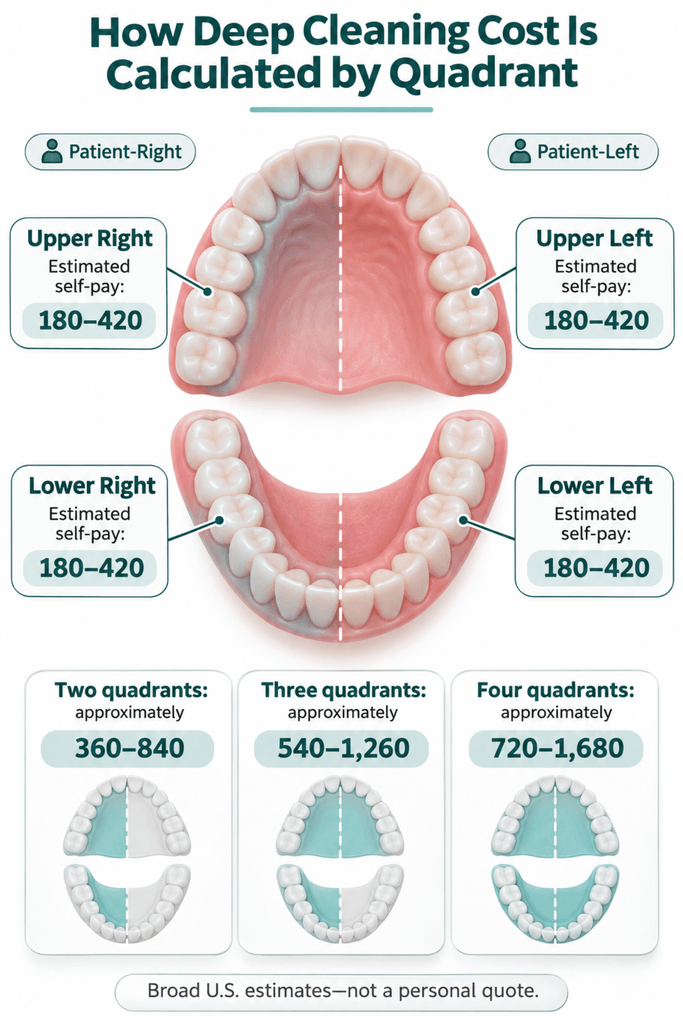
- One Quadrant: Expect roughly $180–$420 before insurance, depending on how many teeth require treatment and local fees.
- Two Quadrants: A simple estimate is about $360–$840, although the office may use different codes for each quadrant.
- Three Quadrants: The total may range from approximately $540–$1,260 before insurance benefits.
- Four Quadrants: Full-mouth treatment may cost roughly $720–$1,680. Many estimates fall near the middle of this broad range.
- Possible Additional Charges: The examination, X-rays, locally placed medication, sedation, or follow-up maintenance may be separate.
Average Cost for One Quadrant
A quadrant is one-quarter of your mouth: upper right, upper left, lower right, or lower left. Treating one quadrant commonly costs about $180–$420 without insurance. Prices toward the upper end may reflect higher local fees, more treatment time, or extensive deposits below the gumline.
The fee also depends on how many teeth receive scaling and root planing. ADA code D4341 applies when four or more teeth in one quadrant are treated, while D4342 applies to one to three teeth. Current ADA guidance on scaling and root planing codes explains why a partial-quadrant fee may differ from a full-quadrant fee.
Estimated Cost for Full-Mouth Treatment
Not everyone needs all four quadrants treated. Your dentist should base the plan on the teeth and areas showing periodontal disease, rather than automatically treating the entire mouth.
- Two Affected Quadrants: A rough self-pay total is $360–$840. These quadrants may be on the same side or in different parts of the mouth.
- Three Affected Quadrants: A broad estimate is $540–$1,260 before insurance.
- All Four Quadrants: Full-mouth treatment may cost about $720–$1,680, depending on the office’s fees and the codes used.
- More Than One Appointment: The dentist may divide treatment into two or more visits for comfort, anesthesia, or scheduling. Multiple visits do not necessarily mean that the same quadrant is charged more than once.
These totals come from multiplying broad per-quadrant estimates. Your written treatment plan provides a more useful figure because it shows the exact quadrants, codes, and additional services.
Why Dentists Price Deep Cleaning by Quadrant
Dentists divide the mouth into four quadrants to record where periodontal disease is present and where treatment is performed. This system also allows the office and insurance company to distinguish between one affected area and full-mouth disease.
A dentist should not recommend scaling and root planing based on billing convenience alone. Each treated area should have supporting clinical findings, such as attachment loss, deposits below the gumline, periodontal pockets, bleeding, or bone changes. When only a few teeth in a quadrant qualify, the office may use a partial-quadrant code rather than charging for four or more teeth.
What Affects the Final Cost of Deep Teeth Cleaning?
Your deep teeth cleaning cost depends on the amount of care you need and how the dental office structures its fees. Two patients receiving “deep cleaning” can therefore receive different estimates without either estimate being incorrect.
- Number of Quadrants: Treating one quadrant costs less than treating three or four. The location of the affected areas does not have to be symmetrical.
- Number of Teeth: A quadrant containing one to three treated teeth uses a different procedure code from a quadrant containing four or more treated teeth.
- Disease Extent: Deeper pockets, attachment loss, difficult root shapes, and heavy tartar below the gumline may require more time and clinical skill.
- Office Location: Dental fees often differ between cities, states, and rural areas because operating costs and local market fees vary.
- Provider Type: Fees may differ between a general dentist and a periodontist, who has advanced training in gum disease. A specialist is not required for every case.
- Diagnostic Services: The examination, periodontal charting, and X-rays may be included in the consultation or billed separately.
- Comfort Options: Local anesthesia is commonly used when needed. Sedation, if requested or clinically appropriate, may incur an additional fee.
- Adjunctive Treatment: Medication placed in selected periodontal pockets is not routine for everyone and may be charged separately.
A higher estimate does not automatically mean that an office is overcharging. Compare the procedure codes, treated teeth, included services, and expected follow-up, not only the total at the bottom of the page.
How Much Does Deep Teeth Cleaning Cost With Insurance?
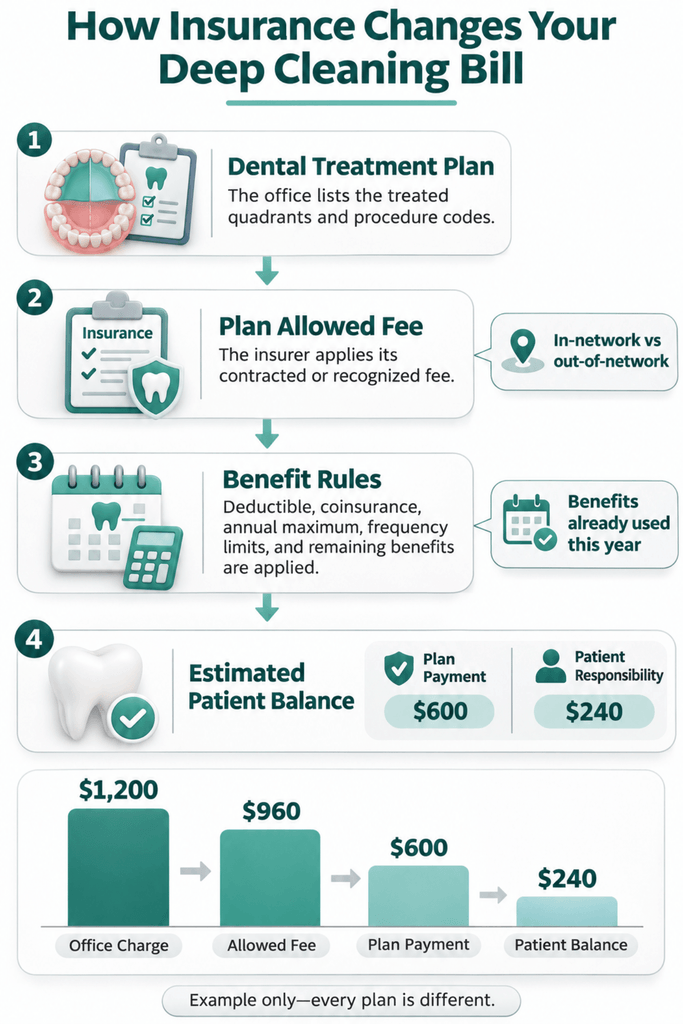
Dental insurance may reduce the cost of deep teeth cleaning, but scaling and root planing is generally processed as periodontal treatment rather than a fully covered routine cleaning. Clinical need and insurance coverage are separate decisions: a dentist may recommend necessary treatment that a plan covers only partly.
The amount you owe depends on the plan’s allowed fee, deductible, coinsurance, annual maximum, network rules, and remaining benefits. Call the insurer or request a written pretreatment estimate instead of assuming a standard coverage percentage.
What Dental Insurance May Cover
- Allowed Fee: The insurer calculates benefits from its approved fee, which may be lower than the dentist’s usual charge.
- Deductible: You may need to pay an annual deductible before the plan contributes toward periodontal care.
- Coinsurance: After the deductible, you may remain responsible for part of the allowed fee. The percentage differs among plans.
- Annual Maximum: Deep cleaning can use a large portion of a plan’s yearly maximum, especially when several quadrants need treatment.
- Waiting Period: A new plan may require you to wait before it covers certain periodontal procedures.
- Frequency Limit: Some plans limit how often they will pay for scaling and root planing in the same area.
- Network Status: An in-network dentist generally follows negotiated fees. Out-of-network care may leave you responsible for a larger difference.
- Related Services: The examination, X-rays, medication, and periodontal maintenance may be subject to separate coverage rules.
Why Coverage May Be Limited or Denied
An insurer may request a periodontal chart, diagnostic X-rays, a diagnosis, and a written treatment plan before paying the claim. The company may also apply its own requirements concerning pocket measurements, bone loss, treated teeth, or the time since previous periodontal therapy.
A denial does not prove that the deep cleaning was unnecessary. It means the claim did not meet the plan’s payment rules or lacked information the insurer requested. Ask the dental office and insurer for the specific reason, then determine whether additional documentation, a corrected claim, or a formal appeal is appropriate.
How to Request a Pretreatment Estimate
- Ask for the Procedure Codes: Request a written plan showing each quadrant and whether the office expects to use D4341 or D4342.
- Confirm Additional Services: Ask whether examinations, X-rays, anesthesia, medication, and reevaluation appear as separate charges.
- Submit the Plan: Ask the dental office to send the proposed codes and supporting records to your insurer before treatment.
- Review the Response: Check the allowed fee, deductible, estimated benefit, annual maximum, exclusions, and expected patient balance.
- Confirm the Limitations: Ask whether the estimate assumes you remain eligible and have benefits available on the treatment date.
A pretreatment estimate helps with budgeting, but it is not always a payment guarantee. Final benefits can change if another claim uses part of your annual maximum or the completed treatment differs from the original plan.
Deep Teeth Cleaning Cost Without Insurance
Without dental insurance, you may owe the office’s full self-pay fee. Ask for a complete written estimate because an advertised price may cover only one quadrant or the scaling and root planing itself.
- Request the Cash Fee: Some practices have a self-pay price that differs from the standard office fee.
- Compare Complete Plans: Make sure each estimate covers the same quadrants, number of teeth, diagnostic services, anesthesia, and follow-up.
- Ask About Dental Schools: Supervised dental or periodontal training programs may provide treatment at reduced fees, although appointments can take longer.
- Check Community Health Centers: The federal HRSA guide to finding lower-cost dental care explains how to locate health centers, dental schools, and other programs. Eligibility, waiting times, and available periodontal services vary.
- Review Membership Plans: An office membership or discount plan may reduce fees, but it is not dental insurance. Check which periodontal procedures qualify.
- Discuss Payment Arrangements: Some offices allow installment payments or third-party financing. Review interest rates, fees, and deferred-interest terms before signing.
The lowest advertised fee is not always the lowest final cost. A quote that already includes the examination, X-rays, anesthesia, and reevaluation may cost less overall than a lower starting price with several added charges.
What Your Deep Cleaning Quote May Include
A written quote should show what the office plans to do and what each part will cost. Scaling and root planing is the central treatment, but related services may be included in the quadrant fee or listed separately.
- Dental Examination: The dentist evaluates your teeth, gums, medical history, and risk factors before diagnosing periodontal disease.
- Periodontal Charting: A probe measures the spaces around each tooth and records bleeding, recession, and other findings.
- Dental X-Rays: Images can show the height and pattern of the bone supporting your teeth. The office may bill them separately if current images are unavailable.
- Local Anesthesia: Numbing may be included in the treatment fee, but confirm this before the appointment.
- Scaling and Root Planing: The quote should identify the treated quadrants and whether each code covers one to three teeth or four or more.
- Locally Placed Medication: An antimicrobial product may be recommended for selected sites. It is not automatically necessary for every treated pocket.
- Reevaluation: The dentist may recheck healing, bleeding, and pocket measurements several weeks later. Ask whether this visit has a separate fee.
- Periodontal Maintenance: Future maintenance is different from the initial deep cleaning and is commonly billed as a separate service.
For more procedural detail, see what happens during a deep teeth cleaning. Your estimate should still explain which parts apply to your own treatment plan.
Deep Cleaning Cost vs. Regular Cleaning Cost
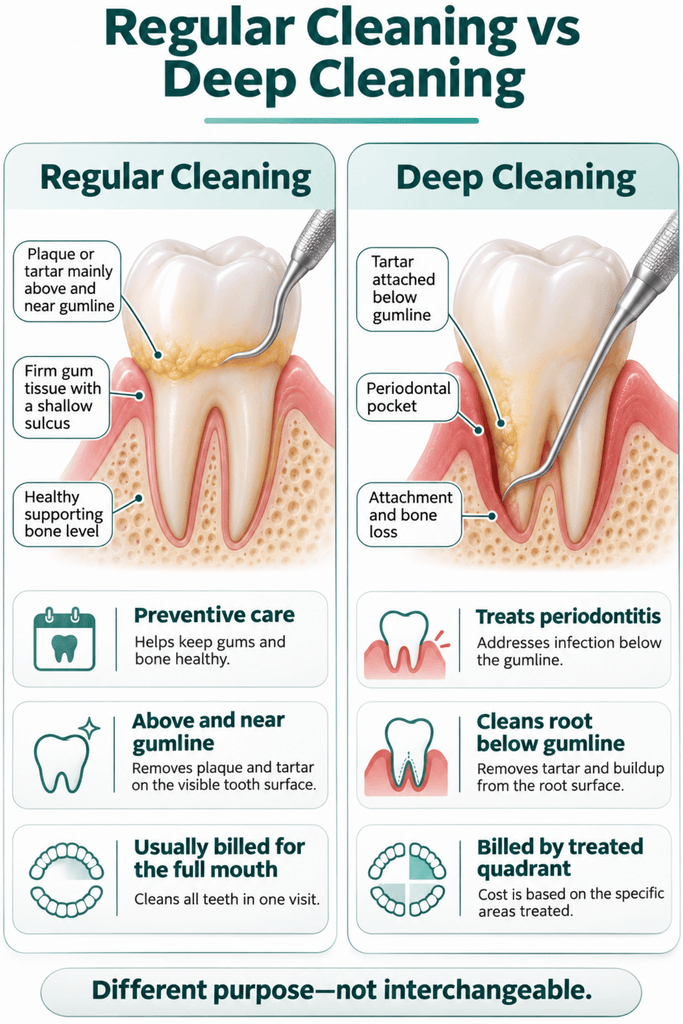
A regular cleaning, or prophylaxis, is preventive care for a generally healthy mouth or mild gum inflammation without periodontal attachment loss. It removes plaque and tartar mainly from the tooth surfaces above and near the gumline. It is usually billed as one full-mouth service and often costs less than scaling and root planing.
Deep cleaning treats areas affected by periodontitis. The hygienist or dentist works below the gumline to remove deposits from root surfaces, often using local anesthesia. Because the disease may affect only part of the mouth, the treatment is billed by quadrant and may require more than one appointment.
A routine cleaning is not a cheaper substitute when the examination shows periodontal attachment or bone loss that requires root-surface treatment. After scaling and root planing, the dentist may recommend periodontal maintenance rather than returning immediately to standard preventive cleanings.
How Dentists Confirm That You Need a Deep Cleaning
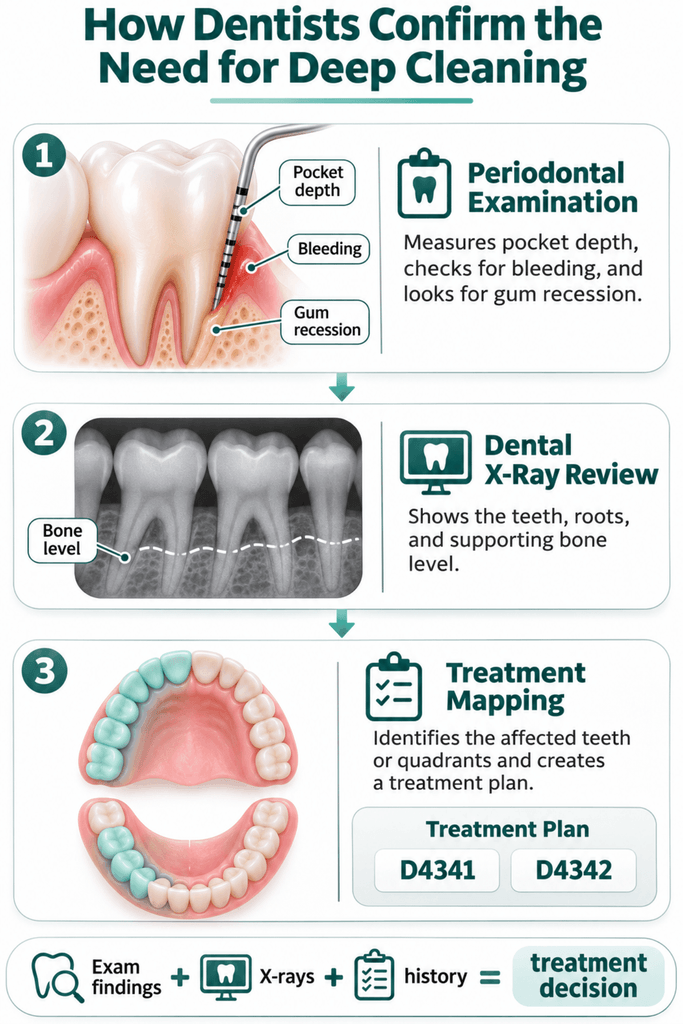
No single symptom or pocket measurement proves that you need scaling and root planing. The dentist combines your examination, periodontal chart, X-rays, health history, and risk factors to reach a diagnosis. The American Academy of Periodontology’s comprehensive periodontal evaluation includes assessment of the teeth, gums, plaque, bite, bone structure, and individual risks.
- Reviewing Your History: The dentist asks about previous gum treatment, smoking, diabetes, medications, pregnancy, and other factors that may affect periodontal health.
- Measuring Around Each Tooth: A periodontal probe measures the space between the tooth and gum at several points. The dentist also records bleeding and gum recession.
- Calculating Attachment Loss: Pocket depth and gum position help show whether the supporting attachment around a tooth has been lost.
- Checking Dental X-Rays: Appropriate images help the dentist assess bone levels, root shapes, and deposits that may be visible below the gumline.
- Creating the Treatment Plan: The dentist identifies which teeth and quadrants meet the criteria for scaling and root planing and whether a general dentist or periodontist should provide care.
Ask the dentist to show you the periodontal chart and relevant X-rays. Understanding why particular teeth need treatment makes it easier to evaluate both the recommendation and its cost.
Is Deep Teeth Cleaning Worth the Cost?
Scaling and root planing is often worthwhile when clinical findings confirm periodontitis. Removing plaque and tartar from diseased root surfaces can reduce inflammation and help control the condition, but it cannot guarantee that lost bone or attachment will return.
The ADA clinical guideline for nonsurgical periodontitis treatment supports scaling and root planing as an initial treatment for periodontitis, with professional judgment and patient needs guiding care. Results also depend on disease severity, daily plaque control, smoking, diabetes management, and maintenance visits.
If you remain unsure, ask the dentist to explain the diagnosis and alternatives. A second opinion is reasonable before nonurgent treatment, especially when the proposed plan or cost is difficult to understand.
How to Lower Your Out-of-Pocket Cost
You may be able to reduce the cost of deep teeth cleaning without choosing a less appropriate treatment. Start by confirming the diagnosis and comparing equivalent written plans.
- Check Network Status: Verify that both the dentist and treating specialist, if involved, participate in your plan.
- Request a Pretreatment Estimate: This can show the insurer’s allowed fee, expected payment, and your likely balance.
- Compare Complete Quotes: Check the number of teeth and quadrants, procedure codes, included services, and future maintenance, not merely the headline price.
- Use Eligible HSA or FSA Funds: Periodontal treatment may qualify as a dental expense, but confirm current eligibility with your plan administrator.
- Ask About Self-Pay Savings: An office may offer a cash fee or membership discount when no claim is submitted.
- Consider Supervised Training Clinics: Dental schools and periodontal residency programs may provide lower-cost treatment, though appointment availability and visit length vary.
- Review Payment Options: Ask whether the office offers installments. Read all financing terms carefully before accepting credit.
- Coordinate Treatment Timing Carefully: Using benefits across two plan years may sometimes reduce your balance, but do not delay or divide necessary care unless the dentist considers that timing clinically safe.
Future Costs After Scaling and Root Planing
The first deep cleaning may not be the final periodontal expense. Your dentist will usually reassess the gums after they have had time to respond. That visit may be included in the original fee or billed separately.
Patients with a history of periodontitis often move to periodontal maintenance, which involves continued cleaning above and below the gumline at an interval based on individual risk. This service may cost more than a routine cleaning and may receive different insurance benefits.
- Reevaluation: The dentist checks bleeding, tissue response, home care, and pocket measurements.
- Periodontal Maintenance: Ongoing visits help control plaque and tartar in areas that remain difficult to clean.
- Additional Nonsurgical Care: Selected areas may need further treatment if deposits or inflammation remain.
- Specialist or Surgical Care: Advanced disease that does not respond adequately may require evaluation by a periodontist. This is not necessary for every patient.
Mild tenderness, brief bleeding, and temperature sensitivity can occur after treatment. Contact the dental office if pain or swelling worsens instead of improving, bleeding is difficult to control, numbness lasts longer than expected, or you develop fever or drainage.
Frequently Asked Questions
What If Insurance Covers Fewer Quadrants Than My Dentist Recommends?
Ask the insurer for the exact reason and compare it with your periodontal chart, X-rays, and treatment plan. The office may submit missing records, correct a claim, or file an appeal. Insurance determines benefits, not clinical need, so discuss the uncovered areas and payment options with your dentist before changing the plan.
Can All Four Quadrants Be Deep Cleaned in One Visit?
Sometimes, but it depends on disease extent, appointment length, anesthesia, your health, and your comfort. Many dentists divide full-mouth treatment into two visits so one side remains comfortable for eating. Completing four quadrants together may also require additional documentation for the insurance claim.
Can I Delay Deep Cleaning Until My Insurance Benefits Reset?
A short delay may reduce your out-of-pocket cost in some situations, but the decision should depend on your gum health. Ask the dentist whether waiting is clinically reasonable and what changes to watch for. Do not postpone treatment solely to gain new benefits when active disease needs timely care.
Why Do I Need Deep Cleaning After a Recent Regular Cleaning?
A routine cleaning mainly removes deposits from above and near the gumline. Periodontal charting or new X-rays may later reveal deeper pockets, attachment loss, or bone changes that require treatment on the roots. Ask the dentist to show which findings changed or were discovered after your previous cleaning.
Are Antibiotics Always Needed After Deep Cleaning?
No. Scaling and root planing alone is the main nonsurgical treatment for many patients. A dentist may recommend a mouth rinse, locally placed antimicrobial, or another medication in selected cases. Ask why it is being prescribed, what benefit is expected, and whether its cost appears separately on the estimate.
Will I Need Time Off Work After Deep Cleaning?
Many patients return to normal activities the same day. Your mouth may remain numb for several hours, and mild tenderness or sensitivity can follow. If your work involves extensive speaking, strenuous activity, or safety-sensitive tasks, ask whether scheduling a lighter day would be more comfortable.
Can I Be Charged for Deep Cleaning Again Later?
Yes, but repeat scaling and root planing should be based on new or recurring disease, not simply the passage of time. Periodontal maintenance is a different service and may occur regularly after treatment. Insurance plans can also limit how often they cover repeat therapy in the same quadrant.
Bottom Line: Cost of Deep Teeth Cleaning
Current self-pay estimates place the cost of deep teeth cleaning at roughly $180–$420 per quadrant. Treating all four quadrants may total about $720–$1,680 before insurance, although the deep cleaning of teeth cost can fall outside this range based on location, disease extent, and added services.
The most useful figure is the written estimate for your own treatment. Compare the same quadrants, procedure codes, included services, and follow-up care, then confirm what your insurance expects to pay.
