Do your teeth still feel rough after brushing? If you are wondering how to remove hard plaque from teeth, first find out what the buildup may be. Soft plaque can be removed at home. Once it hardens into tartar, or dental calculus, a dentist or dental hygienist must remove it. Trying to chip or scrape tartar off yourself can harm your gums or tooth surfaces.
Hard deposits often collect along the gumline, between crowded teeth, or behind the lower front teeth. Brushing and cleaning between your teeth remove fresh plaque from these areas, but they cannot lift attached tartar. Home remedies and tartar-control toothpaste may help prevent buildup, not remove existing calculus.
Professional removal matters because tartar leaves a rough surface where more plaque can gather. Your dentist can also check whether bleeding, swelling, bad breath, or gum recession needs more than a routine cleaning. Start by learning how plaque turns hard and how to tell it from tartar or stains.
What Does “Hard Plaque” on Teeth Usually Mean?
When people ask how to remove hard plaque from teeth, they are usually describing tartar, also called dental calculus. Tartar is plaque that has absorbed minerals and hardened on the tooth surface. Unlike soft plaque, it does not come away with normal brushing or flossing.
However, not every rough spot is tartar. It could be a surface stain, filling edge, damaged enamel, chipped tooth, or another dental issue. The NIDCR’s oral-hygiene guidance on plaque and tartar confirms that tartar requires removal by a dentist or dental hygienist.
How Soft Plaque Becomes Hard Tartar
Dental plaque is a sticky film of bacteria that forms on your teeth throughout the day. It collects food particles and uses sugars and starches from what you eat or drink. If plaque is not removed, it can irritate the gum line and increase the risk of a cavity or gum disease.
Over time, minerals in saliva can enter the plaque and cause it to harden. This hardened plaque is tartar or calculus. The process does not happen at the same speed for everyone, so there is no single timeline that applies to every patient.
Where Tartar Commonly Collects
Tartar tends to form where plaque is repeatedly missed or where saliva reaches the teeth. Some deposits are easy to see, while others may develop below the gum line.
- Along the Gum Line: Plaque often remains at the base of your teeth when the toothbrush does not reach the gum margin.
- Behind the Lower Front Teeth: This area is close to major salivary duct openings and can be difficult to brush thoroughly.
- Between Crowded Teeth: Overlapping teeth create narrow spaces where a toothbrush may not reach.
- Around Dental Work: Plaque buildup may collect near braces, retainers, bridges, crowns, and implants.
- Below the Gums: Tartar can develop inside gum pockets, where it cannot be seen or safely reached at home.
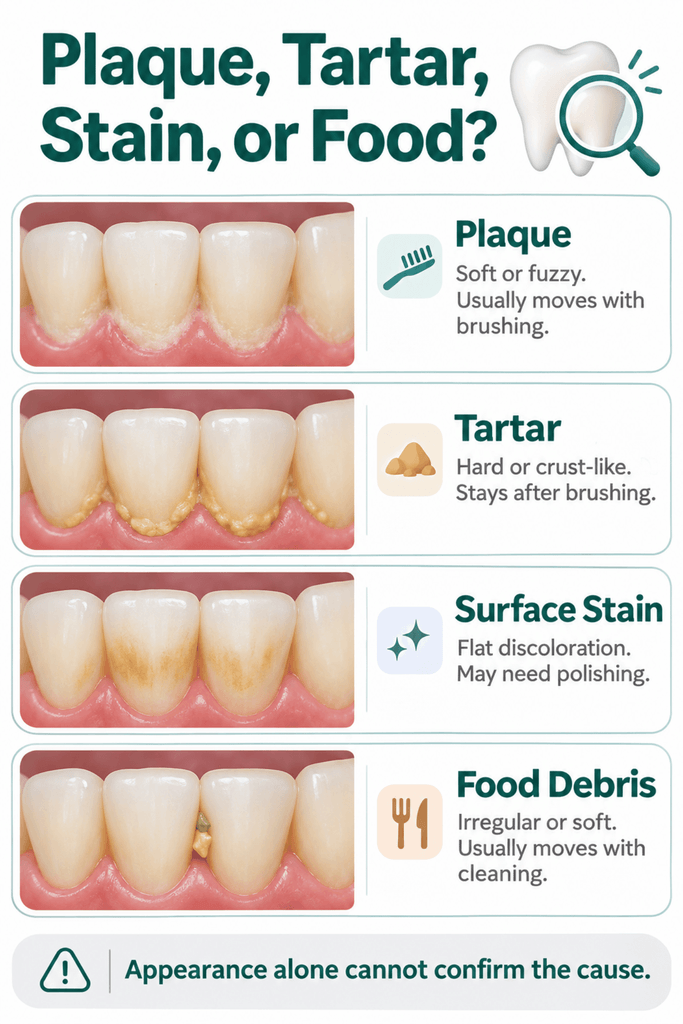
How to Tell Plaque, Tartar, Stains, and Food Apart
You can look at the deposit’s texture, color, location, and response to gentle cleaning. These signs may help you decide what to do next, but they cannot confirm the cause.
| Type of Buildup | How It May Feel | Common Appearance | What Happens With Gentle Cleaning? |
|---|---|---|---|
| Plaque | Soft, sticky, or fuzzy | Clear, white, or pale yellow film | Usually improves with proper brushing and cleaning between the teeth |
| Tartar | Hard, rough, or crust-like | White, yellow, brown, or black deposit | Remains attached after brushing and flossing |
| Surface stain | Usually flat or slightly rough | Brown, black, or yellow discoloration | May fade slightly but often needs professional polishing |
| Food debris | Soft or irregular | Depends on the food | Usually moves with brushing, floss, or an interdental cleaner |
Color alone cannot tell you whether a deposit is plaque, tartar, stain, or tooth decay. A rough patch also does not confirm the cause, so avoid scraping it with a sharp object. Arrange a dental examination if it remains after gentle brushing and cleaning between your teeth.
How to Remove Hard Plaque From Teeth Safely
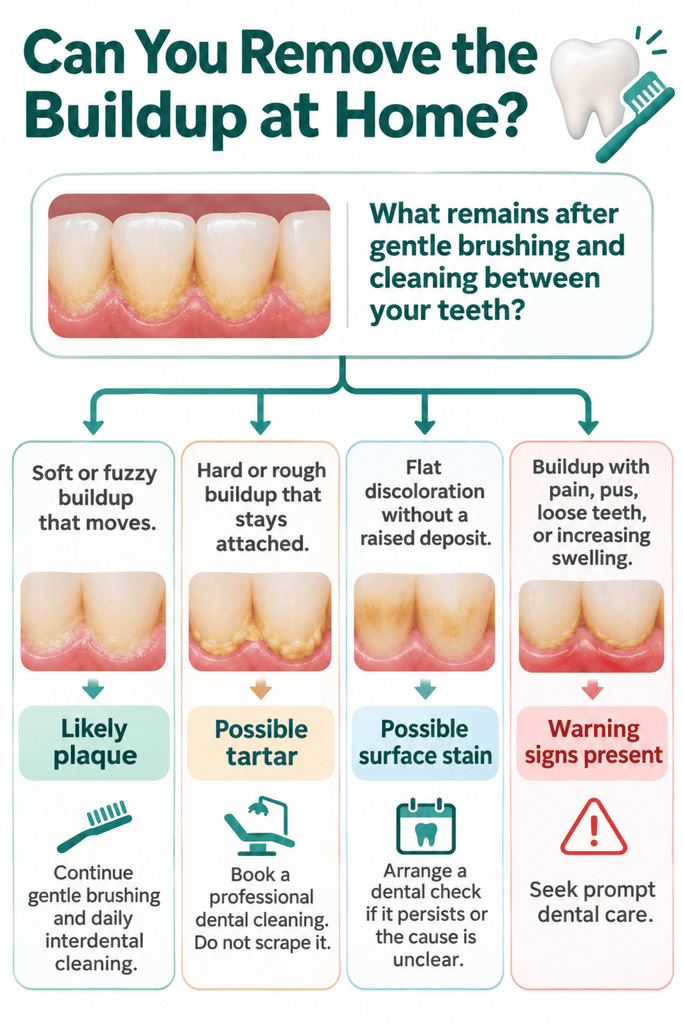
The safe way to remove hard plaque from teeth depends on whether the material is still soft plaque or has turned into tartar. You can remove plaque from teeth at home with effective oral hygiene. Once it becomes mineralized tartar, it needs professional scaling.
Brushing harder will not remove tartar and may irritate the gums or wear exposed root surfaces. Metal picks, fingernails, and home scaling tools are also unsafe because you cannot clearly see the tooth surface or control the instrument as a trained dental professional can.
What Home Care Can Remove
Home care can remove soft dental plaque around the buildup and prevent tartar from getting larger. It also helps lower the risk of tooth decay and gum inflammation.
- Brush Twice a Day: Brush your teeth for at least two minutes with fluoride toothpaste and a soft-bristled toothbrush.
- Use Gentle Pressure: Aim the bristles toward the gum line and use small, controlled movements instead of scrubbing.
- Clean Between Your Teeth: Use floss, an interdental brush, or another suitable cleaner once a day to disrupt plaque that a toothbrush misses.
- Reach Inner Tooth Surfaces: Turn the brush vertically to clean behind the front teeth, especially the lower teeth.
- Follow a Consistent Pattern: Clean each part of your mouth in the same order so you are less likely to miss an area.
The American Dental Association’s guidance on floss and interdental cleaners explains that cleaning between the teeth removes plaque before it has a chance to harden into tartar.
Why Existing Tartar Needs Professional Removal
Tartar forms a firm bond with the tooth surface. A toothbrush can clean the soft plaque around it, but its bristles cannot lift mineralized deposits from the enamel or root surface.
Some tartar also extends below the gum line. Removing it safely requires good lighting, a clear view, professional instruments, and an understanding of tooth and root anatomy. The dentist must also assess the surrounding teeth and gum tissues before deciding whether you need a routine dental cleaning or periodontal treatment.
Why Home Methods Cannot Remove Hard Plaque From Teeth
A product may make your mouth feel fresher or reduce soft plaque without removing tartar buildup. This difference matters because claims such as “dissolves tartar” or “gets rid of tartar naturally” can encourage unsafe care. Existing calculus must be removed by a dental professional.
Dental Scalers and Sharp Tools
Do not try to scrape tartar from your teeth with a dental scaler, metal pick, knife, pin, or fingernail. Without training and a clear view, a sharp tool can cut the gums, damage a filling or restoration, or push bacteria into irritated tissue. You may also remove one visible edge while leaving tartar around or below the gum line. If you feel a hard deposit, let a dentist or hygienist examine and safely remove it.
Baking Soda, Vinegar, and Abrasive Powders
Many home remedies are promoted as a way to remove tartar from teeth, but they do not work like professional scaling.
- Baking Soda: A properly formulated baking soda toothpaste may help remove plaque and surface stains. Loose baking soda mixtures are not proven to detach established tartar.
- Vinegar and Lemon Juice: Acidic liquids do not provide a safe tartar-removal solution. Repeated acid exposure can soften and erode tooth mineral.
- Salt Scrubs: Rubbing coarse salt against the teeth can irritate the gums without removing calculus attached to the tooth.
- Charcoal Powders: Charcoal products vary widely and have not been shown to safely remove tartar. Some also lack fluoride, which is important for cavity prevention.
The American Dental Association’s review of dental erosion explains that repeated acid exposure can cause progressive, irreversible loss of tooth mineral.
Mouthwash, Water Flossers, and Tartar-Control Toothpaste
These products may support daily dental care, but their benefits have limits:
- Mouthwash: Some rinses help reduce bacteria, plaque, or gingivitis. They do not dissolve tartar already attached to teeth.
- Water Flosser: A water flosser can remove food debris and disrupt some plaque around your teeth. It cannot break away hardened calculus.
- Tartar-Control Toothpaste: These toothpastes may slow the mineralization of new plaque. They do not remove tartar buildup that has already formed.
- Fluoride Toothpaste: Fluoride helps protect teeth against cavities, but it is not a tartar-removal agent.
Use these products as part of daily oral hygiene, not as replacements for professional dental cleanings.
How Dentists Remove Hard Plaque From Teeth
A dentist or hygienist first examines the buildup, teeth, and gums. The assessment may include checking for bleeding, gum recession, periodontal pockets, loose teeth, cavities, and tartar below the gum line. Dental X-rays may be needed when there is concern about bone loss or disease that cannot be evaluated by sight alone.
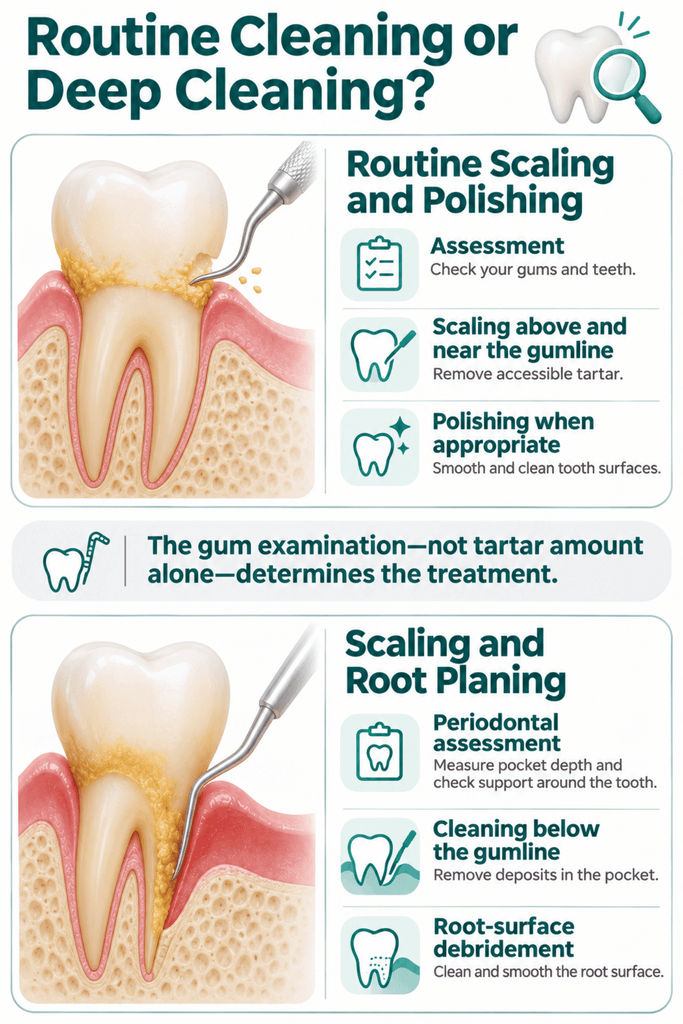
The findings determine whether routine scaling is enough or whether deeper periodontal care is needed. Heavy tartar does not automatically mean that every patient needs deep cleaning.
Routine Scaling and Polishing
A routine professional dental cleaning may include these steps:
- Dental and Gum Assessment: The dental professional checks where plaque and tartar have collected and looks for signs of inflammation or tooth damage.
- Professional Scaling: Hand instruments or an ultrasonic scaler remove plaque and calculus from accessible tooth surfaces and along the gum line.
- Polishing When Appropriate: Polishing can smooth the tooth surface and remove some external stains left by coffee, tea, or tobacco.
- Cleaning Between the Teeth: Floss or another interdental tool removes remaining debris and checks contact areas.
- Personalized Home-Care Advice: The dentist or hygienist may show you which surfaces you are missing and recommend suitable cleaning tools.
Polishing may make the teeth look brighter by removing surface stains, but it does not change their natural color like teeth whitening.
When Scaling and Root Planing May Be Needed
Scaling and root planing is a deeper form of teeth cleaning used to treat periodontal disease. Scaling removes plaque and tartar from above and below the gum line. Root planing cleans and smooths affected root surfaces so the gum tissues can heal more effectively.
This treatment is based on a periodontal assessment, not simply the amount of visible tartar on teeth. Deeper gum pockets, inflammation, attachment loss, or bone loss may affect the decision. Local anesthesia may be used, and treatment may require more than one visit.
The American Dental Association’s explanation of scaling and root planing describes it as a deep cleaning below the gum line for patients with gum disease.
What to Expect After Tartar Removal
Your teeth may feel smoother and look cleaner after tartar removal. If there was heavy buildup, the spaces between some teeth may appear more noticeable because tartar is no longer filling them. The teeth may also feel temporarily sensitive, especially near exposed roots or after treatment below the gums.
After your cleaning:
- Brush Gently: Continue brushing with a soft-bristled toothbrush unless your dentist gives different instructions.
- Clean Between the Teeth: Follow the recommended method, but avoid forcing floss or an interdental brush into a tender area.
- Manage Sensitivity: Ask your dentist whether a sensitivity toothpaste or fluoride product is suitable for you.
- Avoid Tobacco: Smoking can interfere with gum health and healing.
- Follow Specific Instructions: After scaling and root planing, follow the dental office’s advice about eating, cleaning, medication, and follow-up care.
Contact the dental office if pain, swelling, or bleeding becomes severe, worsens, or does not improve as expected.
When Hard Buildup Needs Dental Care
A hard deposit that remains after careful brushing is usually not an emergency, but it should be examined and removed rather than ignored.
Book a Dental Appointment If:
- The Deposit Does Not Brush Away: A firm, rough area may be tartar or another tooth-surface problem.
- Your Gums Bleed Repeatedly: Ongoing bleeding can be a sign of gum inflammation.
- Your Gums Look Swollen or Receded: These changes deserve a professional gum assessment.
- Bad Breath Persists: Plaque and tartar may contribute, but other dental or medical causes are possible.
- A Hard Fragment Falls Off: The dentist should confirm whether it was tartar, tooth structure, or part of a restoration.
Seek Prompt Dental Care If:
- You Have Increasing Pain: Pain may indicate decay, infection, gum disease, or another problem beyond tartar buildup.
- You Notice Pus: Drainage around a tooth or the gum line can indicate infection.
- A Tooth Feels Loose: Tooth movement may be related to reduced periodontal support and needs assessment.
- Swelling Is Increasing Quickly: Rapid swelling should not wait for a routine teeth cleaning.
- You Develop Facial Swelling or Trouble Swallowing or Breathing: Seek urgent medical or dental care.
The NIDCR’s guidance on periodontal disease symptoms and treatment lists bleeding gums, recession, persistent bad breath, painful chewing, and loose teeth among important findings.
How to Prevent Hard Plaque From Returning
Preventing tartar buildup depends on disrupting soft plaque before minerals can harden it. Regular brushing and flossing matter, but technique and access are just as important as frequency.
Some people form tartar faster because of tooth position, dry mouth, dental appliances, tobacco use, differences in saliva, or previous gum disease. A routine that works well for one person may need to be adjusted for another.
Brush the Gumline and Every Tooth Surface
Use this pattern each time you brush your teeth:
- Choose a Soft Brush: A manual or powered toothbrush can remove plaque when used correctly.
- Add Fluoride Toothpaste: Fluoride helps strengthen teeth and prevent cavities.
- Brush for at Least Two Minutes: Divide the mouth into sections so every area receives enough attention.
- Angle Toward the Gum Line: Use gentle, short strokes where plaque begins to collect at the base of your teeth.
- Clean Every Surface: Brush the outer, inner, and chewing surfaces of each tooth.
- Turn the Brush Vertically: Use small up-and-down movements behind the upper and lower front teeth.
Aggressive pressure does not clean better. It can make brushing uncomfortable and may harm exposed root surfaces over time.
Clean Between the Teeth Every Day
A toothbrush cannot fully reach the tight spaces between teeth. Choose a tool that fits the size of the space and your dental needs.
- Dental Floss: Floss works well for tight contacts. Curve it around each tooth and move it gently up and down.
- Interdental Brushes: These small brushes can help clean larger spaces, braces, bridges, and areas affected by gum recession.
- Water Flossers: Water flossers may help people with braces, bridges, implants, or limited hand movement.
- Floss Threaders: A threader can guide floss under bridges and fixed orthodontic wires.
- Specialized Picks: Use wooden or plastic cleaners only as directed by a dental professional.
The goal is to disrupt plaque without cutting the gums. Ask your dentist or hygienist to recommend the right tool and interdental-brush size for your mouth.
Focus on Areas Where Plaque Keeps Returning
- Crowded Teeth: Use floss or a small interdental tool to reach overlapping surfaces.
- Braces: Clean around brackets and beneath wires with an orthodontic brush, interdental brush, or water flosser.
- Bridges: Use a floss threader, super floss, or another recommended tool under the replacement tooth.
- Implants: Clean around the implant crown and gum margin with tools that will not damage the restoration.
- Removable Retainers: Clean the retainer as directed and brush the teeth before placing it back in the mouth.
- Lower Front Teeth: Turn the toothbrush vertically and spend extra time on the tongue-facing surfaces.
If plaque repeatedly returns in the same place, ask the dental professional to watch your technique and check whether tooth position or dental work is making the area harder to clean.
Choose a Cleaning Schedule Based on Your Needs
Cleanings every six months are common, but every six months is not the correct schedule for every patient. Some people with stable oral health may need less frequent visits, while patients with gum disease, heavy tartar formation, dry mouth, smoking, diabetes, or difficult-to-clean dental work may need closer care.
Your dentist should base the interval on current findings, dental history, home care, and risk of future disease. The NICE recommendations for risk-based dental recall intervals support choosing and reviewing the interval for each patient rather than automatically scheduling everyone twice a year.
Frequently Asked Questions About Hard Plaque Removal
Can a Piece of Tartar Fall Off, or Did My Tooth Chip?
Tartar can sometimes break away, especially when the buildup is heavy. A tartar fragment may feel rough and look yellow, brown, or black, but a chipped tooth or restoration can look similar. Do not pick at the remaining area. Save the fragment if possible and arrange an examination, particularly if the tooth feels sharp, painful, or sensitive.
Does Professional Tartar Removal Damage Enamel?
Professional scaling is designed to remove plaque and tartar without removing healthy enamel. Dentists and hygienists control the instrument’s pressure, angle, and position. Temporary sensitivity can occur after cleaning, especially when tartar covered an exposed root, but this does not mean the enamel was scraped away. Report persistent pain or a new defect to your dentist.
Why Do My Teeth Look Spaced or Feel Different After Tartar Removal?
Heavy tartar can fill spaces and cover parts of the teeth. Once removed, the natural gaps and tooth surfaces become noticeable again. Cleaning does not cause bone loss or loosen healthy teeth. However, existing gum disease may already have reduced tooth support, so teeth that feel mobile after treatment need a periodontal assessment.
Why Do My Teeth Still Feel Rough After a Professional Cleaning?
A rough area may be remaining tartar, a surface stain, a filling edge, exposed root texture, or a small enamel defect. It does not always mean the cleaning failed. If the spot remains obvious or catches your tongue several days later, contact the dental office so the area can be checked and polished or treated if needed.
Why Does Tartar Return Quickly After a Dental Cleaning?
Tartar can return when plaque remains in hard-to-clean areas. Crowded teeth, dry mouth, braces, retainers, smoking, and differences in saliva may also affect how quickly it forms. Review your brushing and interdental technique with a dental professional rather than brushing harder, which may irritate your teeth and gum tissues.
Will Removing Tartar Make My Teeth Whiter?
Tartar removal can make teeth look cleaner by removing yellow or brown deposits. Polishing may also reduce some surface stains from coffee, tea, or tobacco. However, professional dental cleaning does not change the natural color inside the teeth. A separate teeth-whitening treatment is needed if you want to lighten that color.
Can Hard Plaque Build Up Around Crowns, Braces, or Implants?
Yes. Dental plaque forms on natural teeth and around crowns, braces, bridges, and implants. If it is not removed, it may turn into tartar and irritate nearby gum tissue. These areas often need floss threaders, interdental brushes, water flossers, or other adapted tools. Ask your dental professional which tools are safe for your dental work.
Can Children Develop Hard Plaque or Tartar?
Children can develop tartar when plaque repeatedly remains around the gum line or in difficult-to-clean areas. Braces, crowded teeth, and incomplete brushing can increase buildup. A parent should not scrape it away at home. A dentist or hygienist can confirm the deposit, remove it safely, and help the child improve brushing and flossing.
Bottom Line: Hard Plaque Needs the Right Kind of Care
If you are trying to learn how to remove hard plaque from teeth, remember the key difference: home oral hygiene can remove soft plaque, but it cannot remove tartar that has already hardened. Avoid sharp tools, acidic remedies, and aggressive brushing.
Continue to brush and floss so the buildup does not worsen, then visit your dentist for an examination and professional tartar removal. This approach protects your teeth and gums while helping prevent tartar, cavities, and gum disease.
