If your wisdom teeth are not painful, you may wonder why anyone would remove them. The benefits of keeping wisdom teeth are real when the teeth are healthy, well positioned, useful for chewing, and easy to clean. Leaving them in place also means avoiding an operation that may not be needed.
Still, keeping every wisdom tooth is not always the best choice. A tooth can be painless but remain trapped, collect plaque, or harm the molar in front of it. The decision depends less on whether you feel pain today and more on the tooth’s position, gum health, cleaning access, and changes seen during dental checkups.
A dentist can compare the value of the tooth with its chance of causing future trouble. Some wisdom teeth work like normal molars for life, while others need treatment or removal because of decay, infection, or damage nearby. Knowing which benefits are genuine and what conditions make them possible can help you discuss monitoring or removal with confidence.
What Purpose Do Wisdom Teeth Serve?
Wisdom teeth are the last adult teeth to develop. They are the third set of molars at the back of the mouth and usually appear during the late teens or early twenties. Like other molars, their main purpose is to crush and grind food.
Modern diets do not demand as much heavy chewing as early human diets did. Most people can chew normally without wisdom teeth when their other molars are healthy. However, the benefits of keeping wisdom teeth are most relevant when they grow into useful positions and function like other teeth in your mouth.
What Are the Benefits of Keeping Wisdom Teeth?
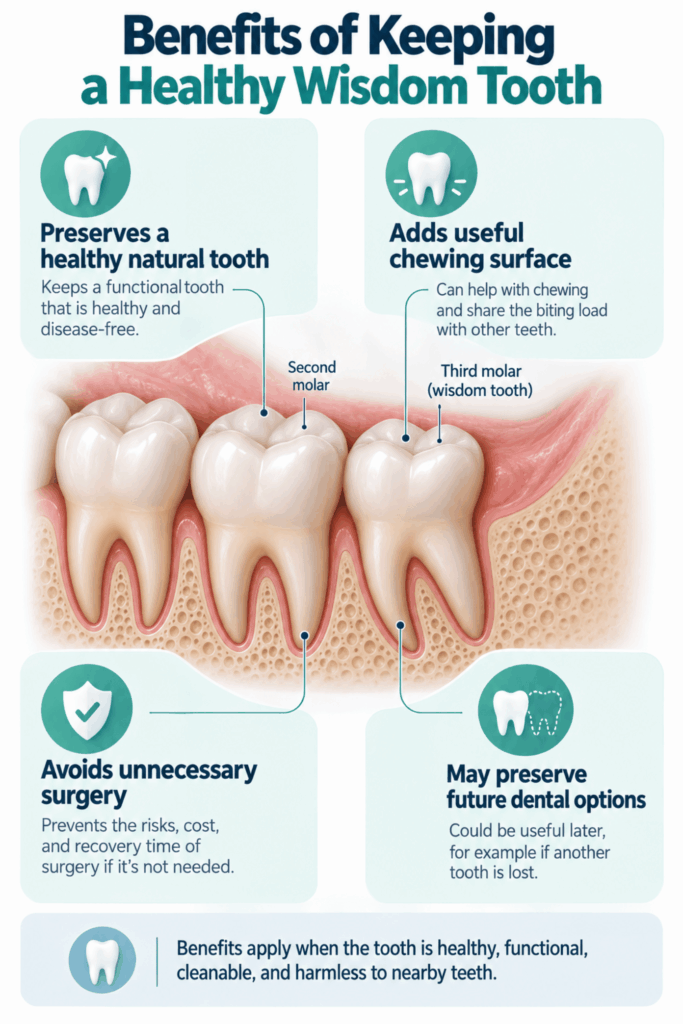
The benefits of keeping wisdom teeth mainly apply to teeth that are healthy, functional, and easy to maintain. Such teeth can provide extra chewing surface and may have future dental value. Keeping them also avoids an extraction that has no clear present benefit.
These advantages become less meaningful when a tooth is impacted, repeatedly infected, difficult to clean, or damaging adjacent teeth. The goal is not to save or remove every wisdom tooth. It is to choose what is best for your oral health based on the condition of each tooth.
Preserving a Healthy Natural Tooth
The benefits of keeping a healthy wisdom tooth are greatest when it serves a purpose and does not threaten surrounding teeth. Unlike an implant or bridge, it has a natural root, ligament, and sense of pressure when you bite.
That principle does not mean every wisdom tooth must stay. A tooth with severe decay, poor gum support, or an unfavorable position may offer little long-term value. The decision to keep or extract your wisdom tooth should reflect its health and likely future, not simply the fact that it is natural.
Adding Useful Chewing Surface
Keeping fully erupted wisdom teeth can provide chewing benefits when they meet the opposing teeth correctly. If it meets an opposing tooth correctly, it can help grind food and share some of the workload carried by the first and second molars.
For someone with a complete set of healthy molars, the added benefit may be modest. It may matter more when another molar is missing, heavily restored, or weakened. Still, wisdom teeth are not essential for proper digestion, and removing wisdom teeth does not normally stop a person from chewing a balanced diet.
Avoiding Unnecessary Surgery
Keeping healthy wisdom teeth offers benefits such as avoiding extraction when the teeth are unlikely to cause problems. Most people recover normally after surgery, but recovery still requires time and care.
Possible effects and complications include:
- Postoperative Pain and Swelling: Pain and discomfort are expected for a period after many surgical tooth extractions.
- Temporary Diet Changes: Chewing may be uncomfortable, so patients often need softer foods while the extraction sites begin healing.
- Bleeding and Infection: These problems are uncommon with proper care, but they remain possible after surgery.
- Dry Socket: This painful condition develops when the protective blood clot within an extraction socket breaks down or is lost, delaying healing.
- Nerve or Sinus Problems: Lower wisdom teeth may sit near nerves that supply sensation to the lip, chin, and tongue. Upper teeth can lie close to the maxillary sinus.
Avoiding these risks is a reasonable benefit when there is no sound reason for getting your wisdom teeth removed. It is not a reason to retain a tooth that already has disease or presents a meaningful threat.
Preserving Future Dental Options
Keeping a healthy, well-positioned wisdom tooth may provide future dental benefits if other teeth require treatment or replacement. For example, it might contribute to a restorative plan if another molar is lost. In selected cases, an orthodontist may move it forward into a better position.
A developing wisdom tooth may also be transplanted into the socket of a missing or severely damaged molar. Autotransplantation is a specialized procedure, and suitability depends on root development, tooth shape, available space, and surgical skill. These possibilities can add value to a tooth, but they are not guaranteed long-term benefits for every patient.
When Do the Benefits of Keeping Wisdom Teeth Apply?
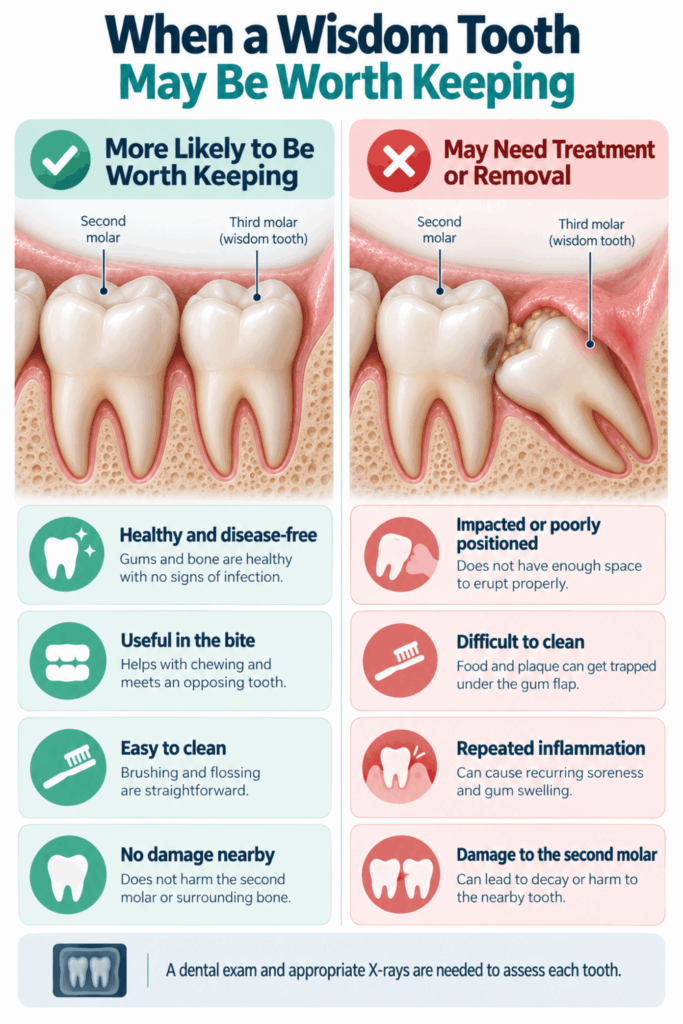
Keeping your wisdom teeth may provide benefits when they are healthy, stable, functional, and unlikely to damage nearby teeth. A lack of symptoms helps, but dentists also look for disease that you cannot see or feel.
A wisdom tooth may be a good candidate for retention when:
- It Is Free From Active Disease: There is no serious decay, infection, cystic change, or significant gum disease.
- It Has a Favorable Position: The tooth is upright or positioned in a way that does not threaten the second molar.
- It Has Enough Space: There is enough room in the jaw for the tooth without harmful pressure or trapping.
- It Is Functional: The tooth meets an opposing tooth and contributes to chewing without injuring the cheek or gums.
- It Can Be Cleaned: You can reach the tooth and the area between it and the second molar.
- It Can Be Monitored: You can attend dental examinations so changes are found before they become serious dental problems.
The Tooth Is Healthy and Free From Disease
Healthy wisdom teeth should have no active infection, unrestorable cavity, significant bone loss, cystic change, or damage to nearby teeth. The gum around an erupted tooth should also remain firm enough to support it and allow comfortable cleaning.
A tooth can look normal from above while decay develops between it and the second molar. A deep gum pocket can also form at the back of the mouth without causing immediate pain. A dental examination helps identify these less obvious problems.
The Tooth Has Enough Room and a Useful Position
The most useful wisdom tooth is usually fully erupted, reasonably upright, and healthy and properly aligned with the bite. An opposing tooth allows it to share chewing forces rather than sitting unused.
A tooth that might come in crooked or remain trapped is less likely to provide these benefits. Angled impacted wisdom teeth may press against a second molar, while partly erupted teeth can trap plaque beneath a gum flap. Position alone does not decide treatment, but it changes the balance between value and risk.
You Can Clean Around It Effectively
Wisdom teeth are the last teeth in each dental arch, making them harder to see and reach. If plaque stays around the gumline or contact point, it may lead to decay, gum inflammation, or damage to the neighboring molar.
Useful cleaning habits include:
- Reach the Back Surface: Angle a small, soft toothbrush behind the wisdom tooth instead of brushing only its chewing surface.
- Clean Along the Gumline: Move the bristles gently where the tooth meets the gum.
- Clean Between the Molars: Use floss or another interdental cleaner when the space and tooth position allow it.
- Check for Persistent Bleeding: Bleeding that continues despite careful cleaning may indicate inflammation that needs a dental assessment.
Good home care lowers risk, but it cannot make a poorly positioned tooth easy to maintain. If anatomy blocks access, professional cleaning alone may not solve the long-term problem.
Regular Monitoring Is Possible
Keeping a wisdom tooth does not mean ignoring it. Your dentist should reassess its health, gum support, position, and effect on the second molar during appropriate checkups.
X-rays are not required at every visit or on the same schedule for every patient. The American Dental Association’s recommendations for selecting dental X-rays support choosing images according to the clinical examination, symptoms, age, disease risk, and information needed for care.
Benefits and Risks of Keeping Wisdom Teeth
Neither retention nor wisdom teeth removal is automatically best. The right choice depends on whether the tooth offers useful function without creating an unreasonable chance of disease.
| Factor | Keeping the Wisdom Tooth | Removing the Wisdom Tooth |
|---|---|---|
| Natural tooth | Preserves a healthy natural molar | Permanently removes the tooth |
| Chewing | May add useful chewing surface if fully erupted and functional | Usually causes little long-term change when other molars are healthy |
| Surgery | Avoids immediate surgical risks and recovery | Treats or prevents problems linked to that specific tooth |
| Cleaning | Requires reliable access at the back of the mouth | Removes a difficult-to-clean area after healing |
| Infection and decay | Risk may remain if the tooth is partly erupted or inaccessible | Removes disease within the extracted tooth, but surgery has its own risks |
| Adjacent teeth | A healthy tooth may remain harmless | Removal may protect a second molar already at risk from impaction or disease |
| Follow-up | Requires continued clinical monitoring | The area may still need short-term postoperative review |
| Future treatment | May preserve a possible restorative or orthodontic option | Avoids the possibility of a more difficult extraction later |
Evidence does not support one universal answer for symptom-free, disease-free impacted teeth. A Cochrane review comparing removal with retention found insufficient reliable evidence to determine which choice is better for everyone. It supports shared decision-making and regular assessment when such teeth are retained.
Does a Painless Wisdom Tooth Need to Be Removed?
Keeping a painless wisdom tooth may offer benefits when dental checks confirm that it is healthy and does not threaten nearby teeth. If it is healthy, cleanable, stable, and not harming another tooth, monitoring may be a reasonable choice.
However, painless does not always mean disease-free. Decay, periodontal pockets, bone changes, or damage to a second molar may develop before they cause pain. This is why a dentist considers the examination and appropriate X-rays along with your symptoms.
The reason for extraction should be specific. Ask what problem exists now, what future problem is reasonably expected, and what monitoring would involve if the tooth stays.
Can You Keep an Impacted Wisdom Tooth?
Some impacted wisdom teeth can remain in place, but they require individual assessment. A wisdom tooth becomes impacted when another tooth, bone, or soft tissue prevents normal eruption.
Factors that affect the decision include:
- Current Disease: Decay, infection, cystic change, gum disease, or root damage favors active treatment.
- Type of Impaction: A fully covered tooth has different risks from one that communicates with the mouth.
- Effect on the Second Molar: Pressure, food trapping, decay, or bone loss behind the adjacent tooth may support removal.
- Surgical Difficulty: Deep roots or close contact with nerves and other structures can increase extraction risk.
- Age and General Health: Healing and surgical risk vary among patients, but age alone should not determine treatment.
- Ability to Attend Follow-Up: Retention is safer when the tooth can be checked over time.
- Personal Preference: When more than one option is reasonable, your priorities should be part of the decision.
Fully Impacted Wisdom Teeth
A fully impacted tooth remains covered by gum and bone and has no direct opening into the mouth. This limits contact with food and oral bacteria, but it does not make every fully impacted tooth harmless.
A dentist may monitor changes around the crown, effects on the second molar, root resorption, and the surrounding bone. If the tooth remains disease-free and surgery carries meaningful risk, observation may be reasonable. If pathology develops, the balance may shift toward extraction or another surgical option.
Partially Erupted Wisdom Teeth
A partially erupted tooth has broken through the gums but has not reached a normal position. A flap of gum may cover part of its crown, creating a space where food and bacteria collect.
Inflammation around this flap is called pericoronitis. It can cause gum tenderness, swelling, a bad taste, pain during chewing, or difficulty opening your mouth. Local cleaning and dental treatment may control an episode, but repeated infection often means the position is not sustainable.
Partial eruption can also allow decay to form on the wisdom tooth or the back surface of the second molar. Because that contact area is hard to see and restore, dentists pay close attention to it when deciding whether
What Purpose Do Wisdom Teeth Serve?
Wisdom teeth are the third and final set of molars at the back of the mouth. They usually develop during the late teens or early twenties. Like other molars, their broad chewing surfaces help crush and grind food.
Modern diets and smaller jaws mean many people do not need these extra teeth. However, a wisdom tooth that grows upright, breaks through the gums fully, meets an opposing tooth, and stays healthy can work like any other molar. It is useful but not essential when the remaining teeth function normally.
What Are the Benefits of Keeping Wisdom Teeth?
The genuine benefits of keeping wisdom teeth apply mainly to teeth that are healthy, functional, and easy to clean. Keeping a diseased or poorly positioned tooth simply because it is natural may create more dental problems than benefits.
Preserving a Healthy Natural Tooth
A healthy wisdom tooth does not automatically need extraction. If it contributes to the bite without harming the gums, bone, or adjacent teeth, keeping it preserves a natural part of your mouth.
Still, saving a natural tooth is worthwhile only when it has a reasonable long-term outlook. A deeply decayed, repeatedly infected, or damaging wisdom tooth may offer little value compared with the problems it can cause.
Adding Useful Chewing Surface
A fully erupted wisdom tooth adds another surface for grinding food. It can share chewing forces with the other molars and may become more useful if a nearby molar is missing or weakened.
The benefit is usually modest for someone who already has a complete and healthy set of molars. Wisdom teeth can help with chewing, but their absence does not normally prevent a person from eating or digesting food properly.
Avoiding Unnecessary Surgery
Keeping your wisdom teeth avoids surgery when there is no sound clinical reason to remove them. Wisdom teeth extraction is common, but it still creates a wound that needs time to heal.
Possible short-term effects and complications include:
- Pain and Swelling: Some pain, tenderness, and facial swelling are expected after removing wisdom teeth.
- Temporary Diet Changes: Hard, crunchy, and chewy foods may need to be avoided while the extraction site begins healing.
- Limited Daily Activity: Some people need time away from work, school, exercise, or other normal activities.
- Dry Socket: The blood clot protecting the socket can break down or become dislodged, exposing sensitive bone and delaying healing.
- Infection or Bleeding: These complications are uncommon but may require additional care.
- Nerve or Sinus Problems: Lower tooth extractions may affect nearby sensory nerves, while upper extractions can occasionally involve the sinus.
These risks do not mean that necessary surgery should be avoided. They mean that getting your wisdom teeth removed should have a clear expected benefit that outweighs the risks.
Preserving Future Dental Options
A healthy, well-positioned wisdom tooth may affect future dental planning. For example, it might help share chewing forces if another molar is lost, or an orthodontist may sometimes move it forward into a more useful position.
In selected younger patients, a developing wisdom tooth may be transplanted to replace a badly damaged molar. This procedure is highly case-dependent and requires suitable root development, anatomy, timing, and surgical skill. It should be viewed as a possible future option rather than a routine reason to retain every wisdom tooth.
When Do the Benefits of Keeping Wisdom Teeth Apply?
The benefits of keeping your wisdom teeth are most relevant when the teeth have a good chance of remaining healthy and useful. A suitable tooth usually meets several conditions:
- Healthy: It has no active infection, serious gum disease, destructive cystic change, or unrestorable decay.
- Well Positioned: It is upright or positioned in a way that does not threaten nearby teeth.
- Functional: It meets an opposing tooth and contributes to chewing without injuring the cheek or gums.
- Cleanable: You can reach its surfaces and the area between it and the second molar.
- Stable: Dental examinations show no concerning changes over time.
- Monitorable: You can attend checkups so that new problems are found before they become severe.
The Tooth Is Healthy and Free From Disease
Healthy wisdom teeth should have sound tooth structure and stable gum support. There should be no abscess, damaging cyst, significant periodontal pocket, or injury to the second molar.
A dental examination may reveal trouble that you cannot see or feel. Decay can form between the second and third molars, and gum or bone loss may progress with little pain. This is why symptom-free and disease-free do not mean exactly the same thing.
The Tooth Has Enough Room and a Useful Position
A wisdom tooth is more likely to provide value when there is enough room in the jaw for it to erupt completely. An upright tooth with an opposing molar can join the bite and function normally.
By contrast, a tooth might come in crooked, become impacted, or remain partly covered by gum. An angled tooth may trap food against the second molar, while a partly erupted tooth can create a sheltered space for bacteria. These positions can reduce the benefits of keeping the tooth.
You Can Clean Around It Effectively
Wisdom teeth sit at the back of the mouth, where brushing and flossing can be difficult. Poor cleaning access allows plaque to remain around the gumline or between the wisdom tooth and the molar in front of it. Over time, this may lead to decay or gum disease in either tooth.
Check whether you can:
- Reach the Back Surface: The toothbrush should clean behind the wisdom tooth without causing repeated gagging or discomfort.
- Clean the Gumline: Bristles should reach the border where the tooth meets the gum.
- Clean Between the Molars: Floss or another suitable interdental cleaner should pass between the wisdom tooth and second molar when their position allows it.
- Notice Changes: Bleeding, swelling, food trapping, bad taste, or increasing tenderness should prompt a dental assessment.
Regular Monitoring Is Possible
Retaining a wisdom tooth is not the same as ignoring it. Your dentist should examine the area during appropriate checkups and compare any changes in tooth position, gum health, decay risk, and the condition of the second molar.
X-rays are not required at every visit or on a fixed schedule. Their timing should depend on symptoms, examination findings, previous images, and your risk of disease. The American Dental Association’s recommendations for selecting dental X-rays support choosing images for each patient’s clinical needs rather than taking them routinely.
Benefits and Risks of Keeping Wisdom Teeth
Neither keeping nor removing wisdom teeth is automatically best. The right choice depends on what each tooth contributes and the problems it currently causes or may reasonably be expected to cause.
| Factor | Keeping the Wisdom Tooth | Removing the Wisdom Tooth |
|---|---|---|
| Natural tooth and function | Preserves a healthy tooth that may add chewing surface | Removes a tooth that may provide little function |
| Surgery | Avoids an operation and its recovery | Accepts short-term surgical effects to treat or prevent a defined problem |
| Cleaning | Requires reliable access to the back of the mouth | Removes a difficult-to-clean area once healing is complete |
| Infection and decay | Risk may remain if plaque collects around the tooth | Removes disease in the wisdom tooth, but surgery has its own infection risk |
| Adjacent teeth | A healthy position may cause no harm | Removal may protect a second molar already at risk |
| Future care | Requires continued observation | Usually ends problems arising from that tooth |
| Surgical complications | Avoided while the tooth remains | May include pain, swelling, dry socket, bleeding, infection, or nerve injury |
Evidence does not support one universal choice for every symptom-free impacted tooth. A Cochrane review comparing removal with retention of disease-free impacted wisdom teeth found insufficient evidence to determine which approach is better overall. It supports shared decision-making and regular assessment when an impacted tooth is retained.
Does a Painless Wisdom Tooth Need to Be Removed?
No, a painless wisdom tooth does not always need removal. If it is healthy, functional, cleanable, and not harming nearby structures, monitoring may be reasonable.
However, pain is not the only sign of disease. A painless tooth can develop decay, a deep gum pocket, bone loss, root resorption, or damage to the adjacent second molar. An examination and appropriate imaging help determine whether “no pain” also means “no disease.”
Can You Keep an Impacted Wisdom Tooth?
Some impacted wisdom teeth can remain under professional monitoring. An impacted tooth has failed to erupt into a normal position because bone, gum, another tooth, or insufficient space blocks its path.
The decision depends on several factors:
- Current Disease: Decay, infection, a cyst, root resorption, or second-molar damage can favor treatment or removal.
- Type of Impaction: A fully covered tooth behaves differently from one that communicates with the mouth.
- Position: The angle and depth affect disease risk, possible function, and surgical difficulty.
- Nearby Structures: Dentists consider the second molar, surrounding bone, nerves, and the maxillary sinus.
- Age and General Health: These factors can affect healing, surgical planning, and the value of delaying treatment.
- Ability to Monitor: Retention is less suitable when reliable follow-up is unlikely.
- Personal Preference: When evidence does not clearly favor one option, your concerns and priorities should form part of the decision.
The NICE recommendations on wisdom tooth extraction advise against routine removal of pathology-free impacted third molars within the UK’s National Health Service. Local professional guidance can differ, so the recommendation for an individual tooth should still be based on its clinical findings.
Fully Impacted Wisdom Teeth
A fully impacted wisdom tooth remains covered by gum and bone without direct exposure to the mouth. Because food and plaque cannot collect directly on its crown, it may have a different risk pattern from a partially erupted tooth.
Dentists still monitor the surrounding bone, the dental follicle around the crown, the roots of nearby teeth, and any changes in position. Full coverage does not guarantee that a tooth will remain harmless, but it also does not mean extraction is automatically necessary.
Partially Erupted Wisdom Teeth
A partially erupted wisdom tooth has broken through the gums but has not entered a normal, fully cleanable position. A flap of gum, called an operculum, may cover part of its crown. Food and bacteria can collect underneath this flap.
The trapped area can become inflamed or infected, causing pericoronitis. Symptoms may include gum soreness, swelling, a bad taste, pain when chewing or swallowing, and difficulty opening your mouth. The tooth and the back of the adjacent second molar may also develop decay or gum disease.
A single mild episode does not always lead directly to extraction. A dentist may clean and irrigate the area, assess the tooth’s eruption potential, and address the current inflammation. Repeated infection or an unfavorable position makes long-term retention less attractive.
Claims About Keeping Wisdom Teeth That Need Caution
Some claimed long-term benefits sound convincing but go beyond what current evidence supports.
| Common Claim | What the Evidence Suggests |
|---|---|
| Wisdom teeth preserve your facial shape. | Wisdom teeth are not required to maintain facial appearance. There is no good evidence that routine wisdom tooth removal causes a lasting change in facial shape. |
| They stop other teeth from shifting. | Keeping wisdom teeth has not been shown to prevent normal age-related tooth movement. Removing them also does not reliably prevent late front-tooth crowding. |
| They provide essential jaw strength. | A healthy tooth stimulates the bone immediately around its roots, but wisdom teeth are not essential for overall jaw strength. |
| They greatly improve digestion. | Healthy wisdom teeth can add chewing surface, but people with functioning first and second molars usually chew normally without them. |
| They are useless and should always be removed. | A healthy, properly aligned wisdom tooth can function like another molar and does not automatically require extraction. |
| Every healthy wisdom tooth will be valuable later. | Selected teeth may assist future restorative, orthodontic, or transplantation planning, but this is uncommon and cannot be guaranteed. |
The strongest established benefit is simple: keeping a healthy, functional wisdom tooth avoids surgery that may not be necessary. However, retaining a diseased or damaging tooth offers little benefit. The same caution applies to claims about wisdom teeth removal; extraction can treat or prevent specific problems, but it should not be promoted as protection against every future dental issue.
How Dentists Decide Whether You Can Keep a Wisdom Tooth
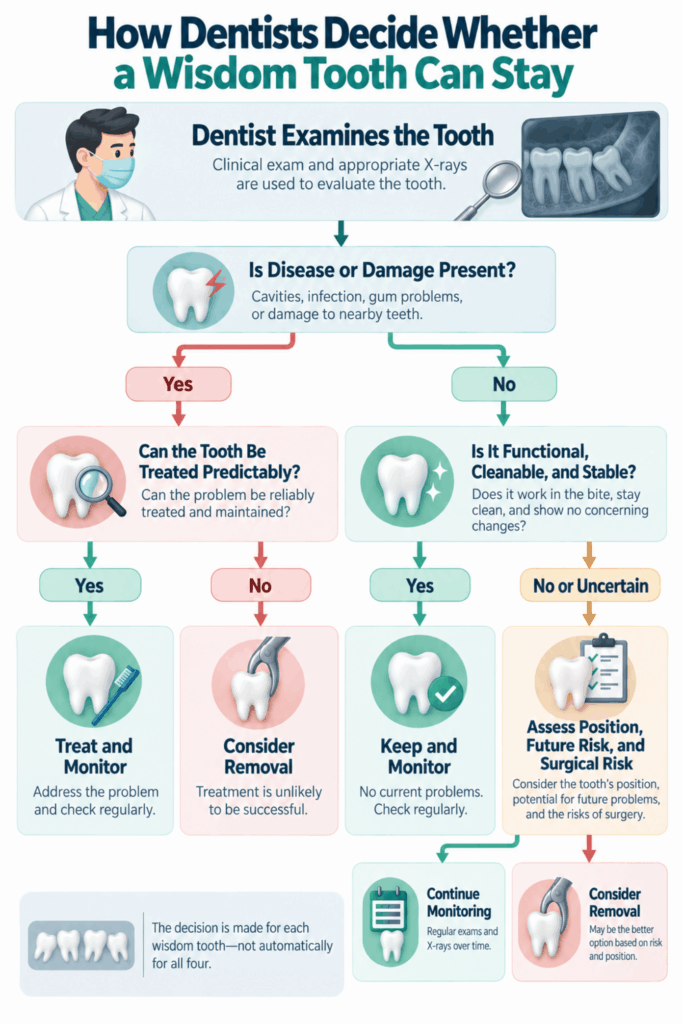
Dentists do not base the decision to keep or extract your wisdom tooth on pain alone. They combine your history, clinical findings, imaging when needed, expected disease risk, surgical risk, and personal preferences.
A typical evaluation includes:
- Reviewing Your History: The dentist asks about pain, swelling, bad taste, food trapping, previous infections, and difficulty cleaning.
- Examining the Tooth: Its eruption level, angle, function, condition, and relationship with the gums and adjacent teeth are checked.
- Assessing Cleanability: The dentist looks for plaque, bleeding, pocketing, or decay in areas that are hard to reach.
- Reviewing Appropriate Images: Existing or new X-rays may reveal findings hidden below the gum or bone.
- Comparing Options: Monitoring, restorative treatment, local gum care, extraction, or referral may be considered.
- Discussing Your Priorities: The final plan should account for likely benefits, risks, follow-up needs, and what matters to you.
Dental Examination
The clinical examination may assess:
- Eruption Level: Whether the crown is fully visible, partly covered by gum, or completely unerupted.
- Tooth Position: Whether the tooth stands upright, leans toward the second molar, points backward, or lies horizontally.
- Decay: Whether cavities affect the wisdom tooth or the hard-to-see back surface of the second molar.
- Gum Health: Whether the area bleeds, swells, traps food, or has a deep periodontal pocket.
- Signs of Infection: Redness, drainage, tenderness, swelling, or restricted mouth opening may suggest active inflammation.
- Bite Function: The dentist checks whether the tooth contacts an opposing molar or bites into the cheek or gum.
- Nearby Teeth: Special attention goes to the second molar because an impacted wisdom tooth can damage its crown, roots, gum support, or surrounding bone.
Dental X-Rays
A panoramic X-ray can show all four wisdom teeth, their eruption paths, root development, nearby bone, and their relationship with other teeth. Smaller dental images may provide better detail when the concern is decay or gum support around a specific molar.
Cone-beam computed tomography, or CBCT, provides a three-dimensional view. It may help in selected surgical cases when a lower wisdom tooth appears close to a nerve or when two-dimensional images do not answer an important question. According to the ADA’s dental imaging guidance, CBCT should be used only when lower-exposure options cannot provide the necessary diagnostic information.
Personal Risks and Preferences
The decision to keep or extract your wisdom tooth should account for your age, general health, symptoms, past infections, ability to clean the area, and access to follow-up care. Surgical difficulty also matters, especially when roots lie close to a nerve or sinus.
Your preferences become especially important when the tooth is symptom-free and no option clearly offers a better outcome. Ask what problem exists now, what may happen if you wait, how the tooth would be monitored, and what complications are relevant to your case.
When Removal May Be Better Than Keeping the Tooth
Removing wisdom teeth may be the better choice when they have active disease, repeatedly cause pain and discomfort, or threaten surrounding teeth. The reason should be specific to the tooth rather than based only on the fact that wisdom teeth are often removed.
Common reasons include:
- Repeated Gum Infection: Recurrent pericoronitis suggests that the area may remain difficult to clean or that the tooth lacks room to erupt.
- Unrestorable Decay: A deep cavity may be impossible to repair predictably because of its size, location, or poor access.
- Damage to Nearby Teeth: An angled wisdom tooth may contribute to decay, gum disease, bone loss, or root resorption in the second molar.
- Abscess or Spreading Infection: An infected tooth may need drainage, local treatment, medication when indicated, and removal of the source.
- Cystic or Other Pathologic Change: An abnormal area around an impacted tooth needs diagnosis and appropriate management.
- Repeated Cheek or Gum Injury: A tooth that erupts into an unfavorable position may continually traumatize soft tissue.
- Interference With Other Care: Removal may be appropriate when the tooth obstructs necessary surgery, reconstruction, or another carefully planned treatment.
Disease or Damage That May Support Removal
Findings that may shift the decision toward extraction include:
- Recurrent Pericoronitis: More than one significant episode can indicate an ongoing problem around a partially erupted tooth.
- Decay That Cannot Be Restored: A tooth may be too damaged or inaccessible for a predictable filling or crown.
- Significant Gum Disease: Deep pockets and bone loss may threaten both the wisdom tooth and the adjacent second molar.
- Dental Abscess: Pus, swelling, and infection around the wisdom tooth require prompt assessment and control of the source.
- Damage to the Second Molar: Decay, root resorption, or loss of gum support can make continued retention harmful.
- Cystic Change: An enlarging or abnormal follicular space around an unerupted tooth may require further investigation and surgery.
- Poor Long-Term Position: A tooth with no useful function and little chance of becoming cleanable may provide few benefits.
Not every problem requires immediate tooth extraction. A restorable cavity may receive a filling, and local treatment may settle a first episode of mild pericoronitis. The decision depends on whether treatment can create a healthy, maintainable result.
Symptoms That Need Prompt Dental Care
Contact a dentist promptly if you notice:
- Increasing Pain or Swelling: Worsening symptoms may suggest active inflammation or infection.
- Pus or a Persistent Bad Taste: Drainage around a wisdom tooth can indicate infection even if pressure and pain temporarily improve.
- Fever or Feeling Unwell: General symptoms may mean the infection is affecting more than the tissue directly around the tooth.
- Worsening Difficulty Opening Your Mouth: Increasing jaw stiffness can occur as inflammation spreads into nearby spaces.
- Pain When Swallowing: This needs prompt assessment, particularly when accompanied by swelling or fever.
Seek emergency medical help for difficulty breathing, severe difficulty swallowing, rapidly increasing facial or neck swelling, confusion, or other signs of serious illness. Do not wait for a routine dental visit when breathing or swallowing is affected.
How to Care for Wisdom Teeth You Keep
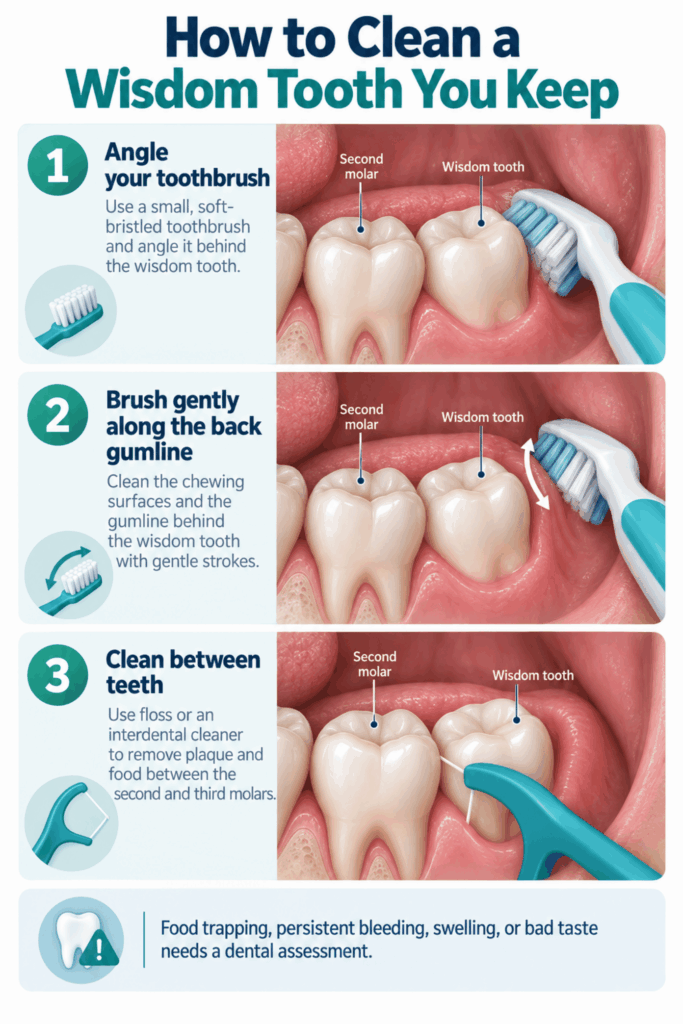
Keeping wisdom teeth clean helps preserve their benefits and protects the nearby teeth from plaque and food buildup. It reduces plaque and food buildup, although it cannot correct insufficient space in the mouth or change an unfavorable tooth angle.
- Use a Small, Soft Toothbrush: Angle the bristles toward the gumline and brush the biting, cheek, tongue, and back surfaces of the tooth.
- Slow Down at the Back of the Mouth: Short, controlled strokes often work better than forceful scrubbing in a tight area.
- Clean Between the Molars: Use floss, a floss holder, or an interdental brush if it fits safely. Ask your dentist or hygienist which option suits the space.
- Address Food Trapping: Frequent trapping between the second and third molars may signal a position or contact problem that needs assessment.
- Watch the Gum Tissue: Bleeding, swelling, tenderness, or a recurring bad taste should not be dismissed as normal eruption.
- Attend Recommended Checkups: Your dentist can monitor areas that are difficult to see and decide whether new imaging is justified.
- Avoid Relying on Mouthwash Alone: A rinse may help freshen the mouth, but it does not replace mechanical plaque removal with brushing and interdental cleaning.
Can a Damaged Wisdom Tooth Be Treated Instead of Removed?
Sometimes. A fully erupted, useful, and accessible wisdom tooth may receive a filling or other restorative care like another molar. Treatment is more reasonable when the dentist can remove the decay, keep the area dry, place a durable restoration, and expect you to clean the tooth afterward.
Extraction may offer a better outcome when decay extends deeply below the gum, access is poor, gum support is weak, or the tooth has little function. The dentist also considers the health of the second molar, the cost and complexity of restoration, and the chance that the wisdom tooth will cause problems again.
Can Wisdom Teeth Become Useful if Another Molar Is Lost?
A wisdom tooth may occasionally become useful after another molar is lost. It might drift forward naturally, or an orthodontist may move it into a better position. A suitable tooth may also help support selected restorative work.
Autotransplantation is another specialized option. A dentist or oral and maxillofacial surgeon moves a suitable tooth, often a developing wisdom tooth, into the socket of a missing or hopeless molar. Success depends on careful patient selection, root development, surgical handling, and follow-up, so not every retained tooth can serve as a future replacement.
Frequently Asked Questions
Can I Keep Some Wisdom Teeth and Remove the Others?
Yes. Dentists assess each wisdom tooth separately because the four teeth can have different positions, cleaning access, disease risks, and relationships with nerves or sinuses. One healthy, functional tooth may stay while an impacted or repeatedly infected tooth on the other side is removed. There is no rule that all four must receive the same treatment.
Should Healthy Wisdom Teeth Be Removed Before Braces?
Healthy wisdom teeth do not routinely need removal just to prevent the front teeth from shifting after braces. The Cochrane review found no reliable evidence that extracting symptom-free impacted wisdom teeth prevents clinically important crowding. Removal may still be advised if a tooth has disease, blocks planned movement, or creates another specific orthodontic or surgical concern.
Is It Safe to Keep Wisdom Teeth After Age 30?
It can be safe when the teeth are healthy, stable, cleanable, and monitored. Age alone does not decide whether they should stay. However, surgical recovery and complication risks may change with age, so a dentist should compare the benefit of continued retention with the difficulty of removal if a problem is already present.
Can Waiting Make Wisdom Tooth Removal More Difficult?
It can in some cases. Roots may finish developing, bone can become denser, and existing disease may damage nearby tissue. Yet this does not justify removing every healthy wisdom tooth early. The relevant question is whether a particular tooth shows disease or has a strong likelihood of causing harm that outweighs the risks of surgery now.
What Happens if a Wisdom Tooth Has No Opposing Tooth?
A wisdom tooth without an opposing molar may continue erupting beyond the normal biting level. It can trap food, irritate the opposite gum, or interfere with the bite. If it remains stable, clean, and harmless, it may only need monitoring. Treatment becomes more likely when overeruption creates injury, disease, or functional problems.
Can Wisdom Teeth Be Kept During Pregnancy?
Yes. Healthy, symptom-free wisdom teeth can usually remain under observation during pregnancy. If pain or infection develops, do not delay an assessment; necessary dental care and appropriately selected X-rays can be provided during pregnancy. The American Dental Association’s pregnancy guidance supports providing needed preventive, diagnostic, restorative, and emergency dental care rather than postponing treatment solely because of pregnancy.
Bottom Line: Are Wisdom Teeth Worth Keeping?
Healthy wisdom teeth can be worth keeping when they are functional, well positioned, easy to clean, and harmless to nearby structures. When wisdom teeth grow upright and have enough space, they can provide a useful chewing surface. The benefits of keeping wisdom teeth also include preserving a healthy natural tooth and avoiding unnecessary surgery.
Wisdom teeth can cause problems when they become impacted, collect plaque, or damage a nearby molar. Although many people worry that they will overcrowd the mouth or cause misalignment, current evidence does not support removing healthy wisdom teeth solely to prevent front-tooth crowding. Ask your dentist to assess each tooth and recommend suitable treatment or monitoring.
