Pain or swelling behind your last molar can make you wonder if a wisdom tooth infection has started. Other possible signs include red gums, a bad taste, bad breath, or trouble opening your mouth. These symptoms deserve a dental check because an infection usually needs professional care.
A wisdom tooth can become infected when bacteria collect beneath a gum flap, enter a cavity, or reach damaged tissue around the tooth. The problem may remain near the tooth, but it can worsen or return if the source is not treated. A dentist can identify the cause and decide whether cleaning, drainage, dental repair, or removal is appropriate. Antibiotics help in certain cases, but they do not always remove the source.
You can take safe steps to ease discomfort while arranging care, but home remedies should not delay an examination. Fever, increasing facial or neck swelling, trouble swallowing, or difficulty breathing can signal that the infection is spreading. Knowing the difference between common local symptoms and urgent warning signs will help you choose the right next step.
What Is a Wisdom Tooth Infection?
A wisdom tooth infection develops when harmful bacteria affect the tooth, the gum around it, or the tissues near its roots. It often occurs at the back of the mouth, where wisdom teeth can be difficult to see and clean.
The infection may take several forms. Pericoronitis affects the gum around a partly erupted tooth. Deep tooth decay can infect the soft tissue inside the tooth, called the pulp. Infection may also form a pocket of pus known as a dental abscess. These conditions can cause similar symptoms, but they may require different dental treatments.
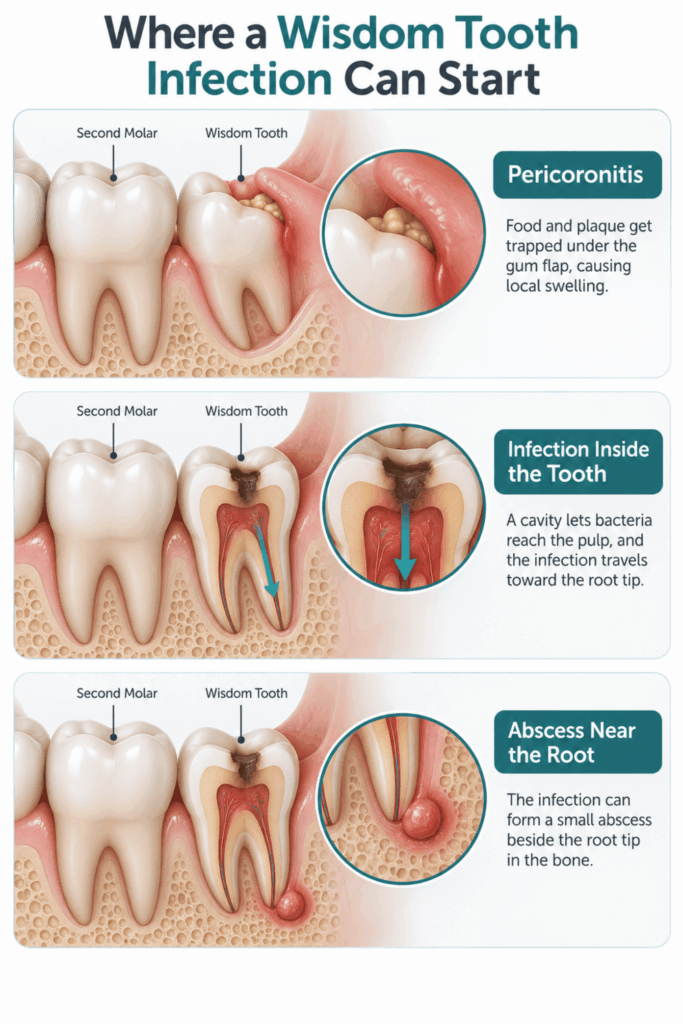
Pericoronitis Around a Partially Erupted Wisdom Tooth
Pericoronitis is inflammation around the crown of a partially erupted wisdom tooth. It most often affects a lower wisdom tooth covered by a flap of gum tissue called an operculum. Food, plaque, and bacteria can collect beneath this flap because normal brushing may not reach the area.
Mild inflammation may cause temporary gum tenderness without a deeper infection. Increasing pain, swelling, pus, a bad taste, fever, or difficulty opening the mouth suggests that the problem needs professional dental care. Repeated episodes may occur if the tooth cannot fully erupt or the area remains difficult to clean.
Infection Inside the Tooth or Around Its Root
Deep decay or a crack can allow bacteria to reach the pulp, which contains nerves and blood vessels. The pulp may become inflamed and then die, allowing infection to pass through the root into the surrounding bone.
This infection can produce an abscess near the root. However, not every infected tooth has a visible gum bump or active drainage. A dentist may need an examination and X-rays to determine whether the infection is inside the tooth, around its root, or in the nearby gum tissue.
Wisdom Tooth Infection Symptoms and Warning Signs
Wisdom tooth infection symptoms depend on where the infection began and whether it remains local or has started to spread. One symptom alone cannot confirm the diagnosis, but a group of worsening signs deserves prompt attention.
Common Symptoms Around the Tooth
Symptoms of wisdom tooth infection often begin around the affected tooth. They may remain steady, come and go, or become more noticeable over several days.
- Pain Behind the Last Molar: Wisdom tooth pain may feel dull, throbbing, or sharp. Chewing or touching the gum can make it worse.
- Red or Swollen Gum Tissue: The gum around the wisdom tooth may look puffy, feel tender, or bleed during cleaning.
- Pain When Biting or Chewing: Pressure on the infected tooth or inflamed gum flap can make eating uncomfortable.
- Food Trapping: Food may repeatedly collect beneath a gum flap or between the wisdom tooth and second molar.
- Bad Breath: Bacteria, trapped debris, or drainage can cause an odor that remains after brushing your teeth.
- Unpleasant Taste: A salty, bitter, or foul taste may come from fluid draining around the infected tooth.
- Pus or Fluid: White, yellow, or cloudy drainage is a sign of infection and should be checked by a dentist.
- Jaw Stiffness: Inflammation near the chewing muscles may make it harder or more painful to open the mouth.
Signs the Infection May Be Spreading
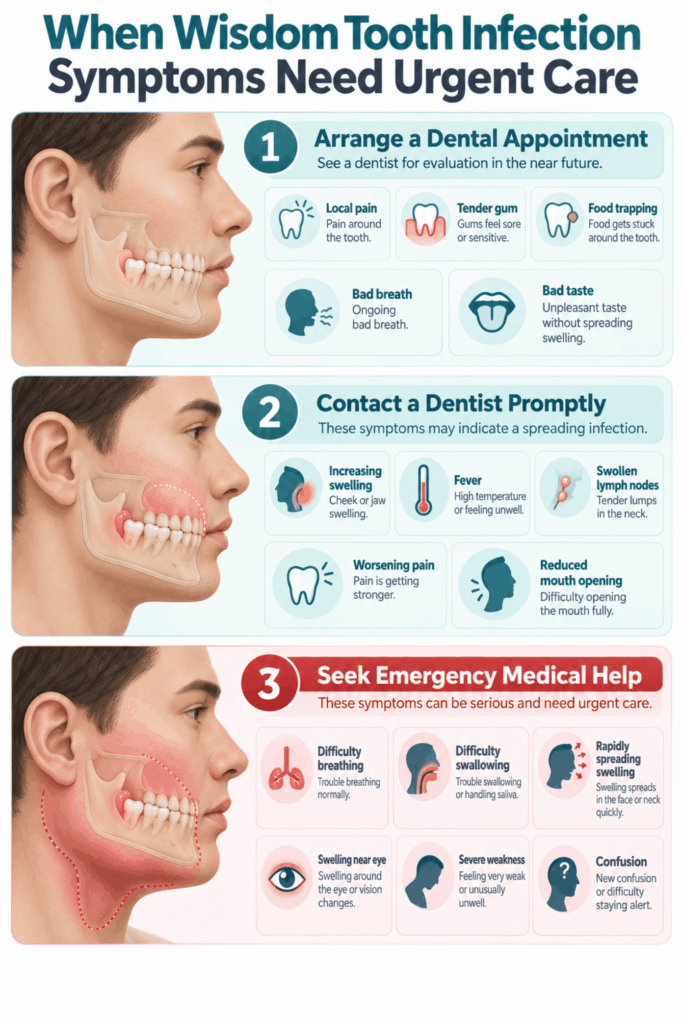
A dental infection may extend beyond the tooth into the cheek, jaw, or deeper spaces of the face and neck. Contact a dentist promptly if you notice:
- Increasing Swelling: Swelling that moves from the gum into the cheek, jaw, or face requires timely assessment.
- Fever or Chills: These symptoms may show that your body is responding to an infection beyond a small local area.
- Feeling Unwell: Unusual tiredness, weakness, or a general sick feeling can accompany a spreading infection.
- Swollen Lymph Nodes: Tender lumps beneath the jaw or in the neck may develop as the immune system responds.
- Worsening Pain: Pain that becomes stronger, more constant, or difficult to control can indicate progression.
- Reduced Mouth Opening: Increasing difficulty opening the mouth, known as trismus, may occur when inflammation affects nearby muscles.
These findings do not prove how far the infection has traveled, but they justify prompt professional assessment. Waiting for severe pain is not a safe way to judge the problem.
When to Seek Emergency Help
Most infected wisdom teeth require dental care rather than hospital treatment. However, an infection can become a medical emergency if swelling threatens the airway or reaches important spaces in the face or neck. The NHS guidance on dental abscess emergencies advises emergency care for serious breathing problems or significant mouth swelling.
Seek emergency medical help for:
- Difficulty Breathing: Call emergency services if breathing feels restricted or noisy.
- Difficulty Swallowing: Get urgent help if you cannot swallow normally, are drooling, or struggle to handle saliva.
- Rapidly Spreading Swelling: Swelling that is quickly enlarging across the face, beneath the jaw, or into the neck needs immediate assessment.
- Swelling Near the Eye: Eye swelling, eye pain, or a change in vision can indicate that infection has reached a dangerous area.
- Severe Weakness or Confusion: These symptoms may signal serious illness and require emergency evaluation.
Do not drive yourself if you feel faint, confused, or unable to breathe safely. Ask someone to help or call your local emergency number.
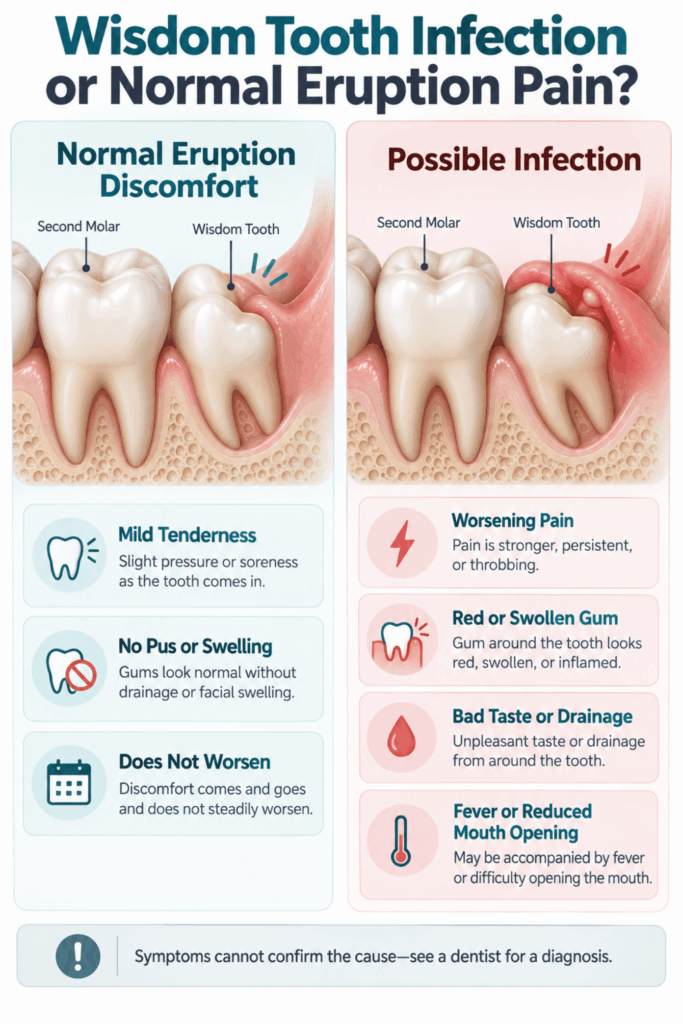
Wisdom Tooth Infection or Normal Eruption Pain?
A wisdom tooth pushing through the gum may cause short-term pressure or tenderness. Infection is more likely when discomfort becomes worse or appears with swelling, drainage, fever, or a persistent bad taste.
| Feature | Normal Eruption Discomfort | Possible Wisdom Tooth Infection |
|---|---|---|
| Pain | Mild pressure or tenderness | Persistent, throbbing, or worsening pain |
| Gum | Slight tenderness as the tooth erupts | Marked redness, swelling, bleeding, or pus |
| Taste and Breath | Usually unchanged | Persistent bad taste or bad breath |
| Facial Swelling | Not expected | Cheek or jaw swelling may occur |
| General Health | No fever or sick feeling | Fever, chills, or feeling unwell may occur |
| Mouth Opening | Usually normal | Opening may become painful or limited |
| Pattern | Often settles as the gum adapts | May persist, worsen, or keep returning |
These differences can help you decide when to seek care, but they cannot provide a diagnosis. Decay, a nearby tooth, a jaw-joint problem, and other conditions can produce similar pain.
What Causes a Wisdom Tooth to Become Infected?
Wisdom teeth often erupt in areas with limited space and poor access for cleaning. Infection risk rises when food and bacteria become trapped around the tooth or enter it through damaged enamel.
Common causes include:
- Partial Eruption: A partly visible tooth can leave a pocket beneath the gum where plaque and food collect.
- Impaction: An angled or blocked tooth may create a hard-to-clean space against the neighboring tooth.
- Tooth Decay: Bacteria can pass through a cavity and reach the pulp inside the wisdom tooth.
- Cracks or Damage: A broken surface may expose deeper parts of the affected tooth to bacteria.
- Gum Disease: A deep periodontal pocket can allow infection to develop beside the tooth and affect its bone support.
- Poor Access for Cleaning: A toothbrush and floss may not reach the far side of an upper or lower wisdom tooth.
Partial Eruption and a Difficult-to-Clean Gum Flap
When wisdom teeth erupt only partway, gum tissue may remain over part of the crown. The flap creates a sheltered space where bacteria and food debris can build up. An upper tooth may also bite the swollen flap over a lower tooth, adding repeated trauma.
Cleaning may settle a mild first episode, especially if the tooth still has room to erupt. However, pericoronitis may return when the flap remains or the tooth cannot move into a cleanable position.
Impaction and Limited Space
Impacted wisdom teeth are partly or fully blocked by bone, gum, or another tooth. A partly impacted tooth that communicates with the mouth can collect bacteria. If it leans toward the second molar, it may also create a deep pocket that is difficult to brush.
A fully covered, disease-free impacted tooth is not automatically infected. It may be monitored when examination and imaging show no symptoms or damage. The need for wisdom teeth removal depends on disease and individual risk, not simply on whether all four wisdom teeth have erupted.
Tooth Decay, Cracks, and Gum Disease
Wisdom teeth can develop cavities like any other teeth. Their position can make decay harder to notice and more difficult to restore. Once bacteria reach the pulp, the tooth can become infected around its root.
A deep gum pocket can also cause infection beside the tooth. In some cases, an angled wisdom tooth contributes to decay, bone loss, or gum disease on the back of the neighboring second molar. Treatment must then consider both teeth, not just the wisdom tooth causing the infection.
How Dentists Diagnose a Wisdom Tooth Infection
A dentist diagnoses the problem by combining your symptoms, medical history, examination findings, and imaging when needed. The goal is to identify the source, judge the infection’s extent, and rule out other causes of pain.
- Review Your Symptoms: The dentist asks when the pain began, whether it is worsening, and whether you have swelling, drainage, fever, or trouble swallowing.
- Check Your Health History: Medical conditions, pregnancy, allergies, immune problems, and current medications can affect infection risk and treatment choices.
- Examine the Back of the Mouth: The dentist looks for a gum flap, trapped debris, redness, pus, decay, swelling, and damage to nearby teeth.
- Test the Tooth: Tapping, biting, cold, or other pulp tests may help determine whether the infection comes from inside the wisdom tooth or another tooth.
- Assess the Surrounding Tissues: The dentist may check lymph nodes, facial swelling, gum-pocket depth, and how far you can open your mouth.
- Choose Suitable Imaging: An X-ray may be taken when it is likely to change the diagnosis or treatment plan.
When Dental X-Rays Are Needed
X-rays can reveal details that are hidden beneath the gum. They may show the wisdom tooth’s angle, tooth decay, changes around the roots, bone loss, damage to the second molar, or an unerupted tooth’s position.
A small dental X-ray may provide a detailed view of decay and the roots. A panoramic X-ray shows all four wisdom teeth, both jaws, and nearby structures. Three-dimensional imaging is reserved for selected cases in which standard images do not answer an important treatment question. The ADA and FDA recommendations for selecting dental X-rays support choosing images according to the patient’s examination findings and individual needs.
Other Problems That Can Feel Similar
Several conditions can resemble a wisdom tooth infection:
- Normal Eruption Discomfort: A tooth moving through the gum may cause mild pressure without pus, fever, or spreading swelling.
- Tooth Decay Without Infection: A cavity may cause sensitivity or pain before bacteria reach the pulp or surrounding tissues.
- Dry Socket: This painful problem occurs after tooth extraction when the socket loses its protective blood clot. It is not an infection of an unerupted tooth.
- Jaw-Joint or Muscle Pain: Temporomandibular joint problems may cause pain near the ear, jaw stiffness, or discomfort while chewing.
- A Sore Throat: Tonsil or throat inflammation can cause pain near the back of the mouth and difficulty swallowing.
- Another Infected Tooth: Pain from the second molar or an upper tooth may feel as if it comes from the wisdom tooth.
A dental examination is the safest way to identify the affected tooth and avoid treating the wrong problem.
How Dentists Treat a Wisdom Tooth Infection
Treatment depends on whether the infection affects the gum flap, the pulp inside the tooth, or an abscess near its root. The dentist also considers swelling, tooth position, restorability, previous infections, and your overall health.
Pain relief and antibiotics may support treatment, but lasting care addresses the source. This may require cleaning, drainage, repair, root canal treatment, or tooth removal.
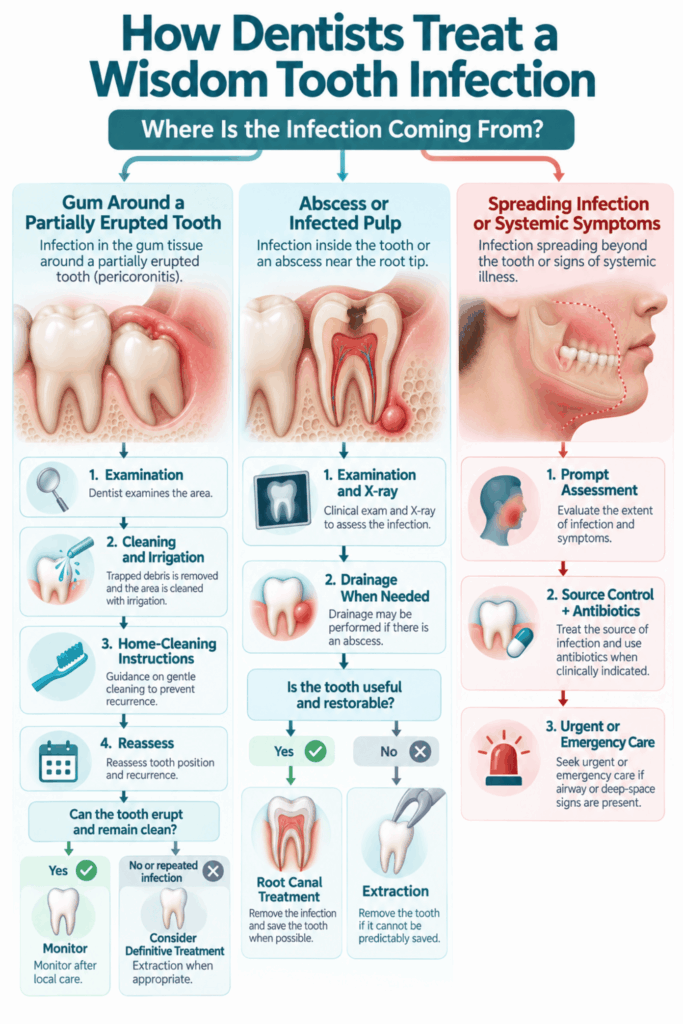
Cleaning and Irrigation Around the Gum Flap
For localized pericoronitis, the dentist may gently flush beneath the flap of gum tissue and remove trapped food, plaque, and pus. This reduces the bacterial load and helps the tissue drain. You may then receive instructions for cleaning the area at home.
Local care may control a mild first episode if the tooth can continue to erupt into a healthy position. Repeated infection requires a closer look at available space, bite trauma, gum-flap anatomy, and whether the area can remain clean.
Draining an Abscess
An abscess is a collection of pus that may need drainage. Depending on its location, the dentist may drain it through the gum, through the tooth during root canal treatment, or by removing the affected tooth.
Drainage can reduce pressure and help control infection, but it is not always the final treatment. A dental abscess usually still requires treatment of the tooth or gum problem that allowed it to form.
Repairing, Treating, or Removing the Tooth
A fully erupted wisdom tooth may sometimes be kept if it is useful, accessible, and restorable. A small cavity may receive a filling. If the pulp is infected but the tooth has a sound structure and useful position, root canal treatment can remove the infected pulp and preserve the tooth. The American Association of Endodontists’ explanation of root canal treatment describes how the canals are cleaned, shaped, filled, and sealed.
Wisdom tooth extraction is often more practical when the tooth is badly decayed, poorly positioned, repeatedly infected, or impossible to clean or restore predictably. The decision may depend on:
- Restorability: Enough healthy tooth structure must remain to support a lasting repair.
- Access: A dentist needs adequate access to perform and maintain a filling or root canal treatment.
- Position: An impacted or severely angled tooth may not contribute useful chewing function.
- Repeated Infection: Recurring pericoronitis may continue while a gum pocket or difficult tooth position remains.
- Effects on Nearby Teeth: Tooth removal may be considered when the wisdom tooth contributes to decay, gum disease, or bone loss beside the second molar.
- Surgical Risk: Root shape, bone coverage, nerve position, age, and medical health affect the benefits and risks of oral surgery.
Removing one problematic tooth does not mean all four wisdom teeth must be removed. Each wisdom tooth or teeth should be assessed according to its position, health, and future risk. NICE guidance states that a mild first episode of pericoronitis alone is not necessarily an indication for surgery, while repeated episodes may support removal after individual assessment. See the NICE recommendations on wisdom tooth extraction.
Can an Infected Wisdom Tooth Be Removed Right Away?
An infected wisdom tooth can often be removed during the active episode. Active infection alone does not always require waiting. Extraction can remove the source and allow infected material to drain.
Immediate tooth extraction may be harder if severe swelling limits access, the patient cannot open the mouth, anesthesia may be difficult to achieve, or infection has spread into deeper tissues. Medical conditions and surgical complexity also matter. A dentist or oral surgeon may begin with drainage, local treatment, and medication before arranging removal, or may perform the extraction at once when that offers the safest source control.
Are Antibiotics Needed for a Wisdom Tooth Infection?
Antibiotics are not needed for every wisdom tooth infection. A localized infection may respond better to cleaning, drainage, root canal treatment, or extraction because these treatments directly remove its source.
A dentist may prescribe antibiotics when infection spreads beyond the immediate area, causes fever or other systemic symptoms, or cannot receive prompt drainage or dental treatment. A weakened immune system or another medical risk may also affect the decision. The American Dental Association’s guidance on antibiotics for dental pain and swelling emphasizes treating the dental cause and avoiding antibiotics when they are not necessary.
Key points include:
- Local Treatment Comes First When Possible: Cleaning or drainage often does more to stop the infection than medication alone.
- Antibiotics Do Not Replace Dental Treatment: The affected tooth or gum pocket may remain a source of future infection.
- Not Every Toothache Is Bacterial: Pressure, pulp inflammation, muscle pain, and other problems may not benefit from antibiotics.
- Spreading Infection Needs Prompt Care: Medication may be necessary, but worsening swelling still requires professional reassessment.
Why Antibiotics Alone May Not Stop the Infection From Returning
Antibiotics can help your body control bacteria that have spread into surrounding tissues. They cannot fill a cavity, remove a trapped food pocket, clean dead pulp from a tooth, or correct an impacted tooth’s position.
Symptoms may settle while the underlying problem remains. Once the medication ends, bacteria can build up again, and the infection may return. Do not take leftover antibiotics, share them, or use someone else’s prescription. The wrong medicine or duration can cause side effects, delay proper diagnosis, and contribute to antibiotic resistance.
What Your Dentist Checks Before Prescribing Medicine
The safest antibiotic choice depends on more than the location of the infection. Your dentist may check:
- Drug Allergies: Describe the exact reaction you had rather than reporting only the medicine’s name.
- Pregnancy or Breastfeeding: Some medication choices require added consideration during these periods.
- Age and Body Size: These factors can affect whether a drug and dose are suitable.
- Medical Conditions: Kidney, liver, digestive, blood, or immune conditions may change the plan.
- Current Medicines: Some antibiotics interact with prescription drugs, supplements, or alcohol.
- Recent Antibiotic Use: Recent treatment may influence bacterial resistance and the safest next option.
- Infection Severity: Fever, spreading swelling, drainage, and airway symptoms affect the need for medication and the urgency of care.
There is no single antibiotic or dose that is right for every infected wisdom tooth. Follow the prescription exactly and contact the prescriber if you develop a concerning reaction.
How to Ease Pain While Waiting for Dental Care
Home care may provide temporary relief from wisdom tooth pain, but it cannot confirm the diagnosis or remove every source of infection. Arrange a dental appointment even if the discomfort improves.
- Clean the Area Gently: Use a soft toothbrush to remove visible plaque and food without digging under the gum with a sharp object.
- Rinse With Warm Salt Water: Gently move the rinse around the back of the mouth, then spit it out. Do not swallow it or rinse so forcefully that you irritate the tissue.
- Choose Soft Foods: Yogurt, eggs, soup that is not hot, and other soft foods may be easier to chew. Use the other side of your mouth when comfortable.
- Stay Hydrated: Water helps prevent dry mouth and supports normal oral cleaning by saliva.
- Use a Cold Compress: Place a wrapped cold pack against the outside of the cheek for short periods if swelling is present. Do not place ice directly on the skin or tooth.
- Avoid Irritants: Smoking, vaping, and very hot, hard, spicy, or sugary foods may make the area more uncomfortable.
Using Over-the-Counter Pain Medicine Safely
Ibuprofen, acetaminophen, or an appropriate combination may reduce acute dental pain in eligible adults. The ADA guideline for acute dental pain recommends nonopioid options, particularly nonsteroidal anti-inflammatory drugs with or without acetaminophen, as first-line treatment in many situations.
These medicines are not safe for everyone. Ulcers, kidney or liver disease, bleeding problems, pregnancy, allergies, alcohol use, and other medications can change what you can take. Follow the package directions and avoid taking two products that contain the same ingredient. Ask a dentist, physician, or pharmacist if you are unsure.
What Not to Put on an Infected Wisdom Tooth
Avoid treatments that can burn the gum, push bacteria deeper, or delay dental care:
- Aspirin on the Gum: Aspirin held against oral tissue can cause a chemical burn. Swallow pain medicine only as directed.
- Undiluted Chemicals or Essential Oils: Concentrated peroxide, bleach, alcohol, clove oil, and other substances can injure the gum.
- Sharp Objects Beneath the Gum Flap: Pins, toothpicks, and improvised tools may cut tissue or force debris deeper.
- Forceful Squeezing or Puncturing: Trying to drain swelling yourself can spread bacteria or injure nearby structures.
- Leftover Antibiotics: An old prescription may be unsuitable, incomplete, expired, or unable to treat the source.
Can a Wisdom Tooth Infection Go Away on Its Own?
Mild irritation around an erupting tooth may improve with careful oral hygiene. An established dental infection, however, should not be assumed to have healed because the pain faded. An abscess requires professional care, and the NHS overview of dental abscess treatment notes that it does not go away on its own.
Symptoms may fluctuate if pressure drains or inflammation temporarily decreases. Yet a deep cavity, infected pulp, persistent gum flap, or problematic tooth position can remain. This is why a wisdom tooth infection may go quiet and then return.
What to Do if Swelling or an Abscess Drains
A sudden foul taste, fluid release, or drop in pressure may mean an abscess has drained. Gently rinse with warm salt water, do not squeeze or puncture the area, and arrange dental care. Drainage can reduce pain, but it does not prove that the infection or its source has resolved.
What to Expect After Treatment
What happens next depends on the dental treatment you received. Symptoms may begin to settle after cleaning or drainage, but the dentist may still need to repair, treat, or remove the tooth. After extraction or oral surgery, follow the specific instructions provided for protecting the socket and keeping your mouth clean.
Pain and swelling should generally move in the right direction rather than becoming steadily worse. Attend planned follow-up visits, especially if drainage or antibiotics were used before definitive treatment.
Signs That Treatment May Not Be Working
Contact your dentist if symptoms fail to improve as expected or begin to worsen. Seek help sooner for:
- Increasing Pain or Swelling: A growing lump or expanding facial swelling needs reassessment.
- Persistent Fever: Continued fever or feeling increasingly unwell may indicate that infection remains active.
- New or Ongoing Drainage: Repeated pus or a persistent bad taste may mean the source has not been controlled.
- Worsening Jaw Stiffness: Reduced mouth opening can make eating, drinking, and further treatment difficult.
- Medication Reactions: Contact the prescriber for a new rash or troublesome side effects. Facial, lip, tongue, or throat swelling with breathing difficulty requires emergency help.
- Difficulty Swallowing or Breathing: These symptoms require emergency medical care, especially when swelling is spreading.
How to Reduce the Risk of Another Infection
Good oral hygiene can lower the amount of plaque and trapped food around wisdom teeth. It cannot always overcome a tooth position that creates an inaccessible pocket, so regular dental checks remain important.
- Brush Behind the Last Molar: Angle a small, soft toothbrush toward the back and gumline without forcing it under tender tissue.
- Clean Between Accessible Teeth: Floss or an appropriately sized interdental brush can help clean between the wisdom tooth and second molar.
- Follow Personalized Rinsing Advice: A dentist may recommend a specific rinse for a limited period. Routine products are not a substitute for mechanical cleaning.
- Treat Decay and Gum Disease Early: Small problems are usually easier to manage before infection or damage to neighboring teeth develops.
- Attend Dental Examinations: Monitoring can identify changes in impacted teeth, gum pockets, and nearby teeth before symptoms become severe.
- Discuss Repeated Episodes: If pericoronitis keeps returning, ask whether the tooth can erupt and remain clean or whether another treatment would reduce future risk.
Common Questions About Wisdom Tooth Infection
How Long Can a Wisdom Tooth Infection Last?
There is no fixed duration. A mild gum flare may improve after cleaning, while an abscess or infected pulp can persist until its source receives dental treatment. Pain may also fade temporarily after drainage or antibiotics. If symptoms suggest infection, arrange an examination rather than waiting a set number of days.
Can You Have a Wisdom Tooth Infection Without Severe Pain?
Yes. An early or slowly developing infection may cause mild tenderness, gum swelling, drainage, bad breath, or an unpleasant taste without severe pain. Pain intensity does not always show how serious the problem is. A new gum change, pus, recurring swelling, or unexplained bad taste near a wisdom tooth deserves a dental check.
Can a Wisdom Tooth Infection Cause Headaches?
Pain and inflammation near a wisdom tooth can spread toward the jaw, ear, or temple. Jaw-muscle tension may also contribute to a headache. However, headaches have many dental and nondental causes. Seek an assessment if the headache occurs with tooth pain, swelling, fever, limited mouth opening, or other infection symptoms.
Is a Wisdom Tooth Infection Contagious?
The infection itself is not usually considered contagious like a cold. Oral bacteria can pass through saliva, but sharing bacteria does not mean another person will develop the same infection. Tooth position, decay, gum pockets, oral hygiene, and individual health all influence whether infection develops.
Can an Upper Wisdom Tooth Become Infected?
Yes. Upper wisdom teeth can develop cavities, pulp infection, gum disease, or an abscess. Pericoronitis is more commonly linked to a partially erupted lower wisdom tooth, but a gum flap can also surround an upper tooth. Pain from an upper tooth may be felt near the cheek, temple, or back of the upper jaw.
Can You Develop an Infection After Wisdom Tooth Removal?
Yes, although postoperative pain alone does not prove infection. Contact the treating dentist if pain or swelling unexpectedly worsens after starting to improve, or if you develop pus, fever, a persistent bad taste, or increasing difficulty opening your mouth. Dry socket can also cause severe pain after tooth removal, but it is different from infection.
The Bottom Line
A suspected wisdom tooth infection needs dental assessment because the right treatment depends on its source and severity. Cleaning, drainage, tooth repair, root canal treatment, or wisdom tooth extraction may be considered. Antibiotics are useful in selected cases but do not always remove the cause.
Arrange prompt dental care for increasing pain, swelling, drainage, fever, or reduced mouth opening. Seek emergency medical help for difficulty breathing or swallowing, rapidly spreading facial or neck swelling, eye involvement, severe weakness, or confusion.
