Seeing blood on your toothbrush or in the sink can be worrying. If you want to know how to stop bleeding gums, start by cleaning the gumline gently but thoroughly twice a day and cleaning between your teeth daily. Do not avoid the bleeding areas. Plaque left along the gums is a common cause of inflammation, and removing it helps the tissue recover.
Bleeding does not always mean you brushed too hard. It often happens with gingivitis, but new flossing, pregnancy changes, dental appliances, some medicines, and certain health problems can also play a role. A little bleeding that improves with better oral care is different from heavy, unexplained, or ongoing bleeding.
The right next step depends on the pattern and cause. You may need to adjust your technique, replace a worn brush, or have tartar removed by a dental professional. Knowing what to do, what to avoid, and when to book an appointment can help you protect your gums without delaying needed care.
How to Stop Bleeding Gums at Home
The safest way to stop bleeding gums is to remove plaque gently and consistently. Do not stop cleaning the areas that bleed. These steps apply to bleeding during normal brushing or flossing, not active bleeding after an extraction, dental procedure, or mouth injury.
- Brush Twice Daily: Use fluoride toothpaste and a soft-bristled toothbrush. Brush for about two minutes, covering every tooth surface and the area where each tooth meets the gum.
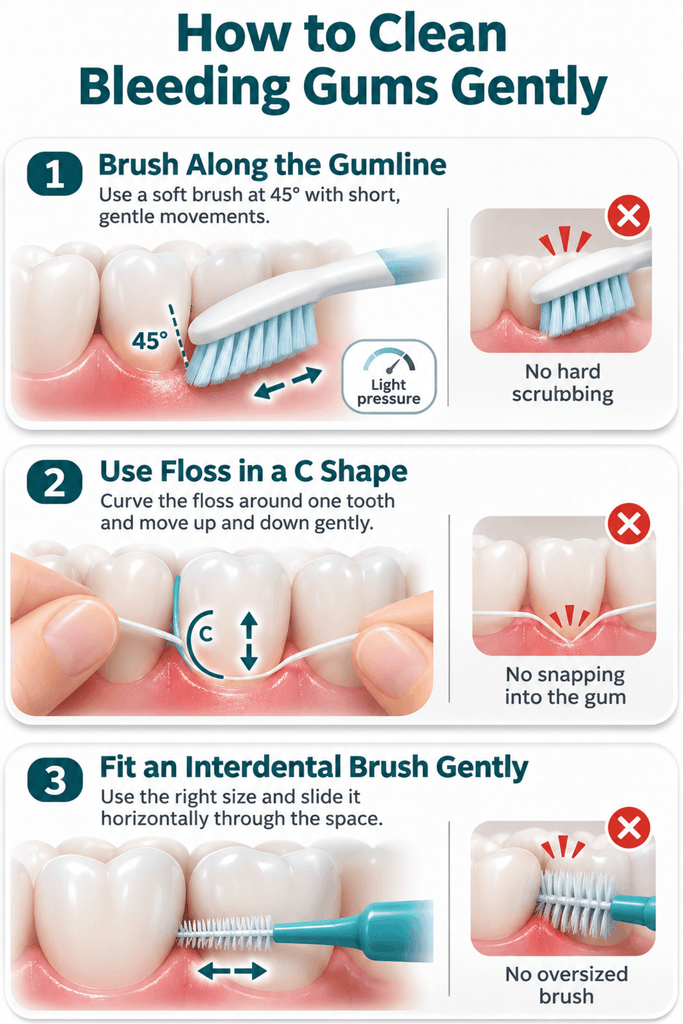
- Use Gentle Pressure: Guide the bristles along the gumline without scrubbing. Heavy pressure can injure the tissue without removing plaque more effectively.
- Clean Between Your Teeth: Use floss or appropriately sized interdental brushes to remove plaque that a toothbrush cannot reach. Move the tool carefully rather than forcing it through a tight space.
- Keep Cleaning Bleeding Areas: Avoiding those areas allows more plaque to remain, which may prolong the inflammation and bleeding.
- Spit Without Rinsing: Spit out excess toothpaste after brushing, but do not rinse immediately with water or mouthwash. This keeps fluoride on the teeth longer.
- Avoid Tobacco: Smoking and other tobacco products harm gum health and can interfere with healing. Smoking can also hide some signs of gum inflammation.
- Watch the Pattern: Note whether the bleeding affects one spot or several areas, happens only during cleaning, or starts without contact. This information can help your dentist identify the cause.
The SDCEP periodontal guidance on oral hygiene aids recommends regular gumline cleaning and advises patients not to stop brushing because their gums bleed.
Why Are Your Gums Bleeding?
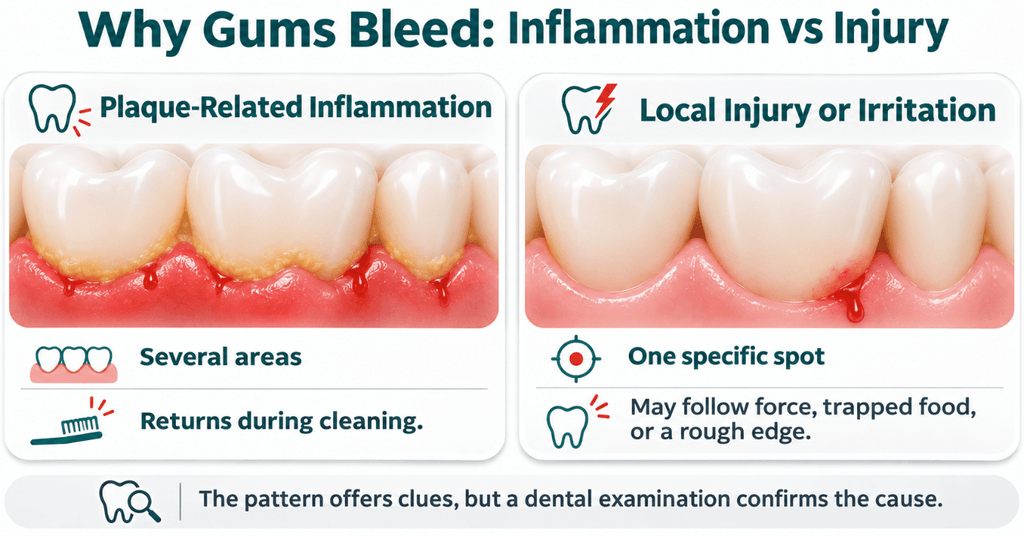
The location, timing, amount of blood, and other symptoms can offer clues. However, these details cannot confirm the cause without a dental examination. Plaque-related inflammation is common, but local injuries, hormonal changes, medicines, and health conditions can also contribute.
Plaque Buildup And Gingivitis
Plaque is a sticky film of bacteria that forms on the teeth. When it remains along the gumline, the gums may become red, swollen, tender, and more likely to bleed during brushing or flossing. This early inflammation is called gingivitis.
Plaque that is not removed can harden into tartar, also called calculus. Brushing and flossing cannot remove hardened tartar. A dentist or dental hygienist must remove it with professional instruments.
Brushing, Flossing, And Local Irritation
Not every episode of bleeding comes from widespread gum inflammation. The pattern can help distinguish a small injury from a plaque-related problem.
- Heavy Brushing Pressure: Scrubbing with too much force can damage the gum surface. The bleeding may appear directly after brushing and affect the areas receiving the most pressure.
- A Firm or Worn Brush: Firm bristles or splayed bristles can irritate the gums. Replace a worn brush head and use a soft-bristled option.
- A New Flossing Routine: Inflamed gums may bleed when you first begin cleaning between the teeth. The bleeding should decrease as plaque control improves.
- Incorrect Flossing: Snapping floss into the gums can cut the tissue. Slide it gently between the teeth and curve it around each tooth.
- Trapped Food: A piece of food between two teeth can press on the gum and cause localized swelling or bleeding.
- Dental Appliances: Braces, dentures, retainers, or other appliances can trap plaque or rub against the gums when they do not fit correctly.
- Dental Restorations: A rough edge, overhanging filling, or poorly fitting crown may irritate the nearby gum and make the area harder to clean.
Bleeding from a direct injury often begins suddenly in one spot. Plaque-related inflammation is more likely to affect several gumline areas and return during routine cleaning.
Pregnancy, Medicines, And Health Conditions
Pregnancy, medicines, and health conditions can change how easily the gums bleed. They do not remove the need to check for plaque and gingivitis, which may still be contributing.
- Pregnancy Changes: Hormonal changes can make the gums respond more strongly to plaque. This may lead to swelling, tenderness, and bleeding during pregnancy.
- Blood-Thinning Medicines: Anticoagulants and antiplatelet medicines can make bleeding easier to notice or harder to stop. Only stop an anticoagulant if the prescribing clinician tells you to do so, as explained in the NHS guidance on taking anticoagulant medicines safely. NHS.
- Vitamin Deficiencies: Severe vitamin C or vitamin K deficiency can contribute to bleeding, but supplements should not be treated as a routine cure. Testing and professional advice may be needed.
- Poorly Controlled Diabetes: Diabetes can increase susceptibility to gum inflammation and may affect healing. Gum problems can also be harder to control when blood sugar remains high.
- Bleeding Disorders: A clotting or blood disorder may cause gum bleeding along with unexplained bruising, nosebleeds, unusual tiredness, or bleeding elsewhere.
Tell your dentist about medicines, supplements, pregnancy, and diagnosed health conditions. Do not change prescribed medicine or begin high-dose supplements on your own.
Should You Keep Brushing If Your Gums Bleed?
Yes, you should usually continue brushing gums that bleed because of inflammation. Use gentle pressure and clean the gumline thoroughly. Stopping allows more plaque to collect and may make the inflammation worse.
This advice does not apply to heavy bleeding, an open mouth injury, or bleeding after a recent procedure. Apply the instructions given by your dentist after treatment. Seek professional help if the bleeding is heavy, starts without contact, or does not stop.
How to Clean Bleeding Gums Without Hurting Them
Effective cleaning depends on technique, not force. Follow the same order each time so you do not miss the gumline behind the front teeth or around the back molars.
Brush Gently Along The Gumline
- Choose The Right Brush: Use a soft-bristled manual toothbrush or a powered brush with a small head.
- Use A Small Amount Of Fluoride Toothpaste: Adults usually need only a pea-sized amount.
- Start At The Gumline: Place the bristles where the teeth and gums meet. Use gentle circular movements with a manual brush, or guide a powered brush slowly without scrubbing.
- Follow A Set Route: Clean the outer, inner, and chewing surfaces of every tooth. Pay extra attention to the back teeth and the inside surfaces of the lower front teeth.
- Brush For About Two Minutes: Complex dental work, braces, or gum problems may require more time to reach every surface.
- Spit Out the Excess: Do not rinse with water immediately after brushing because this washes away concentrated fluoride.
If the bristles quickly become bent or spread apart, you may be pressing too hard. A pressure sensor on some powered brushes can help you learn how much force to use.
Clean Between Your Teeth Carefully
A toothbrush cannot clean every surface between the teeth. Floss can fit through tight contacts, while an interdental brush may clean an open space more effectively.
- Insert The Tool Gently: Never force floss or a brush into the space.
- Curve Floss Around the Tooth: Form a C shape and move the floss up and down against one tooth, then repeat against the neighboring tooth.
- Choose A Snug Interdental Brush: The bristles should touch the tooth surfaces without requiring force. The wire should not scrape the teeth or cut the gum.
- Clean Each Space: Some people need more than one interdental-brush size because the spaces are not equal.
- Ask For A Demonstration: A dentist or dental hygienist can select suitable tools and show you how to reach difficult areas.
Do not assume that bleeding means the tool is harmful. Mild bleeding from inflamed tissue may happen at first, but repeated injury from snapping floss or forcing an oversized brush is not expected.
Can Salt Water Or Mouthwash Stop Bleeding Gums?
Warm salt water may temporarily soothe sore gums, but it does not stop plaque-related bleeding without effective cleaning. Neither option removes plaque as effectively as brushing and interdental cleaning, and neither can remove tartar.
Chlorhexidine mouthwash may be recommended for a limited period in specific situations. A Cochrane review of chlorhexidine as an addition to mechanical cleaning found reductions in plaque and gingivitis, but also reported staining, altered taste, soreness, and irritation. It should not become an indefinite substitute for daily cleaning.
- Use Rinses As Support: Continue brushing and cleaning between the teeth even when using a mouthwash.
- Check the Timing: Do not use mouthwash immediately after brushing because it can wash away fluoride from the toothpaste.
- Follow Product Directions: Do not make a rinse stronger or use it more often than recommended.
- Avoid Harsh Mixtures: Concentrated peroxide, alcohol, essential oils, or other homemade mixtures can burn or irritate oral tissue.
- Ask Before Using Chlorhexidine: A dentist can advise whether it is appropriate and how long to use it.
How Long Does It Take For Bleeding Gums To Improve?
Effective daily cleaning may help stop mild plaque-related bleeding from the gums after several days. The exact timeline depends on how inflamed the gums are, whether tartar is present, how well the area can be cleaned, and whether another condition is contributing.
- During the First Few Days: The gums may still bleed as you begin cleaning areas that were previously missed. Use a gentle technique and remain consistent.
- After About 7 To 10 Days: Bleeding related to mild inflammation should be decreasing. The British Society of Periodontology’s guidance on a new oral-hygiene routine notes that bleeding during brushing should reduce within this period with continued twice-daily brushing. This is a general expectation, not a guarantee.
- After One To Two Weeks: Arrange a dental assessment if the bleeding has not clearly improved, keeps returning, or affects only one unexplained area.
- At Any Time: Seek earlier care if the bleeding is heavy, spontaneous, difficult to stop, or accompanied by significant swelling, pain, loose teeth, fever, or other unusual bleeding.
Improved cleaning cannot remove hardened tartar or correct a rough filling. If either is present, the gums may continue bleeding until the local cause is treated.
When Bleeding Gums Need Professional Care
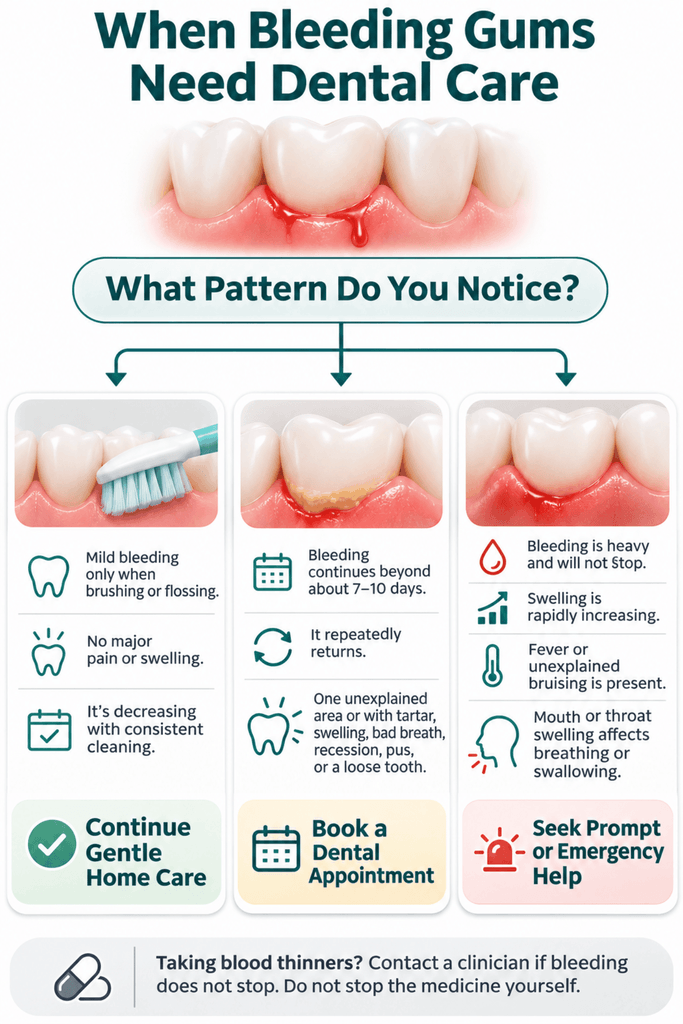
Bleeding gums are not always an emergency, but if home care does not stop the bleeding, arrange a dental assessment. A dental examination can identify plaque, tartar, gum pockets, injuries, and restorations that may be contributing.
Book A Dental Appointment
Arrange a dental visit when you notice one or more of the following:
- Persistent Bleeding: The gums continue to bleed despite consistent, gentle cleaning.
- Recurring Bleeding: The problem improves and then repeatedly returns.
- Visible Tartar: You can see or feel a hard deposit that does not come away with brushing.
- Painful or Swollen Gums: The gums remain sore, puffy, or unusually red.
- Ongoing Bad Breath: Bad breath or an unpleasant taste continues despite normal oral care.
- Gum Recession: The teeth appear longer or the gumline is changing.
- A Localized Problem: One area bleeds around a filling, crown, implant, denture, brace, or other appliance.
- Possible Periodontitis: You notice loose teeth, spaces developing between teeth, or pus around the gumline.
A dentist may recommend professional cleaning even when the bleeding is mild, especially if tartar or gum pockets prevent effective cleaning at home.
Seek Prompt Or Urgent Help
Seek urgent dental or medical advice when the amount of bleeding or the other symptoms suggest that routine home care is not enough.
- Bleeding That Will Not Stop: Heavy mouth bleeding that continues despite firm pressure needs emergency assessment.
- Severe Swelling Or Pain: Rapidly increasing swelling, severe pain, fever, or feeling generally unwell may indicate a spreading infection.
- Breathing or Swallowing Problems: Severe swelling involving the mouth, lips, throat, or neck requires emergency medical care.
- Very Loose Teeth: A tooth that suddenly becomes loose or creates a risk of choking needs prompt attention.
- Unexplained Bruising or Bleeding: Gum bleeding combined with frequent nosebleeds, unusual bruising, or blood elsewhere should be discussed with a medical professional.
- Bleeding While Taking Blood Thinners: Contact the prescribing clinician, anticoagulant service, dentist, or urgent-care service if the bleeding does not stop. Do not skip a dose unless a qualified clinician directs you.
- Persistent Mouth Changes: A growing lump, red or white patch, or ulcer that does not heal should be examined.
The NHS guidance on urgent and emergency dental appointments identifies heavy mouth bleeding that will not stop and severe swelling that affects breathing as reasons for emergency care.
How A Dentist Finds And Treats The Cause
A dentist first determines whether the bleeding comes from plaque-related inflammation, local irritation, an injury, periodontitis, or a possible medical factor. Treatment is then matched to the cause rather than the symptom alone.
- Reviewing Your History: The dentist will ask when the bleeding began, where it occurs, how often it happens, and whether you have pain, swelling, bad breath, or bleeding elsewhere. They will also review medicines, tobacco use, pregnancy, medical conditions, and your oral-care routine.
- Examining the Teeth and Gums: The examination looks for plaque, tartar, redness, swelling, recession, loose teeth, trapped food, and problems around fillings, crowns, implants, braces, or dentures.
- Measuring the Gums: A periodontal probe may be used to measure the spaces between the teeth and gums and check for bleeding. Deeper measurements may indicate attachment loss or periodontitis, but the findings must be interpreted with the complete examination.
- Taking Dental X-Rays When Needed: X-rays may help assess bone support, hidden tartar, infection, or another dental problem. They are not required for every case of bleeding gums.
- Removing Plaque and Tartar: A professional cleaning removes deposits that cannot be removed at home. If periodontitis is present, deeper cleaning below the gumline may be needed.
- Correcting Local Irritation: The dentist may adjust or replace an irritating restoration, smooth a rough area, remove trapped material, or address a poorly fitting appliance.
- Planning Ongoing Care: Treatment may include personalized brushing and interdental-cleaning instruction, follow-up measurements, and a recall schedule based on your gum health and risk.
- Requesting Medical Evaluation: Unexplained bleeding, unusual bruising, or other general symptoms may require assessment by a physician and, when appropriate, blood testing.
Mistakes That Can Keep Your Gums Bleeding
Some attempts to stop bleeding gums can leave more plaque behind or cause additional injury.
- Stopping Brushing: This allows plaque to remain along the gumline. Continue cleaning gently unless a dentist has given different instructions after an injury or procedure.
- Avoiding the Bleeding Area: Skipping one spot can make localized inflammation continue. Clean it carefully and arrange an examination if it does not improve.
- Scrubbing Harder: More pressure does not mean better plaque removal. Use a soft brush and controlled movements.
- Using A Firm or Worn Brush: Damaged or stiff bristles can irritate the gums. Replace the brush head when it becomes splayed.
- Scraping Tartar At Home: Sharp instruments can cut the gums, damage enamel, and push deposits below the gumline. Tartar should be removed professionally.
- Depending Only On Mouthwash: A rinse cannot clean the tooth surfaces or remove hardened deposits. Use it only as an addition to mechanical cleaning.
- Applying Concentrated Peroxide: Strong peroxide or other harsh mixtures can irritate or burn oral tissue. Do not improvise chemical treatments.
- Stopping Prescribed Medicine: Changing an anticoagulant, aspirin, or another medicine without medical advice may be dangerous. Contact the prescribing clinician instead.
- Taking Vitamins Without A Diagnosis: Vitamin supplements will not treat plaque-related gingivitis and may be unnecessary. Discuss suspected deficiency with a healthcare professional.
How to Prevent Bleeding Gums From Returning
To stop bleeding gums from returning, keep plaque under control and correct factors that make cleaning difficult. A routine that fits your mouth and daily schedule is more useful than an aggressive routine that you cannot maintain.
- Brush Twice A Day: Clean every tooth surface and the gumline with fluoride toothpaste.
- Clean Between the Teeth: Use floss, interdental brushes, or another tool selected for your spaces and ability.
- Check Your Technique: Ask a dentist or dental hygienist to demonstrate how to reach areas that repeatedly bleed.
- Replace Worn Brush Heads: Change the brush or head when the bristles spread or no longer clean effectively.
- Monitor Your Gumline: Look for recurring redness, swelling, recession, or bleeding in the same location.
- Keep Recommended Dental Visits: The right interval depends on your gum health, plaque control, medical history, smoking status, and previous periodontal disease.
- Avoid Tobacco: Stopping smoking supports gum health, although bleeding may become more noticeable for a time after quitting because smoking can mask inflammation.
- Manage Health Conditions: Work with the appropriate clinician to manage diabetes, blood disorders, or other conditions that may affect the gums or healing.
- Report Medicine Changes: Tell your dentist when you start a medicine that affects bleeding or the immune system.
Frequently Asked Questions
Why Do My Gums Bleed Around Only One Tooth?
Bleeding around one tooth may come from trapped food, localized plaque, a small injury, or an irritating filling or crown edge. It may also occur beside a deeper gum pocket. Clean the area gently, but arrange a dental examination if the bleeding keeps returning, the tooth hurts, or the gum becomes swollen.
Do Bleeding Gums Mean I Have Periodontitis?
No. Bleeding commonly occurs with gingivitis, which affects the gums without causing the attachment and bone loss seen in periodontitis. A dentist may check for periodontitis when bleeding occurs with deep gum pockets, recession, tooth movement, loose teeth, or bone changes on dental X-rays.
Is Bleeding Normal After A Professional Dental Cleaning?
Mild bleeding can occur during or shortly after cleaning when the gums were already inflamed or when tartar was present below the gumline. It should settle as the tissue heals and daily plaque control improves. Contact the dental office if bleeding is heavy, does not stop, worsens, or comes with increasing pain or swelling.
Can A Water Flosser Help If My Gums Bleed?
A water flosser may make cleaning easier around braces, bridges, implants, or areas that are hard to reach. However, evidence comparing interdental devices remains limited, and a water flosser cannot remove tartar. A Cochrane review of home interdental-cleaning devices found limited and inconsistent evidence for oral irrigators, so ask your dental professional which tool best fits your needs.
Why Do My Gums Bleed More With Braces?
Brackets and wires create extra places for plaque and food to collect, making gum inflammation more likely. Orthodontic parts may also rub the tissue. Use tools designed to clean around the brackets, and ask your dentist or orthodontist for help if bleeding, swelling, pain, or overgrown gum tissue continues.
Could A Vitamin Deficiency Cause Bleeding Gums?
Severe vitamin C or vitamin K deficiency can contribute to gum bleeding, but plaque-related inflammation is more common. Do not assume that bleeding proves a deficiency or begin high-dose supplements without advice. A clinician can review your diet, medicines, and other symptoms and decide whether testing is appropriate.
Why Are My Child’s Gums Bleeding?
Children’s gums may bleed because of plaque, forceful brushing, a new flossing routine, tooth eruption, trapped food, or a minor mouth injury. Help the child clean gently with an age-appropriate brush. Arrange dental care if bleeding continues, occurs without brushing, or comes with pain, marked swelling, fever, unusual bruising, or other bleeding.
Bottom Line: How to Stop Bleeding Gums Safely
To stop bleeding gums safely, continue brushing the gumline gently, clean between the teeth, and correct any technique that is injuring the tissue. Do not rely on mouthwash alone, scrape tartar at home, or change prescribed medicine without professional advice.
Book a dental appointment if the bleeding persists, keeps returning, or comes with swelling, bad breath, recession, or loose teeth. Seek urgent help for heavy bleeding that will not stop, severe swelling, breathing difficulty, or other unusual bleeding.
