Have you been told you need a screw-retained implant crown and are wondering what that means? A screw-retained implant crown is a type of dental implant restoration that attaches directly to the implant with a small screw instead of dental cement. Many dentists prefer this design because it can be removed more easily for maintenance, repairs, or future treatment when needed.
While screw-retained and cement-retained crowns both replace missing teeth, they work differently. The way the crown attaches to the implant can affect long-term maintenance, access for repairs, appearance, and treatment planning. Understanding these differences can help you feel more confident when discussing your options with your dentist.
The design may seem simple, but several factors determine when a screw-retained implant crown is the best choice. Implant position, bite forces, esthetics, and future retrievability all play a role. These factors explain why this restoration is widely used in modern implant dentistry and why it may offer advantages in certain situations.
What Is a Screw-Retained Implant Crown?
A screw-retained implant crown is a type of dental implant restoration that attaches directly to a dental implant using a small retaining screw instead of dental cement. Once the crown is positioned, the screw passes through a screw access channel and secures the restoration to the implant platform. This design allows the crown to remain stable while still being removable by a dentist if needed.
A traditional cement-retained implant crown is bonded to an abutment with implant cement. In contrast, a screw-retained crown eliminates the need for cement and the risks associated with residual cement around the implant. Because the restoration can be retrieved more easily, many clinicians prefer screw-retained implant restorations for long-term maintenance and management.

How Does a Screw-Retained Implant Crown Work?
A screw-retained implant crown consists of several parts working together as a single restorative system. The dental implant serves as the artificial tooth root, while the crown replaces the visible portion of the missing tooth. An abutment is a connector component that attaches to the dental implant and supports the crown above the gumline.
During crown delivery, the restoration is positioned over the implant and secured with an abutment screw or retaining screw. The screw travels through a screw access channel that runs through the crown. Once the crown is tightened to the manufacturer’s recommended torque, the screw access hole is covered with a protective filling material that blends with the crown and restores its appearance.
Parts of a Screw-Retained Implant Crown System
Although a screw-retained restoration may appear simple from the outside, several components work together to create a stable and functional replacement tooth. Understanding each implant component can help patients better understand how the restoration functions and why it differs from a cemented implant crown.
- Dental Implant Fixture: The titanium implant placed in the jawbone that serves as the artificial tooth root.
- Implant Crown: The visible tooth-colored restoration that replaces the missing tooth.
- Retaining Screw: The small screw that secures the crown, or the abutment-crown assembly, to the dental implant.
- Access Hole Filling Material: The material used to seal and hide the screw access opening after placement.
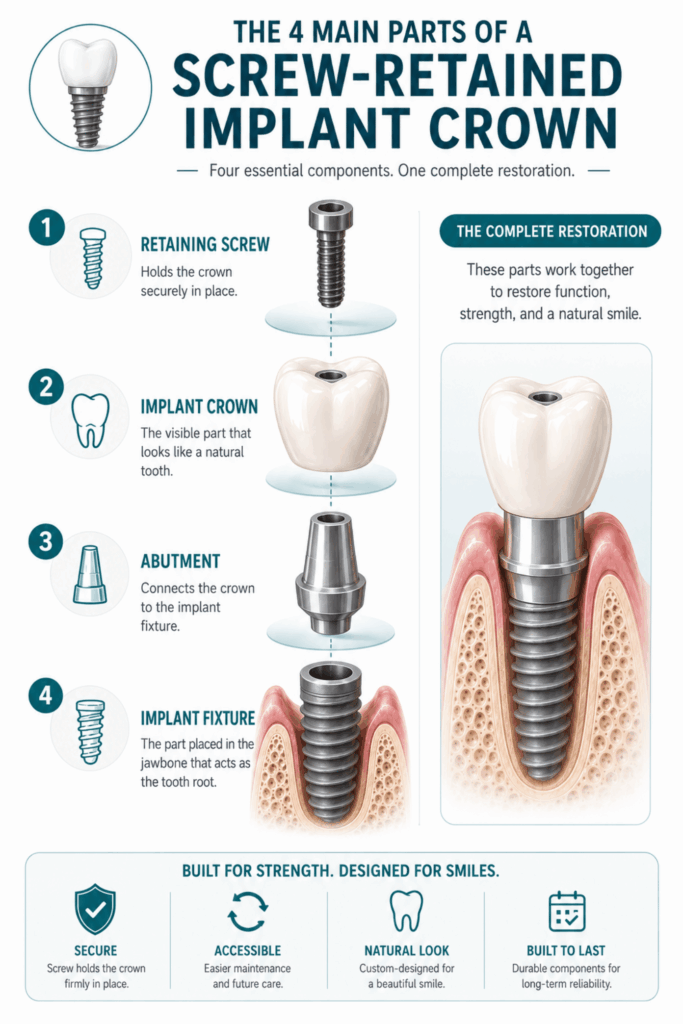
Dental Implant Fixture
The dental implant fixture is the foundation of the entire restoration. It is surgically placed into the jawbone during implant placement and becomes integrated with the bone through a process called osseointegration. Once healed, it functions much like the root of a natural tooth, supporting the implant crown during chewing and speaking.
Implant Crown
The implant crown is the visible portion of the restoration that replaces the missing tooth. It is custom-designed to match nearby teeth in shape, size, and color. Modern crown materials provide excellent strength and esthetic results, allowing the restoration to blend naturally into the smile.
Retaining Screw
The retaining screw is the component that holds the restoration securely to the implant. It passes through the screw channel and locks the crown to the implant platform. This mechanical connection allows dentists to remove the restoration later if repairs, adjustments, or maintenance become necessary.
Access Hole Filling Material
After the crown is secured, the screw access channel remains open at the top of the crown. To protect the screw and improve appearance, the access opening is sealed with a filling material that closely matches the crown color. This material can be removed later if access to the screw is needed.
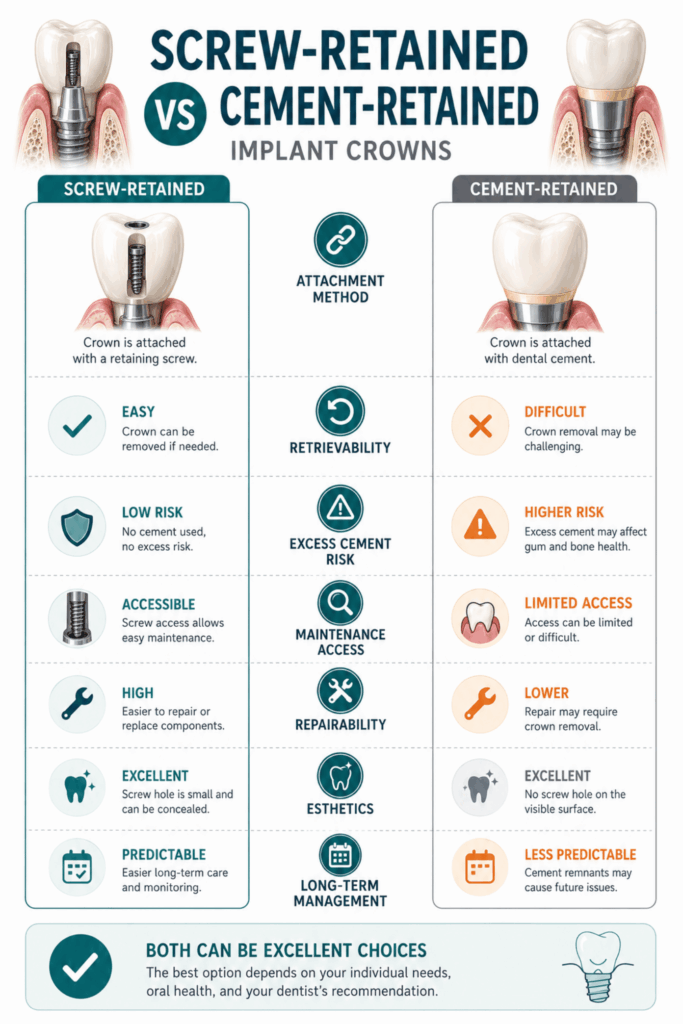
Screw-Retained vs Cement-Retained Implant Crowns
| Feature | Screw-Retained Implant Crown | Cement-Retained Implant Crown |
|---|---|---|
| Attachment Method | Secured with a screw | Cemented to the abutment |
| Retrievability | Easily removable | More difficult to remove |
| Excess Cement Risk | None | Possible |
| Maintenance Access | Excellent | Limited |
| Risk of Residual Cement | Eliminated | Present |
| Esthetics | May show a screw access hole | No access hole |
| Implant Angulation Requirements | More restrictive | More flexible |
| Long-Term Management | Often easier | Can be more challenging |
| Repairability | Typically simpler | Often more complicated |
Both options can provide excellent results when used appropriately. The choice often depends on implant angulation, implant site location, esthetic demands, and long-term maintenance considerations. Many dentists prefer screw-retained or cement-retained crowns based on the specific clinical situation rather than a one-size-fits-all approach.
Advantages of a Screw-Retained Implant Crown
Many implant dentists favor screw-retained designs because they simplify maintenance while reducing some common complications associated with cement-retained implant restorations.
- Eliminates Excess Cement: There is no implant cement that can become trapped around the implant and irritate soft tissue.
- Improves Retrievability: The restoration can be removed when repairs or adjustments are necessary.
- Simplifies Maintenance: Dentists can access the implant more easily during future treatment.
- Reduces Inflammation Risk: Eliminating residual cement may decrease the chance of inflammation around the implant.
- Supports Long-Term Management: Future restorative modifications are often easier to perform.
- Improves Diagnostic Access: The restoration can be removed to evaluate underlying structures when needed.
- Provides Predictable Seating: The crown is mechanically secured rather than relying on cement placement.
Potential Disadvantages and Limitations
Despite their advantages, screw-retained implant crowns are not ideal for every implant case. Certain design and placement factors can influence whether this approach is appropriate.
- Visible Access Hole: The screw access hole may affect esthetic outcomes in highly visible anterior teeth.
- Implant Angulation Challenges: The long axis of the implant must allow proper positioning of the screw channel.
- Risk of Screw Loosening: Mechanical components can occasionally loosen over time.
- Technical Complexity: Planning and fabrication may be more demanding.
- Limited Use in Some Cases: Certain implant positions may favor a cement-retained restoration instead.
- Access Channel Placement Issues: Poorly positioned screw access channels can affect appearance or function.
- Higher Precision Requirements: Accurate implant placement is often more important for successful outcomes.
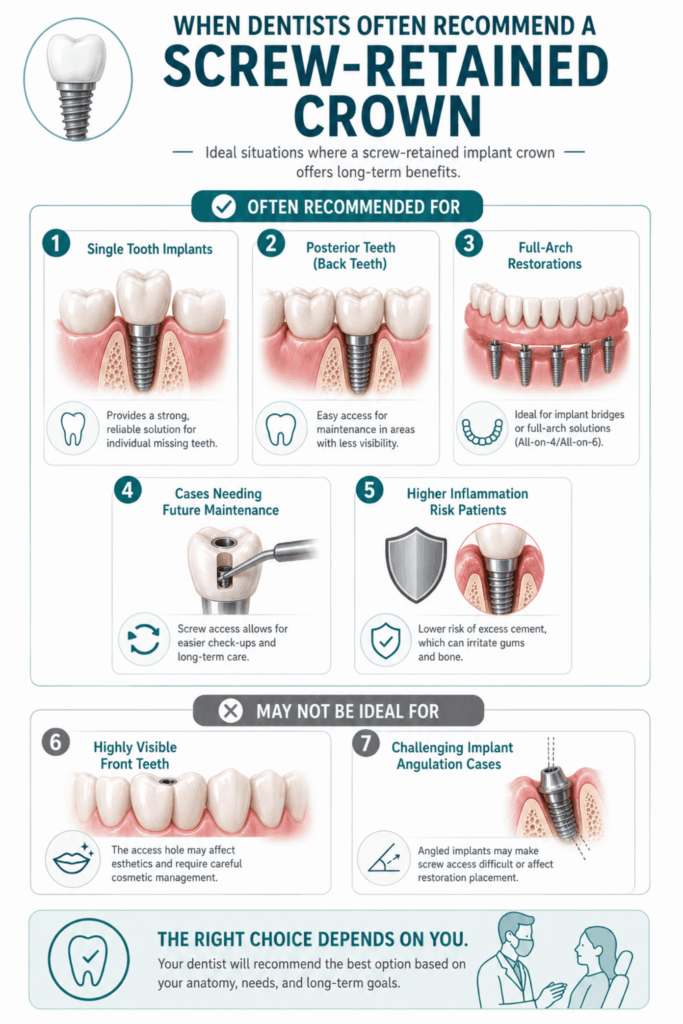
When Is a Screw-Retained Implant Crown Recommended?
Treatment recommendations vary because every patient has unique anatomy, esthetic goals, and restorative needs. In many situations, a screw-retained restoration offers important clinical advantages.
- Single Tooth Implants: Commonly used for single crowns where maintenance access is important.
- Posterior Teeth: Often ideal for back teeth where the access opening is less visible.
- Patients at Higher Risk of Inflammation: Eliminating retained cement may benefit peri-implant tissue health.
- Complex Implant Cases: Helpful when future retrievability is expected.
- Full-Arch Restorations: Frequently used in screw-retained full-arch implant prostheses.
- Cases Requiring Easy Repairs: Allows future maintenance without damaging the restoration.
- Long-Term Restorative Planning: Preferred when ongoing access may be beneficial.
The Screw-Retained Implant Crown Procedure Step by Step
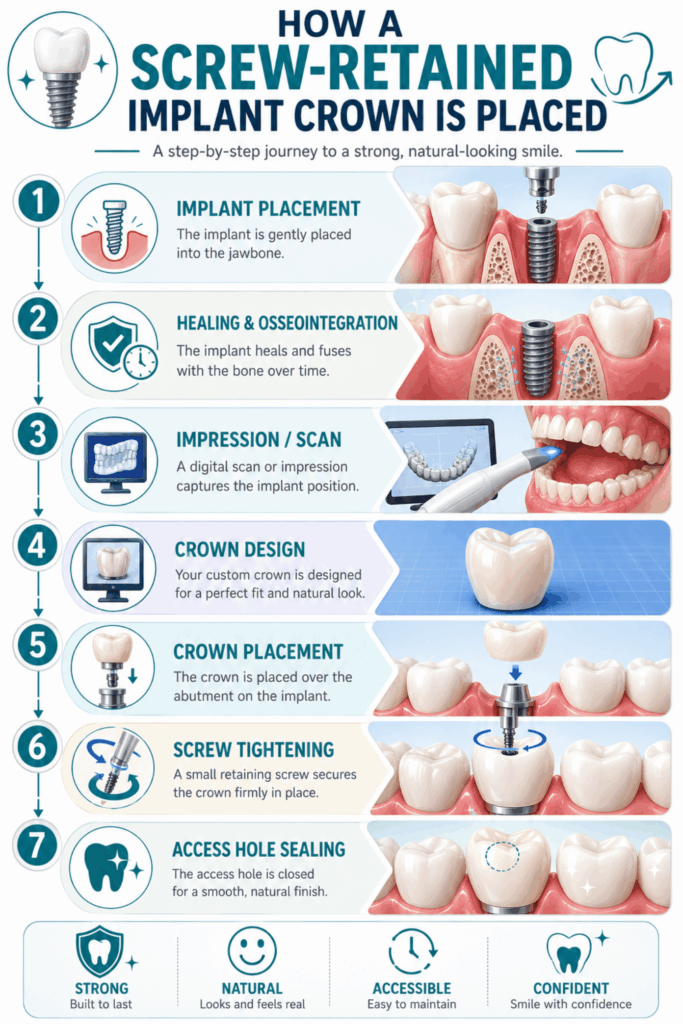
The process involves several stages, beginning with implant placement and ending with final crown delivery. Understanding each step can help patients feel more confident about treatment.
- Implant Placement: The implant fixture is surgically inserted into the jawbone.
- Healing Period: Bone integrates with the implant through osseointegration.
- Implant Impression Collection: Records the exact implant position.
- Crown Design and Fabrication: The final restoration is created in the laboratory.
- Crown Placement: The crown is positioned over the implant.
- Screw Tightening: The retaining screw secures the restoration.
- Access Hole Sealing: The screw access opening is covered with filling material.
Implant Placement and Healing
During implant placement, the titanium implant is inserted into the jawbone at the implant site. Over the following months, the bone grows around the implant in a process called osseointegration. A healing abutment may be placed temporarily to help shape the surrounding soft tissue while healing occurs.
Digital or Traditional Impressions
After healing is complete, implant impressions are taken to record the precise location and orientation of the implant. Many dentists now use digital scanners, while others use traditional impression materials. Both methods help ensure the final restoration fits accurately.
Crown Fabrication
Using the impression data, the dental laboratory designs the final restoration. Modern implant technology allows highly precise fabrication using digital workflows and advanced crown materials. The goal is to create a restoration that functions comfortably and looks natural.
Crown Placement and Screw Tightening
At the delivery appointment, the crown is positioned on the implant and secured using the retaining screw. The screw is tightened to a specific torque recommended by the implant manufacturer. After verification of fit, bite, and esthetics, the screw access hole is sealed with a restorative filling material.
How Long Does a Screw-Retained Implant Crown Last?
A well-made screw-retained implant crown can often last 10 to 15 years or longer. In many cases, the implant itself lasts even longer when proper oral hygiene and maintenance are maintained. The longevity of the crown depends on material selection, bite forces, and daily care habits.
Several factors influence lifespan. Patients who grind their teeth, miss maintenance visits, or neglect oral hygiene may experience complications sooner. Regular professional evaluations allow dentists to detect minor issues before they become larger restorative problems, helping extend the life of both the crown and the implant.
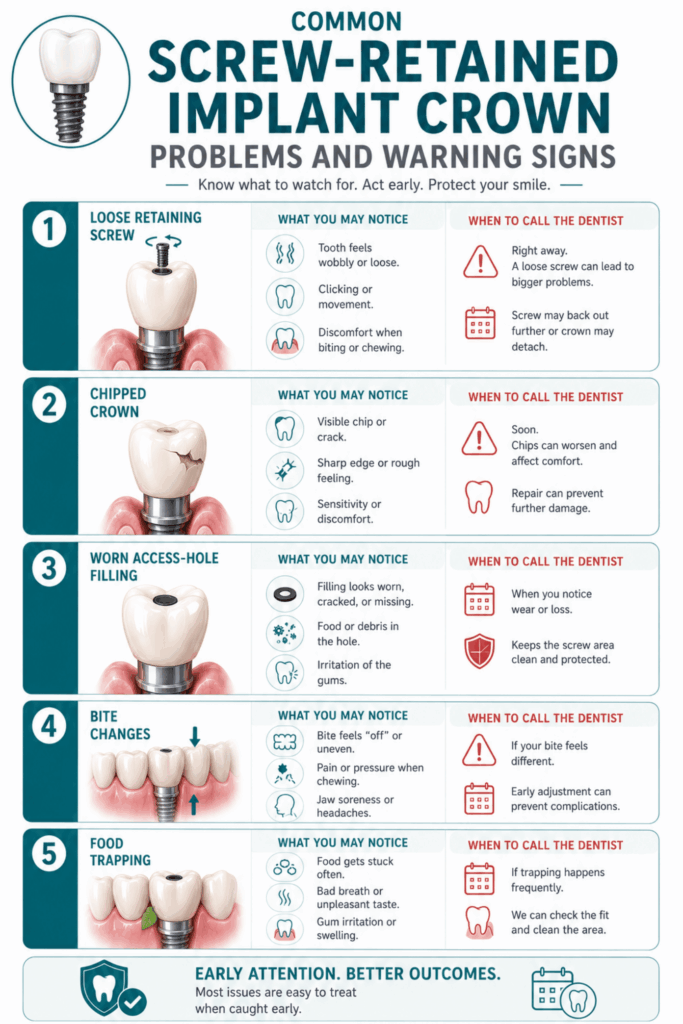
Common Problems With Screw-Retained Implant Crowns
Most screw-retained implant restorations function successfully for many years. However, like any dental restoration, they can occasionally develop mechanical or restorative complications.
- Loose Retaining Screw: May affect crown stability and chewing comfort.
- Chipped Crown Material: Can occur from excessive bite forces or trauma.
- Access Hole Filling Wear: The sealing material may deteriorate over time.
- Bite Changes: Uneven forces can place stress on restorative components.
- Component Wear: Mechanical parts may require periodic maintenance.
- Food Trapping: Some patients notice food accumulation around the restoration.
Loose Retaining Screw
Screw loosening can result from heavy bite forces, grinding habits, or repeated mechanical stress. Patients may notice slight movement, unusual sensations during chewing, or a clicking feeling. Treatment typically involves removing the access filling, tightening or replacing the screw, and verifying proper bite alignment.
Chipped Crown Material
Porcelain or other crown materials can occasionally chip due to trauma, accidents, or excessive chewing forces. Minor chips may be polished or repaired, while larger fractures may require crown replacement. The treatment depends on the extent and location of the damage.
Wear of the Access Hole Filling
The filling material used to block the screw access opening can gradually wear down from chewing forces. When this occurs, the material can often be replaced quickly during a routine dental visit. Replacing worn material helps maintain both appearance and protection of the underlying screw.
Caring for a Screw-Retained Implant Crown
Good home care and regular dental visits play a major role in long-term success. While implants cannot develop cavities, the surrounding tissues still require proper maintenance.
- Brush Twice Daily: Remove plaque around the implant and neighboring teeth.
- Clean Between Teeth: Use floss or interdental brushes as recommended.
- Attend Maintenance Visits: Regular examinations help identify early problems.
- Protect Against Grinding: Wear a nightguard if recommended by your dentist.
- Avoid Excessive Force: Do not use teeth to open packages or bite hard objects.
- Monitor Changes: Report unusual movement, discomfort, or wear promptly.
- Maintain Overall Oral Health: Healthy gums support long-term implant success.
When Should You Contact Your Dentist?
Many implant crown issues are minor when addressed early. Waiting too long can allow small problems to become more complicated and expensive to correct.
- Crown Feels Loose: Any movement should be evaluated promptly.
- Pain During Chewing: May indicate bite problems or mechanical complications.
- Visible Screw Access Changes: Worn filling material may need replacement.
- Chipped or Cracked Crown: Early repair can prevent additional damage.
- Swelling Around the Implant: Could indicate irritation or inflammation.
- Difficulty Cleaning the Area: May signal changes around the restoration.
- Unusual Sounds or Movement: Clicking sensations often require evaluation.
Frequently Asked Questions About Screw-Retained Implant Crowns
Can a Screw-Retained Implant Crown Be Removed?
Yes. One of the main advantages of screw-retained crowns is that dentists can remove them when maintenance, repairs, or adjustments are necessary.
Is the Screw Hole Visible?
Usually, the screw access hole is covered with a tooth-colored filling material. In many cases, it is difficult to notice during normal conversation.
Can the Screw Become Loose?
Yes. Although uncommon, screw loosening can occur over time. Regular dental visits help identify and correct the issue before it causes larger problems.
Is a Screw-Retained Crown Better Than a Cement-Retained Crown?
Neither option is universally better. The ideal choice depends on implant position, esthetic requirements, maintenance considerations, and individual clinical factors.
How Much Maintenance Does a Screw-Retained Implant Crown Need?
Maintenance is similar to caring for other implant restorations. Daily cleaning and routine professional checkups are usually sufficient to maintain long-term function.
Key Takeaways About Screw-Retained Implant Crowns
A screw-retained implant crown is a restoration that attaches directly to a dental implant using a retaining screw rather than cement. This design eliminates the risk of excess cement around the implant while providing excellent retrievability for maintenance, repairs, and long-term management. For many patients, these benefits make screw-retained implant restorations an attractive treatment option.
Although screw-retained crowns offer important advantages, they are not ideal for every situation. Factors such as implant angulation, esthetic demands, and restorative goals influence treatment selection. By understanding how these restorations work and maintaining regular dental care, patients can enjoy predictable function, comfort, and long-lasting results.
