If your dentist has recommended a bone graft during wisdom tooth removal, you may wonder whether you truly need another procedure. Bone grafting for wisdom teeth is not routine for every patient. Most extraction sites can heal on their own, but a graft may help when surgery leaves a large bone defect or the nearby second molar needs extra support.
Your need depends on the tooth’s position, existing bone loss, gum health, age, and whether a cyst or infection has damaged the area. An exam and dental images help the surgeon judge these factors. A recommendation should be based on your anatomy and risks, not simply on the fact that a wisdom tooth is being removed.
Before you agree or decline, ask what problem the graft is meant to solve and what may happen without it. It also helps to understand the material used, added cost, possible risks, and recovery. The first step is knowing what bone grafting does and why wisdom tooth sockets often heal without it.
What Is Bone Grafting for Wisdom Teeth?
Bone grafting for wisdom teeth means placing bone graft material into or beside the extraction socket after removing a third molar. The material acts as a scaffold. It holds space while blood vessels, healing cells, and new bone grow through the area. Depending on the defect, the surgeon may also cover the graft with a collagen membrane.
This is different from routine socket preservation before a dental implant. A missing wisdom tooth usually does not need to be replaced, so implant placement is rarely the reason for grafting this area. Instead, the goal is usually to repair a significant defect or protect the jawbone and gum attachment behind the neighboring second molar.
Is Bone Grafting After Wisdom Teeth Removal Usually Necessary?
No. Most patients do not automatically need a bone graft after wisdom tooth removal. According to the AAOMS clinical paper on bone grafting after impacted third-molar removal, grafting should be considered selectively when the extraction leaves a meaningful bone or soft-tissue defect. The condition of the second molar is often more important than the empty wisdom tooth socket itself.
When the Socket May Heal Naturally
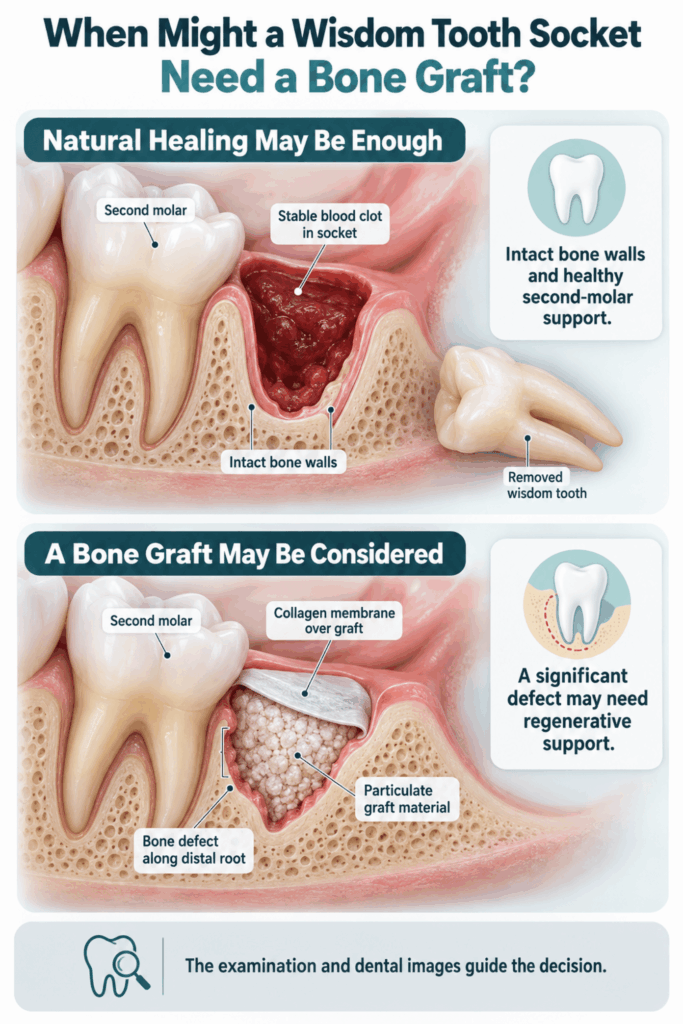
After a tooth extraction, the socket first fills with blood. A stable clot forms, soft tissue begins covering the area, and the jaw gradually replaces much of the socket with natural bone. This process can work well when the bony walls remain healthy and the extraction has not left a large defect.
Natural healing may be reasonable when there is no major bone loss, cyst, destructive infection, or deep periodontal defect behind the second molar. Because patients rarely place a dental implant where a wisdom tooth was removed, preserving every part of the ridge is not usually necessary in an uncomplicated site.
When a Bone Graft May Be Considered
Bone grafting may be worthwhile when the surgeon expects natural healing to leave a persistent defect. Having impacted wisdom teeth does not prove that grafting is necessary; the recommendation should address a specific clinical problem.
Situations that may support grafting include:
- A Large Bone Defect: Deep impaction or extensive bone removal may leave an area that is less predictable to heal fully on its own.
- Bone Loss Behind the Second Molar: A graft may help support bone regeneration when the wisdom tooth has damaged the bone and gum attachment on the back of the tooth in front of it.
- A Cyst or Other Lesion: Removing a cyst with the tooth can leave a larger bony space that may require reconstruction.
- Damage From Chronic Disease: Long-standing infection or periodontal disease may destroy part of the surrounding jawbone. The surgeon must first decide whether the site can be cleaned well enough for immediate graft placement.
- An Unstable Second Molar: A severe defect may reduce support around the neighboring tooth and increase its risk of future gum problems.
- Higher-Risk Anatomy: Patient age, a deep horizontal or forward-leaning impaction, root damage to the second molar, and the size of the existing defect may influence the decision.
Why the Bone Behind the Second Molar Matters
A lower wisdom tooth sits directly behind the second molar. When it leans forward or remains deeply impacted, the two teeth may share a broad contact area. Plaque, inflammation, root resorption, or bone loss can then develop along the back surface of the second molar.
Removing the wisdom tooth eliminates the source of pressure or disease, but it can reveal a defect that was already present. In some cases, surgery also leaves the area with limited bone walls to guide natural bone growth. A 2025 overview of systematic reviews on periodontal defects after lower third-molar surgery found that regenerative treatments can improve some second-molar outcomes, although the evidence varies between techniques and patient groups.
A simple way to picture the area is:
- The second molar is the tooth that must remain healthy and functional.
- The wisdom tooth occupies the space immediately behind it.
- The important defect is often along the back root surface of the second molar.
- The graft is placed to support healing in that defect, not to replace the extracted wisdom tooth.
How Your Dentist Decides Whether You Need a Bone Graft
The decision should combine your examination, dental history, and images. A dentist or oral surgeon should be able to show you the problem the graft is intended to treat rather than recommending it only because a wisdom tooth is being extracted.
The assessment may include:
- Tooth Position: A deep horizontal or mesioangular wisdom tooth may create a larger contact area and defect behind the second molar.
- Existing Bone Levels: The dentist looks for bone loss around both teeth before surgery. A large pre-existing defect may be more important than the size of the final socket.
- Gum Measurements: Deep periodontal pockets or loss of gum attachment behind the second molar may indicate reduced support.
- Root Condition: The dentist checks the second molar for decay, root resorption, mobility, or other damage that could affect its long-term outlook.
- Cysts and Infection: Images and the clinical exam help identify disease that has replaced or destroyed healthy bone.
- Socket Anatomy: After extraction, the surgeon can directly inspect the remaining bone walls and decide whether the site can contain and protect graft material.
- Health and Healing Factors: Smoking, poorly controlled diabetes, certain medications, immune problems, and previous healing difficulties may change the expected benefit and risk.
- Appropriate Imaging: A panoramic or intraoral X-ray is often enough for the first assessment. CBCT provides three-dimensional detail but should answer a specific question that ordinary images cannot. The 2026 ADA and AAOMR dental-imaging recommendations support choosing images according to the individual examination and clinical need rather than ordering CBCT routinely.
What Happens During Wisdom Tooth Removal and Bone Grafting?
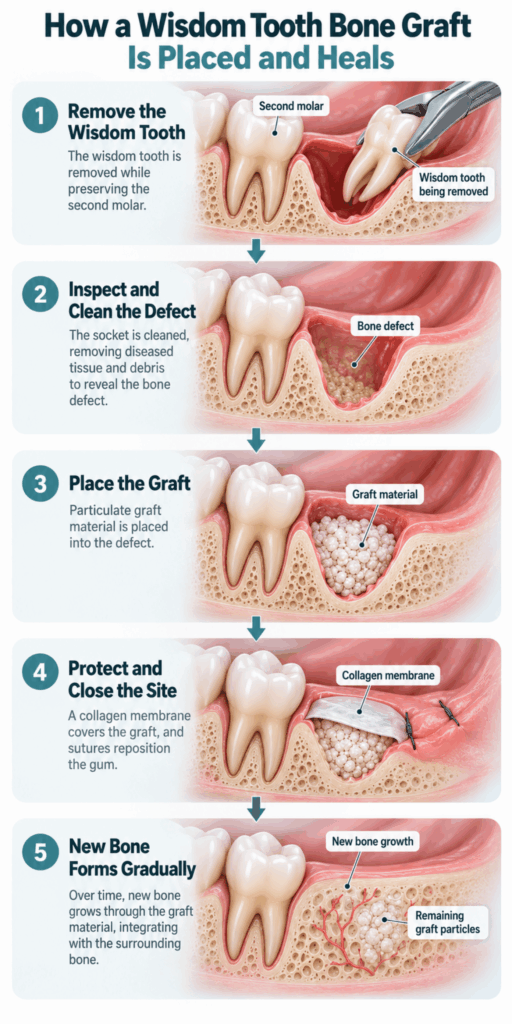
When grafting is planned, the surgeon usually places the material during the same visit as the extraction. The exact grafting procedure depends on the tooth’s position, the size of the defect, and the remaining bone walls.
- The Area Is Numbed: The surgeon uses local anesthesia and any planned sedation before starting the oral surgery.
- The Wisdom Tooth Is Removed: The gum may be opened, and a small amount of bone may be removed to reach an impacted tooth. The surgeon may divide the tooth into sections so it can be extracted with less pressure.
- The Socket Is Inspected and Cleaned: Inflamed tissue, cyst lining, or loose debris is removed. The surgeon checks the bone behind the second molar and confirms whether grafting is still appropriate.
- The Graft Material Is Placed: Small particles or another graft form are positioned in the defect. The material should support the healing space without being packed so tightly that it interferes with blood supply.
- A Membrane May Be Added: A collagen or synthetic membrane can help contain the particles and limit soft tissue from growing into the bony defect too quickly. Not every graft needs one.
- The Gum Is Repositioned: The surgeon closes the area with sutures when appropriate. Complete coverage may not always be possible in a third-molar site.
The graft does not become live bone immediately. It first serves as a framework. Your body gradually forms blood vessels and new bone around it, while some graft materials slowly break down or become incorporated into the healing jaw.
Which Materials Are Used in Bone Grafting for Wisdom Teeth?
Dental bone grafting can use natural tissue, processed donor material, animal-derived material, or a synthetic bone substitute. The review of bone grafts used in dental and oral surgery explains that each material behaves differently, so there is no single best choice for every defect.
| Graft Material | Source | Main Advantage | Main Limitation | Second Surgical Site? |
|---|---|---|---|---|
| Autograft | The patient’s own bone, sometimes taken from a nearby jaw area or another donor site | Contains natural bone-forming cells and growth factors | Adds surgery and may cause discomfort at the donor site | Usually |
| Allograft | Processed human donor bone from a regulated tissue bank | Avoids harvesting bone from the patient | Acts mainly as a scaffold and depends on processing and product type | No |
| Xenograft | Processed animal-derived material, often bovine or porcine | Maintains space well and resorbs slowly | May remain in the area for a long time and may not suit every patient’s preferences | No |
| Alloplast | Synthetic material such as calcium phosphate or hydroxyapatite | No human or animal donor tissue is used | Bone replacement and resorption can vary by product | No |
| Tooth-Derived Graft | Processed dentin from an extracted tooth | Reuses the patient’s mineralized tooth structure | Requires special processing and has less evidence for wisdom tooth defects than established materials | No separate donor site |
For a small posterior defect, the surgeon may use one material or combine it with locally collected bone. Large ridge augmentation procedures may need more autogenous bone, but this is different from the minor grafting procedures usually considered after wisdom tooth removal.
Collagen membranes and platelet concentrates are not bone substitutes by themselves. A membrane protects the healing space, while platelet concentrates provide a fibrin matrix and growth factors. Neither should automatically be presented as a replacement for a bone graft.
What Are the Potential Benefits and Limitations?
Bone grafting may improve healing in a selected defect, but it is not an upgrade that every wisdom tooth patient needs. Its value depends on whether the procedure addresses a real bone or periodontal problem.
Potential Benefits in Selected Cases
Possible benefits include:
- Supporting Bone Regeneration: The graft can provide a scaffold that helps new bone grow through a large or poorly contained defect.
- Preserving the Second Molar: Regenerative treatment may improve bone height, gum attachment, or probing depth behind the neighboring tooth in selected high-risk cases.
- Filling a Pathologic Defect: A graft may help restore bone after the removal of a cyst or another lesion, provided the site is suitable for graft placement.
- Maintaining the Shape of the Ridge: Graft material can reduce collapse in a damaged part of the jaw when maintaining bone width has a clear treatment purpose.
- Supporting Later Treatment: In an unusual case where later reconstruction or implant treatment is planned nearby, preserving bone may make future treatment more predictable.
The amount of improvement can differ between patients. Studies use different graft materials, membranes, surgical methods, follow-up periods, and definitions of success. This makes it difficult to promise one result for every wisdom tooth socket.
What a Bone Graft Cannot Guarantee
A graft cannot guarantee complete bone regeneration, perfect gum attachment, or lifelong health of the second molar. It also cannot correct decay, root damage, or advanced periodontal disease that has already made the neighboring tooth hopeless.
Successful bone growth still depends on blood supply, stable graft placement, wound protection, and the patient’s ability to heal. Infection, smoking, uncontrolled medical problems, movement of the graft, or poor soft-tissue coverage can make the result less predictable.
Does a Bone Graft Prevent Dry Socket?
A bone graft is not a guaranteed way to prevent dry socket. Dry socket, or alveolar osteitis, develops when the protective blood clot breaks down or disappears before the extraction site has progressed through early healing. Graft material serves as a scaffold for bone regeneration, but it does not remove the need for a stable clot.
Some studies of materials placed inside lower wisdom tooth sockets have reported fewer cases of dry socket. However, these studies evaluate different products and techniques, and the results should not be applied to every conventional bone graft. The Cochrane review of local methods used to prevent and manage dry socket shows that the evidence varies by intervention and is not a reason to prescribe routine grafting solely for dry-socket prevention.
Patients still need to protect the clot. Avoid smoking, forceful spitting, vigorous rinsing, and other actions your surgeon says could disturb the surgical site.
What Are the Risks of Bone Grafting for Wisdom Teeth?
Bone grafting is generally well tolerated, but it adds material and surgical steps to the extraction. Expected postoperative effects should improve as healing progresses. A complication is more likely when symptoms become severe, start worsening after improvement, or do not follow the pattern your surgeon described.
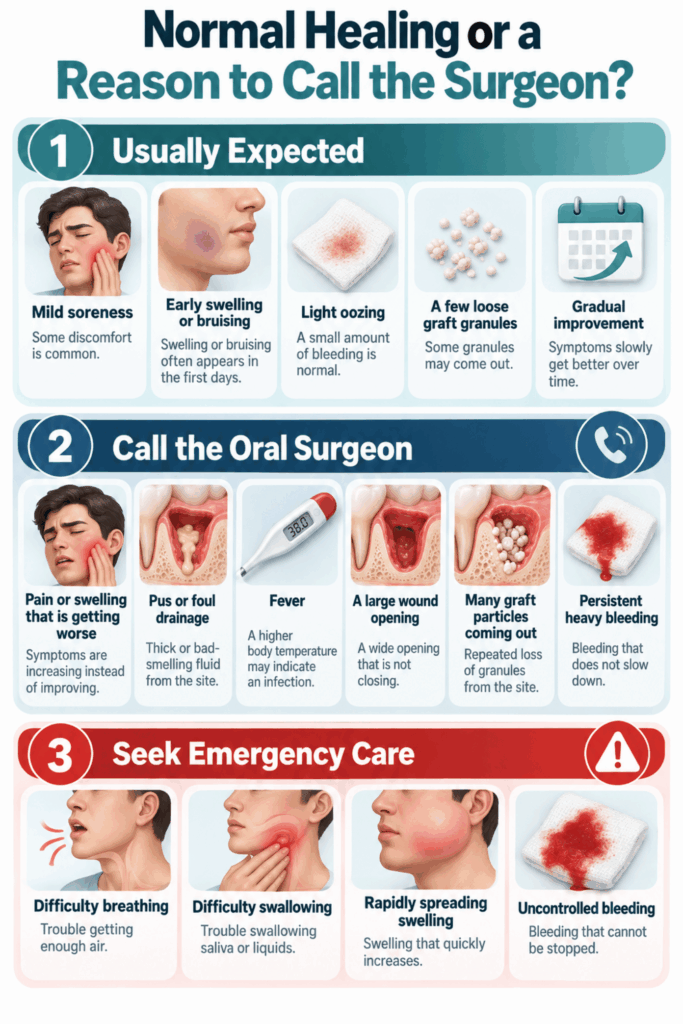
Expected effects can include:
- Soreness: The extraction and surrounding tissue may feel tender after the anesthetic wears off.
- Swelling: Temporary swelling can occur from the extraction, graft placement, or both.
- Minor Bleeding: Light oozing may occur early in recovery.
- Bruising and Jaw Stiffness: These effects relate mainly to the extent of surgery and tissue handling.
- A Few Loose Particles: Small granules may occasionally reach the mouth during early healing. This does not always mean the entire graft has failed.
Contact the surgeon about:
- Increasing Pain or Swelling: Symptoms that worsen instead of improving may need an examination.
- Pus or Foul Drainage: These findings can suggest infection.
- Persistent Heavy Bleeding: Bleeding that does not respond to the surgeon’s instructions requires prompt advice.
- Wound Opening: A wide opening may expose or release graft material and needs professional evaluation.
- Large Amounts of Lost Material: Significant graft loss may reduce stability or indicate that the site has opened.
- Poor Graft Integration: In some cases, the material does not support the planned bone growth and may require monitoring, removal, or another procedure.
- Donor-Site Problems: An autograft can cause added pain, bleeding, or other complications where the patient’s own bone was collected.
What Is Recovery Like After a Wisdom Tooth Bone Graft?
The gum and deeper jawbone do not heal at the same speed. Soft tissue can begin closing over the site while bone regeneration continues for several months. Healing time depends on the graft size, remaining bone walls, material, surgical complexity, oral health, smoking, and medical conditions.
The Cleveland Clinic’s medically reviewed guidance on dental bone-graft recovery distinguishes early recovery from the much longer process of graft integration. Your surgeon’s tooth extraction aftercare instructions should take priority because a small socket graft and a large reconstructive graft do not have the same recovery needs.
What You May Notice During Normal Healing
- First Day: Light bleeding or oozing, tenderness, and early swelling can occur. The area may still feel numb for several hours.
- First Few Days: Swelling, soreness, bruising, and jaw stiffness may become more noticeable before they begin to settle. These effects often come from the extraction itself.
- Early Gum Healing: Sutures may loosen or dissolve according to the material used. The surface can look white or yellow as healing tissue forms; appearance alone cannot confirm infection or graft failure.
- Occasional Graft Granules: A few particles that feel like grains of sand may escape. Contact the surgeon if you lose a large amount or the wound opens.
- Following Weeks and Months: The gum may look healed before the bone underneath has matured. Symptoms cannot confirm the amount or density of new bone, so clinical review or imaging may be needed when the result affects later treatment.
How to Protect the Graft
- Do Not Disturb the Area: Avoid touching the site with your fingers, tongue, toothbrush, or other objects during early healing.
- Control Bleeding as Directed: Use gauze with steady pressure if your surgeon recommends it. Do not keep removing the gauze to check the socket.
- Choose Soft Foods: Eat foods that require little chewing and keep hard crumbs, seeds, and sharp pieces away from the site.
- Avoid Suction and Forceful Rinsing: Do not use straws, spit forcefully, or create strong pressure inside the mouth during the restricted period.
- Clean Gently: Brush the other teeth normally but follow your surgeon’s timing and method for cleaning near the graft.
- Use Rinses Only as Directed: Your surgeon may recommend gentle salt water or a prescription rinse at a specific time. Starting too early or swishing hard can disturb the wound.
- Avoid Smoking and Vaping: Tobacco and nicotine reduce blood flow and can interfere with clot stability, soft-tissue healing, and bone regeneration.
- Take Medication Correctly: Use prescribed or recommended medication exactly as directed. Do not start leftover antibiotics or change the dose without professional advice.
- Attend Follow-Up Visits: The surgeon may need to inspect the tissue, remove sutures, monitor the second molar, or assess whether the graft remains protected.
When to Contact the Oral Surgeon
Call the surgeon promptly if you notice:
- Worsening Pain: Pain that becomes stronger after it had started improving deserves evaluation.
- Increasing Swelling: New or progressive swelling may indicate infection or another postoperative problem.
- Pus, Fever, or Foul Drainage: These findings can be associated with infection.
- Persistent Heavy Bleeding: Seek advice if pressure does not control the bleeding.
- A Large Wound Opening: Visible graft exposure or loss of many particles should be checked.
- A Strong, Persistent Bad Taste: This may come from trapped debris, drainage, or infection and should not be diagnosed at home.
Seek emergency care for difficulty breathing or swallowing, rapidly spreading swelling, uncontrolled bleeding, or other symptoms that appear life-threatening.
What Happens If You Decline the Bone Graft?
If the socket is uncomplicated, declining a graft may not cause a problem. A healthy clot and intact bone walls can often support natural healing. The gap will not remain as an empty hole forever; the gum closes, and the jaw remodels over time.
The situation differs when the surgeon has identified a large defect behind the second molar or another reason natural bone regeneration may be less predictable. Without regenerative treatment, a periodontal pocket or reduced bone support may remain. That does not mean failure is certain, but it may require closer cleaning, periodontal care, or delayed treatment.
Before deciding, ask:
- What Exact Defect Is Present? Request an explanation using your X-ray, CBCT, periodontal measurements, or surgical findings.
- Which Tooth Benefits From the Graft? Determine whether the goal is to support the second molar, repair pathology, or prepare for another treatment.
- What Is Expected Without It? Ask whether natural healing, monitoring, or delayed grafting is a reasonable option.
- How Strong Is the Evidence for My Case? Evidence from a deep lower horizontal impaction may not apply to a small upper wisdom tooth socket.
- Can the Decision Wait Until Extraction? In some cases, the surgeon can make the final choice after inspecting the defect directly.
- What Follow-Up Is Needed? If you decline, ask how the second molar and bone level will be monitored.
How Much Does Bone Grafting for Wisdom Teeth Cost?
The price varies by country, surgeon, graft material, defect size, use of a membrane, and whether grafting is performed during extraction or as a later procedure. Insurance may cover medically necessary reconstruction differently from optional socket preservation. Because prices and policies change, an itemized estimate from the surgeon and written benefit information from the insurer are more useful than a general online price.
Before treatment, ask:
- Is the Graft Fee Separate? Confirm whether the quote includes the material, membrane, sutures, imaging, and follow-up care.
- What Material Is Included? Autogenous bone, donor bone, synthetic bone, and other products can involve different costs.
- Is It Medically Necessary or Optional? Ask the surgeon to document the defect and the intended clinical benefit.
- What Will Insurance Cover? Request the procedure code and consider asking for a pre-treatment estimate.
- Could Another Option Cost Less? Natural healing, monitoring, or delayed treatment may be reasonable in some cases, but the choice must fit the defect.
- What Happens If the Graft Does Not Integrate? Ask whether repeat treatment or graft removal would create an additional charge.
Questions to Ask About Bone Grafting for Wisdom Teeth
- What Problem Are You Treating? Ask whether the graft is intended to repair bone loss, support the second molar, fill a cyst-related defect, or serve another purpose.
- Can You Show Me the Defect? Review the X-ray or scan and ask what the surgeon expects to find during extraction.
- Would the Socket Likely Heal Without Grafting? Ask how your site differs from an uncomplicated wisdom tooth socket.
- What Benefit Do You Expect? The answer should relate to your anatomy and oral health rather than a general claim that grafting always promotes healing.
- Which Graft Material Will You Use? Ask whether it comes from your own body, a human donor, an animal source, or a synthetic material.
- Will You Use a Membrane? Find out why it is needed, whether it dissolves, and whether it may require removal.
- What Are the Main Risks in My Case? Discuss infection, exposure, poor integration, healing factors, and any added donor-site risk.
- What Are My Alternatives? Options may include natural healing with follow-up, periodontal treatment, or delayed bone regeneration.
- What Could Happen If I Decline? Ask for the likely outcome, not only the worst possible outcome.
- How Will You Check Healing? Clarify when follow-up is needed and whether the second molar will require future periodontal measurements or imaging.
- What Will I Pay? Request an itemized estimate and check insurance coverage before surgery.
- Would a Second Opinion Change the Plan? A second opinion can be helpful when the reason for grafting remains unclear, the cost is substantial, or the expected benefit appears uncertain.
Frequently Asked Questions
Why Would I Need a Bone Graft If My Wisdom Tooth Will Not Be Replaced?
The graft may be intended to repair a large bone defect or support the second molar rather than prepare for a dental implant. Ask the surgeon to identify the specific area of concern. If the socket is uncomplicated and the neighboring tooth has healthy support, routine ridge preservation may offer little benefit.
Can a Bone Graft Be Placed Later After Wisdom Tooth Removal?
Yes, delayed grafting is possible in some cases. However, the surgeon may need to reopen the gum, remove unhealthy tissue, and prepare the healed bone before placing new material. Immediate placement can be simpler when a significant defect is already visible, while monitoring may be reasonable when natural healing is expected.
Can an Infected Wisdom Tooth Socket Receive a Bone Graft?
Sometimes, but the decision depends on the type and extent of infection. The surgeon must remove diseased tissue and determine whether the site can be cleaned and stabilized. An uncontrolled infection, poor soft-tissue coverage, or ongoing drainage may make delayed grafting safer and more predictable.
Do Upper Wisdom Teeth Near the Sinus Need Bone Grafting?
Not automatically. Many upper wisdom teeth lie close to the maxillary sinus and heal without grafting. If removal creates a significant opening between the mouth and sinus or leaves a large defect, the surgeon may need additional closure or reconstruction. This is different from a sinus lift performed before implant placement.
Does a Bone Graft Make Wisdom Tooth Recovery More Painful?
A small graft does not always make recovery noticeably more painful. Discomfort often depends more on the depth of impaction, bone removal, operating time, and tissue handling. Grafting can add tenderness or swelling, especially if bone is collected from another site, but each patient’s experience differs.
Can I Have a Wisdom Tooth Bone Graft If I Smoke or Have Diabetes?
Smoking and poorly controlled diabetes can interfere with blood supply, infection control, and bone growth, making healing less predictable. They do not automatically rule out grafting, but the surgeon needs an accurate health and medication history. Improving blood sugar control and stopping tobacco use may reduce avoidable risk.
Will a Bone Graft Prevent Facial Changes After Wisdom Tooth Removal?
Removing wisdom teeth does not normally cause the face to collapse. These teeth sit at the back of the jaw and are not major supports for facial height or soft-tissue shape. A graft should treat a documented bone defect, not an unsupported claim that it is needed to preserve facial appearance.
Bottom Line: Do You Need Bone Grafting for Wisdom Teeth?
Bone grafting for wisdom teeth is not a routine requirement. Many extraction sockets heal naturally, especially when the surrounding jawbone is healthy and the neighboring second molar has good support.
A graft becomes more reasonable when the examination, periodontal measurements, images, or surgical findings reveal a specific defect that may not heal predictably on its own. Ask your dentist or oral surgeon to show you that problem and explain the expected outcome with and without grafting before you decide.
