Bleeding gums, bad breath, or teeth that look longer can make you wonder how far gum disease has progressed. The stages of periodontal disease describe the amount of damage around the teeth and how complex treatment may be. Gingivitis comes first and can usually be reversed. Once attachment and supporting bone are lost, the condition is periodontitis, which dentists classify as Stage I, II, III, or IV.
These stages do not depend on symptoms alone. Early periodontitis may cause little discomfort, while advanced disease can lead to deeper pockets, gum recession, loose or shifting teeth, and trouble chewing. A dentist determines the stage by measuring the gums, checking attachment loss, reviewing X-rays, and considering any teeth lost because of the disease.
Finding the stage matters because it guides treatment and helps estimate the risk to your teeth. Gingivitis may improve after professional cleaning and better plaque control, while periodontitis needs ongoing professional care to stop further damage. The sections below explain what changes occur at each stage, which signs you may notice, and how diagnosis and treatment differ.
What Are the Stages of Periodontal Disease?
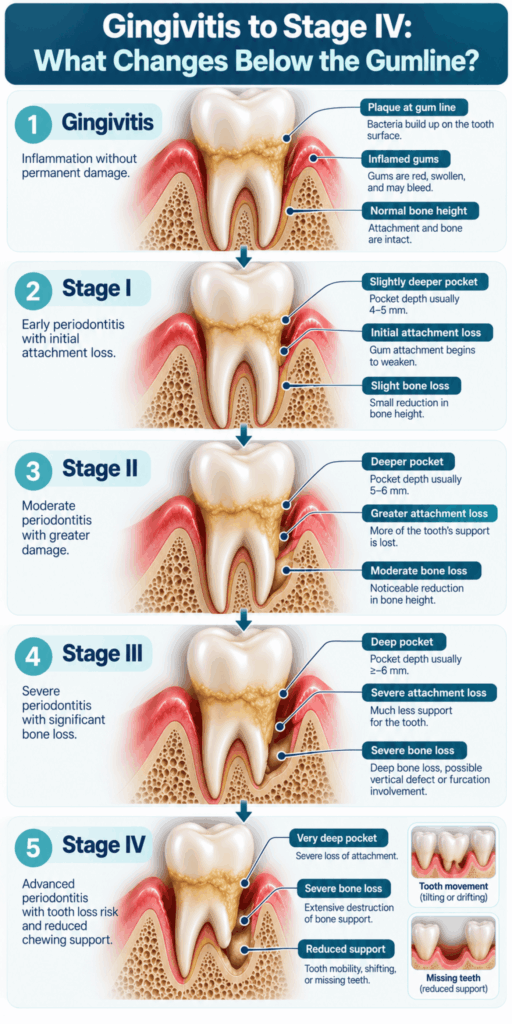
The stages of periodontal disease describe how much support around the teeth has been lost and how difficult treatment may be. Gingivitis affects the gum tissue without causing attachment or bone loss. Periodontitis begins when inflammation damages the ligament and jawbone that support the teeth.
Dentists divide periodontitis into Stages I, II, III, and IV. The following comparison simplifies the clinical criteria in the American Academy of Periodontology’s staging and grading framework.
| Condition or Stage | Main Tissue Changes | What You May Notice | General Treatment Direction |
|---|---|---|---|
| Gingivitis | Gum inflammation without attachment or bone loss | Redness, swelling, bleeding, or bad breath | Professional cleaning and improved daily plaque control |
| Stage I periodontitis | Early attachment loss and less than 15% bone loss in the upper part of the root | Mild bleeding, slight recession, or no obvious symptoms | Oral hygiene instruction, risk control, and cleaning below the gum line |
| Stage II periodontitis | Moderate attachment loss and 15%–33% bone loss in the upper third of the root | Bleeding, recession, sensitivity, or persistent bad breath | Nonsurgical periodontal treatment followed by reassessment |
| Stage III periodontitis | Severe attachment loss, deeper bone loss, and possible loss of up to four teeth from periodontitis | Deep pockets, gum recession, loose teeth, or changes in tooth position | Nonsurgical care with possible periodontal surgery or regenerative treatment |
| Stage IV periodontitis | Severe damage with extensive tooth loss or problems with chewing and bite stability | Loose or shifting teeth, difficulty chewing, bite changes, or fewer functional teeth | Disease control followed by complex rehabilitation when appropriate |
These stages do not work like a simple countdown. A person may first receive a diagnosis at any stage, and different areas of the mouth can have different levels of damage. The overall stage usually reflects the most severely affected area, along with factors that make the case harder to manage.
Why Gingivitis Is Not Stage I Periodontitis
Gingivitis is often called the first stage of gum disease in patient education. Clinically, however, it is not Stage I periodontitis. Gingivitis causes inflammation around the gum line, but the attachment and bone supporting the teeth remain intact.
Stage I periodontitis begins only after measurable attachment or bone loss has occurred. This difference matters because gingivitis can usually be reversed by removing plaque and tartar and maintaining good oral hygiene. Tissue support lost through periodontitis does not return through routine brushing, flossing, or dental cleanings.
How Stage and Grade Answer Different Questions
A complete periodontitis diagnosis may include a stage, grade, and description of how widely the disease affects the mouth.
- Stage I–IV: The stage describes the amount of existing damage, tooth loss caused by periodontitis, and the complexity of treatment.
- Grade A–C: The grade estimates how slowly or quickly the disease may progress. Grade A suggests slower progression, Grade B suggests moderate progression, and Grade C suggests faster progression or greater risk.
- Extent and Distribution: Periodontitis may be described as localized, generalized, or mainly affecting molars and incisors.
Smoking, diabetes control, previous dental records, and bone loss relative to age can influence grading. The American Dental Association’s explanation of periodontitis classification provides further detail about how stage and grade work together.
Gingivitis: Reversible Inflammation Before Periodontitis
Gingivitis develops when plaque buildup triggers an inflammatory response in the gums. The gums may swell, become tender, or bleed during brushing or flossing. Plaque that remains on the teeth can harden into tartar, which a toothbrush and floss cannot remove.
At this point, the inflammation is limited to the gums. There is no periodontitis-related attachment or jawbone loss. Professional cleaning removes hardened deposits, while daily brushing and interdental cleaning help control new plaque. Gingivitis can return if these habits stop or dental visits become irregular.
Common gingivitis findings include:
- Bleeding Gums: The gums may bleed while you brush, floss, or eat firm foods.
- Redness and Swelling: Healthy gums may become puffy, darker, or less firm around the teeth.
- Tenderness: The gum line may feel sensitive, although gingivitis can also be painless.
- Persistent Bad Breath: Bacteria and plaque around inflamed gums may contribute to an unpleasant odor or taste.
- No Attachment or Bone Loss: Gingivitis does not cause the clinical attachment loss that defines periodontitis.
Stage I Periodontitis: Early Loss of Tooth Support
Of the four periodontitis stages, Stage I represents the earliest damage caused by periodontal disease. Clinical attachment loss is generally 1–2 millimeters, and X-rays may show bone loss affecting less than 15% of the root length. Pocket depths are usually no greater than 4 millimeters, with mostly horizontal bone loss and no tooth loss caused by periodontitis.
The changes may be difficult to notice at home. The gums can bleed or recede slightly, but pain is uncommon. Early treatment focuses on controlling plaque and tartar below the gum line before more tooth support is lost.
- Damage Is Present: Stage I is different from gingivitis because the tooth has already lost some attachment or bone support.
- Symptoms May Be Mild: A person can have early periodontitis without pain, swelling, or an obviously loose tooth.
- Home Care Is Not Enough: Brushing and flossing remain essential, but they cannot remove tartar or bacterial deposits from deeper areas.
- Treatment Is Usually Nonsurgical: Care may include scaling and root planing, individualized oral hygiene instruction, and management of risks such as smoking.
Stage II Periodontitis: Moderate, Established Damage
As periodontal disease advances through its stages, Stage II periodontitis involves more established damage. Clinical attachment loss is generally 3–4 millimeters, while bone loss commonly reaches 15%–33% of the root length. Pocket depths may reach 5 millimeters, but no teeth have been lost because of periodontitis.
Some people notice gum recession, bleeding, bad breath, or sensitivity when tooth roots become exposed. However, symptoms do not always reflect the amount of damage. A person may feel little discomfort even though cleaning the periodontal pockets at home has become difficult.
- More Support Has Been Lost: The damage is greater than in Stage I, although it has not reached the severe criteria of Stage III.
- Roots May Become Exposed: Receding gums can make teeth appear longer or become sensitive to heat or cold.
- Pockets Retain More Plaque: Deeper spaces provide an area where bacteria and tartar can collect below the reach of a toothbrush.
- Treatment Requires Follow-Up: Scaling and root planing may be followed by healing checks and periodontal maintenance based on the response.
Stage III Periodontitis: Severe Damage and Risk of More Tooth Loss
Stage III periodontitis involves severe loss of attachment and supporting bone. Clinical attachment loss reaches at least 5 millimeters, and bone loss may extend into the middle or lower third of the tooth roots. Up to four teeth may already have been lost because of periodontitis.
Not every person with Stage III disease has the same findings. One or more complex features may move a case into this stage even when another measurement appears less severe.
- Deep Periodontal Pockets: Pockets may reach 6 millimeters or more, making plaque and tartar harder to remove completely.
- Vertical Bone Defects: Bone loss may form an angled defect along a tooth root rather than remaining evenly horizontal.
- Root-Division Involvement: Bone may be lost between the roots of a molar. Dentists call this area the furcation.
- Tooth Mobility: Reduced bone support may allow one or more teeth to move, although mobility is not present in every case.
- Recession and Sensitivity: Exposed tooth roots may increase gum sensitivity and make cleaning uncomfortable.
- More Complex Treatment: Some areas improve with nonsurgical treatment, while deep remaining pockets or bone defects may require periodontal surgery.
Stage III is serious, but it does not mean further tooth loss is certain. Disease control, effective oral hygiene, regular periodontal treatment, and management of risk factors can help preserve many affected teeth.
Stage IV Periodontitis: Severe Damage That Affects Function
Stage IV periodontitis combines severe tissue destruction with extensive tooth loss or problems that affect chewing and bite stability. A person may have lost five or more teeth from periodontitis, but certain complexity factors can also support a Stage IV diagnosis.
Treatment first aims to control active inflammation. Once the disease is stable, the dental team can plan how to preserve useful teeth and restore function. That plan may include periodontal, restorative, orthodontic, implant, or prosthetic care. Stage IV does not automatically mean every remaining tooth must be removed.
Clinical features may include:
- Severe Attachment and Bone Loss: Bone loss can extend into the middle or lower part of the roots.
- Extensive Periodontal Tooth Loss: Several teeth may already be missing because of advanced periodontal disease.
- Chewing Problems: Reduced support or missing teeth can make it difficult to chew comfortably.
- Marked Tooth Mobility: Some teeth may move because of severe support loss or excessive bite forces.
- Bite Changes: Teeth can drift, flare, or shift as support decreases.
- Loss of Functional Tooth Pairs: The mouth may have fewer than 20 remaining teeth or fewer opposing pairs for effective chewing.
Can Symptoms Reveal Your Periodontal Disease Stage?
Symptoms may suggest periodontal disease, but they cannot reliably distinguish its stages. Bleeding, recession, bad breath, sensitivity, and swelling can occur at more than one stage. Gingivitis may bleed heavily without bone loss, while advanced periodontitis may cause few noticeable symptoms.
Smoking can also reduce visible bleeding even when disease is present. A stage can only be assigned after the dentist combines gum measurements, attachment levels, X-rays, tooth-loss history, and treatment-complexity factors.
Symptoms that may suggest a problem include:
- Possible Gum Inflammation: Bleeding, redness, tenderness, or swelling around the gum line.
- Possible Attachment Loss: Recession, teeth that look longer, or gaps developing between the teeth.
- Possible Advanced Damage: Loose or shifting teeth, bite changes, pus, or discomfort while chewing.
Findings needed for staging include:
- Clinical Attachment Loss: The measured loss of the tissues attaching the gum to the tooth.
- Radiographic Bone Loss: Changes in supporting bone visible on appropriate dental X-rays.
- Periodontitis-Related Tooth Loss: Teeth lost from periodontal destruction rather than decay, injury, or another cause.
- Case Complexity: Deep pockets, root-division involvement, vertical defects, mobility, or loss of chewing function.
How Dentists Diagnose the Stages of Periodontal Disease
Dentists do not diagnose the stages of periodontal disease from one pocket number or X-ray. They complete a periodontal assessment and consider the findings together. The examination helps distinguish gingivitis, periodontitis, previously treated stable disease, and other conditions that can resemble periodontal damage.
Periodontal Charting and Attachment Measurements
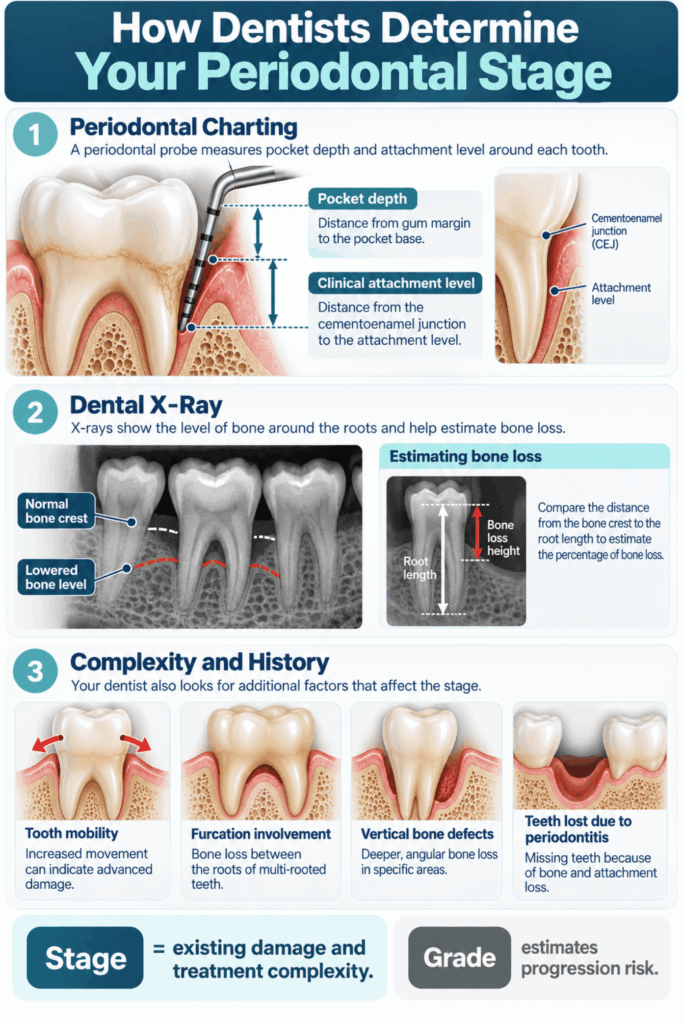
Periodontal charting records the condition of the teeth and gums at several points around each tooth. A rounded periodontal probe is placed gently beside the tooth to measure the space between the gum and root.
- Inspect the Gums: The dentist or hygienist checks for plaque, tartar, redness, swelling, recession, and pus.
- Measure Pocket Depths: The probe records the distance from the gum margin to the bottom of the pocket, usually at six sites around each tooth.
- Calculate Attachment Levels: Pocket depth is combined with the gum’s position to determine how much attachment has been lost.
- Check Bleeding: Bleeding after gentle probing helps identify current inflammation, although its absence does not rule out previous damage.
- Test Tooth Support: The examiner checks mobility and may assess bone loss between the roots of molars.
- Record the Distribution: The chart shows whether damage is limited to a few teeth or spread through the mouth.
Pocket depth and attachment loss are not the same. A swollen gum can create a deeper pocket without permanent attachment loss, while a receded gum may have attachment loss even when the measured pocket is not very deep.
Dental X-Rays and Tooth-Loss History
Dental X-rays show the height and pattern of the bone supporting the teeth. They can reveal horizontal bone loss, vertical defects, root-division involvement, and areas where clinical findings need closer evaluation. The dentist selects the type of X-ray based on the teeth and structures that need assessment.
The cause of each missing tooth also matters. A tooth removed because of decay, fracture, failed root canal treatment, injury, or orthodontic planning does not automatically count as periodontal tooth loss. Previous records and X-rays can help when the reason is uncertain.
Medical History and Periodontitis Grade
The medical and dental history helps estimate how the disease may behave. It does not replace periodontal charting or X-rays, but it adds important context when the dentist assigns a grade.
- Previous Measurements: Older charts and X-rays can show whether attachment or bone loss has changed over time.
- Bone Loss Relative to Age: More destruction than expected for a person’s age may suggest a higher progression risk.
- Smoking: Tobacco use increases periodontal risk, can mask bleeding, and may reduce the response to treatment.
- Diabetes Control: Poorly controlled diabetes can increase inflammation and influence the grade.
- Treatment History: Previous periodontal therapy, maintenance attendance, and the response to care help the dentist judge current stability.
Can Periodontal Disease Be Reversed?
Gingivitis can usually be reversed because the inflammation has not destroyed the attachment or bone supporting the teeth. Periodontitis cannot be fully reversed through routine treatment once that support has been lost. However, treatment can control inflammation, stabilize the condition, and reduce the risk of further damage.
Selected bone defects may qualify for regenerative treatment. These procedures can sometimes rebuild part of the lost support, but they cannot restore every damaged site to its original condition.
What Can Improve With Treatment?
Successful periodontal treatment can produce meaningful improvement even when all lost tissue cannot be replaced.
- Less Bleeding and Swelling: Removing bacterial deposits allows inflamed gum tissue to heal.
- Shallower, Healthier Pockets: The gums may tighten around the teeth as swelling decreases and the tissues heal.
- Better Cleaning Access: Reduced inflammation and corrected plaque-retaining areas can make daily oral hygiene more effective.
- Improved Comfort: Tenderness, bad taste, and sensitivity related to inflammation may decrease.
- Greater Stability: Controlling active disease can protect the remaining attachment and bone.
These changes represent healing and disease control. They do not mean all gum recession, attachment loss, or jawbone damage has disappeared.
Does the Stage Change After Successful Treatment?
The stage usually continues to describe the history and severity of the periodontal damage. A treated Stage III patient may become stable, but the previous attachment and bone loss still matter when planning maintenance and future dental care.
Dentists can record whether the condition is stable, in remission, or unstable after treatment. Successful regenerative treatment may improve attachment and bone measurements at selected sites, but that improvement does not automatically erase the patient’s periodontal history or guarantee a lower overall stage.
How Quickly Can Periodontal Disease Progress Through the Stages?
There is no fixed timeline for how quickly periodontal disease progresses through its stages. Damage may develop slowly over many years, remain stable for long periods, or progress more quickly at certain teeth. A person may also be diagnosed at an advanced stage because earlier disease caused few symptoms or dental visits were delayed.
Grade A, B, or C helps describe the expected rate or risk of progression. Even then, the grade is a clinical estimate rather than a promise about what will happen.
Factors that may affect progression include:
- Plaque Control: Ongoing plaque buildup and inflammation increase the opportunity for further tissue damage.
- Smoking or Tobacco Use: Tobacco increases disease risk and can interfere with healing after periodontal treatment.
- Diabetes: Poor blood sugar control can worsen periodontal inflammation and treatment response.
- Individual Susceptibility: Genetics and differences in the immune response can affect how the body reacts to plaque bacteria.
- Current Disease Activity: Bleeding, deep residual pockets, and new attachment loss may suggest that the condition is not stable.
- Maintenance Attendance: Regular dental visits allow the team to remove deposits, repeat measurements, and treat recurrence earlier.
How Treatment Changes Across Periodontal Disease Stages
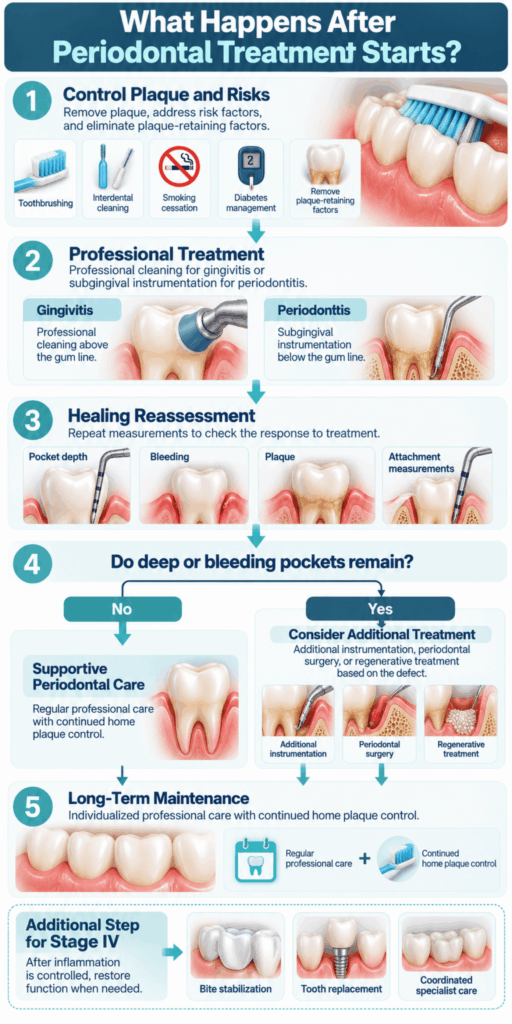
Across its stages, periodontal disease treatment follows a stepwise process. The dental team first improves daily plaque control and addresses changeable risks. It then removes plaque and tartar above and below the gums, allows time for healing, and reassesses the periodontal pockets.
Surgery or complex restorative care is considered only when needed. The European Federation of Periodontology’s guideline for treating Stages I–III supports this evidence-based sequence.
Gingivitis and Early Periodontitis
Gingivitis treatment usually begins with professional plaque and tartar removal. The dentist or hygienist also helps the patient improve brushing and interdental cleaning. A person may need to brush the teeth twice a day and use floss, an interdental brush, or another device suited to the spaces between the teeth.
Stage I periodontitis requires cleaning below the gum line because attachment loss is already present. Scaling and root planing, sometimes called a deep clean, removes deposits from the tooth roots. The tissues are then reassessed to determine whether the pockets have improved.
Moderate to Severe Periodontitis
Stage II and Stage III treatment may require several visits because more root surface and deeper areas need attention. The exact plan depends on the number of affected teeth, pocket depths, bone defects, medical history, and response to initial care.
- Improve Daily Plaque Control: The dental team demonstrates brushing and interdental cleaning methods that fit the patient’s mouth and abilities.
- Manage Risk Factors: Smoking cessation support, diabetes management, and correction of plaque-retaining dental problems may improve treatment response.
- Clean Below the Gums: Scaling and root planing or other forms of subgingival instrumentation remove bacterial deposits and tartar from the root surfaces.
- Reassess Healing: After the tissues have had time to respond, the dentist repeats pocket, bleeding, and attachment measurements.
- Treat Remaining Complex Sites: Deep residual pockets, vertical bone defects, or root-division involvement may require periodontal surgery or regenerative care.
- Begin Periodontal Maintenance: Ongoing professional care helps control plaque and monitor for recurrence.
Antibiotics are not a substitute for mechanical cleaning. A dentist may consider a local or systemic antimicrobial in selected cases, but routine use can create unnecessary side effects and contribute to antibiotic resistance.
Stage IV Periodontitis and Restoring Function
Stage IV treatment begins by controlling periodontal inflammation. Complex restorative work should not be built on teeth and gums with uncontrolled disease. The periodontal response, tooth prognosis, chewing needs, and patient preferences guide later decisions.
The European Federation of Periodontology’s Stage IV treatment guideline supports coordinated care when advanced damage affects function.
Treatment goals may include:
- Control Active Disease: Reduce inflammation and prevent further attachment and bone loss.
- Keep Treatable Teeth: Judge each tooth by its support, mobility, root anatomy, decay, fractures, and response to treatment.
- Improve Bite Stability: Manage drifting, excessive bite forces, and mobile teeth when clinically appropriate.
- Restore Chewing Function: Consider bridges, dental implants, partial dentures, or complete dentures only after evaluating periodontal stability and the remaining support.
- Coordinate Specialists: A periodontist may work with restorative dentists, prosthodontists, orthodontists, or oral surgeons when the case requires several types of care.
How to Keep Periodontal Disease Stable After Treatment
Periodontal care does not end when scaling, root planing, or surgery is complete. Bacterial plaque continues to form, and previously affected sites remain at risk. Maintenance visits allow the dental team to check bleeding, pocket depths, attachment levels, plaque control, mobility, and changes on X-rays when needed.
Recall timing should match the patient’s current risk and periodontal findings. The EFP’s supportive periodontal care guidance recommends individualized intervals ranging from 3 to 12 months after active treatment. A routine dentist-twice-a-year schedule may not be frequent enough for someone with unstable or advanced disease.
A maintenance plan may include:
- Brush Twice Daily: Use a soft toothbrush and fluoride toothpaste to clean along the gum line without aggressive scrubbing.
- Clean Between the Teeth: Use floss, interdental brushes, or another device recommended for the available spaces.
- Attend Periodontal Maintenance: These visits include more than a routine cleaning because previously affected pockets and root surfaces require monitoring.
- Avoid Tobacco: Smoking can increase progression risk, mask bleeding, and reduce healing.
- Manage Diabetes: Work with the appropriate medical professional to improve blood sugar control.
- Report New Changes: Contact the dental office if a tooth becomes loose, the bite changes, or swelling, pus, or persistent bleeding develops.
When Bleeding or Swollen Gums Need Dental Care
Bleeding gums are not always an emergency, but repeated bleeding should not be ignored. An examination can determine whether the cause is gingivitis, periodontitis, local irritation, medication, or another condition.
Seek the appropriate level of care based on your symptoms:
- Arrange a Dental Appointment: Schedule an assessment for persistent bleeding, swollen or receding gums, ongoing bad breath, root sensitivity, pus near the gum line, loose teeth, or a change in your bite.
- Seek Urgent or Emergency Help: Contact a dentist promptly for rapidly increasing swelling, significant pain, fever, pus, or feeling unwell. If swelling in the mouth or neck makes it difficult to breathe, swallow, or speak, seek emergency medical care. The NHS guidance on dental swelling and breathing or swallowing problems treats these as emergency warning signs.
Frequently Asked Questions
Can Teeth Be Saved With Advanced Periodontal Disease?
Many teeth with advanced periodontal disease can be treated, but the stage alone does not decide whether a tooth can be saved. The dentist considers remaining bone support, mobility, root involvement, decay, fractures, bite forces, and treatment response. A severely damaged tooth may need removal if it cannot be cleaned, stabilized, or used comfortably.
Can Periodontal Disease Affect Only One Tooth?
Yes. Periodontal damage may be localized around one tooth or a small group of teeth. However, an isolated deep pocket or bone defect can also result from a root fracture, dental infection, impacted tooth, or poorly fitting restoration. The dentist must evaluate the site before deciding that periodontitis is the cause.
How Long Does Periodontal Treatment Take?
The timeline depends on the disease stage, number of affected areas, and response to nonsurgical care. Scaling and root planing may require one or several visits, followed by a healing assessment. Surgery and complex restorative treatment can extend care over several months. Periodontal maintenance continues long term after active treatment ends.
Do You Need a Periodontist for Every Stage of Periodontal Disease?
No. General dentists and dental hygienists often manage gingivitis and less complex periodontitis. Referral to a periodontist may help when the diagnosis is uncertain, pockets remain deep, bone defects are complex, treatment has not controlled the disease, or periodontal surgery and advanced rehabilitation are being considered.
What Do Localized and Generalized Periodontitis Mean?
These terms describe how widely periodontitis affects the mouth. Localized disease involves less than 30% of the teeth, while generalized disease affects 30% or more. They do not describe severity or speed. A diagnosis may therefore include the extent, a Stage I–IV severity level, and a Grade A–C progression estimate.
Can Periodontal Disease Develop Around a Dental Implant?
Dental implants cannot develop periodontitis because they do not have a periodontal ligament. However, the surrounding tissues can develop peri-implant mucositis or peri-implantitis. Peri-implantitis can cause inflammation and supporting bone loss, but dentists diagnose and manage it using criteria designed specifically for dental implants.
Why Might Two Dentists Assign Different Periodontal Stages?
Differences can occur when dentists have different X-rays, attachment measurements, or information about why teeth were lost. One examiner may also identify a complexity factor that changes the stage. Ask which findings determined the diagnosis. If the difference could change major treatment decisions, an evaluation by a periodontist may help.
Bottom Line: Understanding the Periodontal Disease Stages
Gingivitis causes reversible gum inflammation, while Stages I–IV periodontitis involve increasing attachment loss, bone loss, and treatment complexity. Symptoms alone cannot show your stage, and advanced damage may remain painless. A complete periodontal examination offers the best way to identify the problem, control active disease, and protect as much natural tooth support as possible.
