An ache deep in your ear can be confusing when the back of your jaw also feels sore. Can wisdom teeth cause ear pain? Yes, sometimes. An impacted, partly erupted, inflamed, or infected wisdom tooth can send pain toward the ear, even when the ear itself is healthy.
That link does not mean every earache comes from a wisdom tooth. Ear infections, jaw joint problems, other teeth, sinus pressure, and several medical conditions can feel similar. Pain that worsens with chewing, swollen gum behind the last molar, a bad taste, or trouble opening your mouth may make a dental cause more likely, but only an examination can confirm it.
Most cases need timely care, not panic. The right next step depends on your other symptoms and what is happening around the tooth. Mild discomfort may allow time to arrange a dental visit, while increasing swelling, fever, trouble swallowing or breathing, or feeling very unwell needs faster attention. It helps to start with why wisdom tooth pain can seem to come from the ear.
Why Wisdom Teeth Can Cause Ear Pain
When wisdom teeth cause ear pain, the problem is usually not inside the ear. Pain often travels from an irritated tooth, inflamed gum, jaw muscle, or nearby joint. This is known as referred pain.
Wisdom teeth, also called third molars, are the last set of teeth to develop. They often begin to grow into the mouth during the late teens or early 20s. If there is not enough room, a wisdom tooth may remain trapped beneath the gum or emerge only partway.
Impacted or infected wisdom teeth can cause pain near the back of the jaw. That discomfort may radiate to the ear, temple, or side of the face. A clinical review of referred ear pain identifies dental disease and temporomandibular disorders as important possible causes when an ear examination appears normal.
Referred Pain From the Teeth and Jaw
The teeth, jaw, temporomandibular joint, and parts of the ear send sensory information through connected nerve pathways. Because these areas are close together, the brain may not identify the exact source of every pain signal. You may therefore feel pain near the ear even though it started in a wisdom tooth or the surrounding tissues.
Referred pain does not usually mean that the wisdom tooth has damaged your ear. It means that irritation in the jaw or gum is being felt in a nearby area.
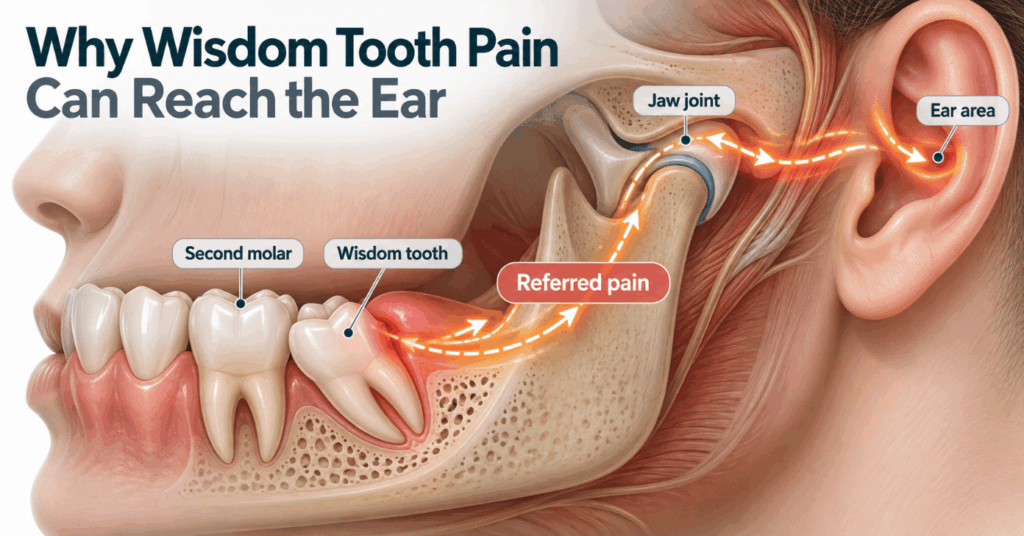
Wisdom Tooth Problems That Can Trigger Ear Pain
Wisdom teeth may cause jaw and ear pain for several reasons:
- Partial Eruption: A partly erupted tooth may leave a flap of gum over part of its crown. Food and bacteria can collect beneath this tissue, making the area difficult to clean.
- Pericoronitis: Pericoronitis is inflammation around a partly erupted tooth. It can cause gum tenderness, swelling, a bad taste, limited mouth opening, and discomfort that radiates to the ear.
- Impaction: A wisdom tooth becomes impacted when it cannot grow into a normal position. It may remain under the gum or bone, tilt toward the neighboring tooth, or emerge only partly.
- Tooth Decay: Partially erupted teeth are difficult to reach with a toothbrush and floss. Decay may affect the wisdom tooth or the adjacent second molar.
- Dental Abscess: Infection can produce a pocket of pus around a tooth or gum. Severe pain, swelling, fever, a bad taste, or feeling unwell may occur.
- Pressure on Nearby Tissues: An impacted wisdom tooth may sit against the neighboring molar or irritate the surrounding gum and bone. This can create pressure or soreness at the back of the jaw, although it does not automatically mean the tooth must be removed.
- Jaw-Muscle Tension: People often chew differently or hold their jaw stiffly when a back tooth hurts. This may strain the chewing muscles or the temporomandibular joint, also called the TMJ, which sits just in front of the ear.
Signs Your Ear Pain May Be Coming From a Wisdom Tooth
Ear discomfort is more likely to have a dental source when it appears with symptoms around the back of your mouth. However, symptoms alone cannot confirm whether the problem comes from a tooth, the TMJ, or the ear.
Signs that may point toward a wisdom tooth include:
- Pain Behind the Last Molar: You may feel soreness, pressure, or throbbing where the wisdom tooth is growing.
- Swollen or Tender Gum: The gum around a partially erupted tooth may look red, feel puffy, or hurt when touched.
- Pain While Chewing: Biting may press on inflamed gum tissue or place stress on the affected tooth.
- Limited Mouth Opening: Inflammation near a lower wisdom tooth can make it uncomfortable or difficult to open and close your mouth.
- A Bad Taste or Drainage: Fluid or pus around the tooth may indicate infection and needs dental attention.
- Bad Breath: Bacteria and trapped food beneath a gum flap may produce an unpleasant odor.
- Jaw Soreness: The jaw may feel stiff or achy, especially on the same side as the ear pain.
- Facial or Jaw Swelling: Swelling outside your cheek or along the jaw can occur with a more significant infection.
- Recurring Symptoms: Pain that settles and then returns may occur when a partly erupted tooth repeatedly traps plaque and food.
These symptoms may be signs of an impacted wisdom tooth or inflamed gum tissue, but a dental examination is needed to find the actual cause.
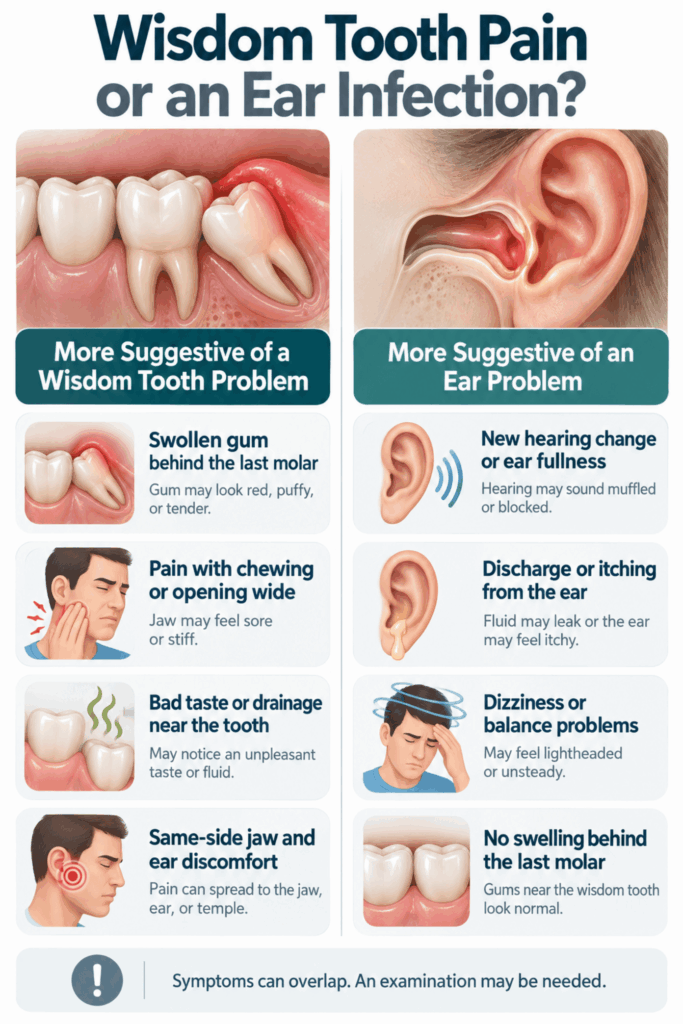
Wisdom Tooth Pain vs Ear Infection: How to Tell
Wisdom tooth pain and an actual ear infection can both produce an ache, pressure, or discomfort near the ear. The pattern of other symptoms may provide useful clues, but it cannot replace an examination.
| Feature | More Suggestive of a Wisdom Tooth Problem | More Suggestive of an Ear Infection |
|---|---|---|
| Pain location | Back of the mouth, jaw angle, gum, or nearby ear | Deeper inside the ear or around the ear canal |
| Mouth findings | Swollen gum, tooth tenderness, bad taste, or trapped food | Usually no swollen gum behind the last molar |
| Chewing and jaw movement | Pain may increase with chewing or opening wide | Jaw movement may not change the pain, although some outer ear infections can hurt during chewing |
| Hearing symptoms | True hearing changes are not typical | Fullness, reduced hearing, or muffled sound may occur |
| Ear discharge or itching | Not normally caused by a wisdom tooth | May occur with some outer or middle ear problems |
| Fever | Possible with a spreading dental infection | Possible with an ear infection |
| Dizziness or balance problems | Not typical of a wisdom tooth problem | May point toward an inner ear condition |
The NHS list of ear infection symptoms includes ear discharge, hearing difficulty, fullness, irritation, and balance problems. These findings deserve medical assessment rather than being blamed automatically on a wisdom tooth.
When Another Condition May Be Causing the Pain
A painful wisdom tooth is only one possible source of ear discomfort. Decay or infection in another molar can also radiate pain toward the ear. Temporomandibular disorders may cause jaw pain, clicking, stiffness, headaches, or an ache in front of the ear, especially when chewing.
Sinus inflammation, throat conditions, earwax, and diseases of the outer, middle, or inner ear can produce similar symptoms. Persistent ear pain with no clear dental cause may require an examination by a medical clinician or an ear, nose, and throat specialist.
How a Dentist Finds the Source of the Pain
A dentist does not diagnose a wisdom tooth problem from ear pain alone. The goal is to match your symptoms with findings from the mouth, teeth, gums, jaw, and dental images.
The assessment may include:
- Reviewing Your Symptoms: The dentist will ask where the pain began, whether it is constant or comes and goes, and whether chewing or opening your mouth makes it worse. Mention hearing changes, ear discharge, fever, swelling, or dizziness.
- Examining the Back of Your Mouth: The dentist will look for partially erupted teeth, inflamed gum tissue, trapped food, decay, drainage, and tenderness.
- Checking Nearby Teeth: A second molar or another tooth may be the true source. The dentist may test for biting tenderness, temperature sensitivity, or other signs of tooth disease.
- Assessing Your Jaw: Jaw movement, muscle tenderness, clicking, or pain near the temporomandibular joint may suggest a TMJ or muscle problem.
- Taking an X-Ray When Needed: Dental X-rays can show whether the teeth are impacted, how they are positioned, and whether a wisdom tooth has affected the adjacent tooth or surrounding bone. The NHS guidance on wisdom tooth problems and removal notes that dentists may use X-rays to evaluate wisdom tooth position.
- Recommending Medical Assessment: If the dental exam and X-rays do not explain the pain, the dentist may recommend that a physician examine the ear and other nearby structures.
How to Relieve Wisdom Tooth Ear Pain at Home
Home care may reduce mild discomfort while you arrange a dental exam, but it cannot correct impaction, remove deep decay, or cure an abscess. Avoid delaying care if the pain persists, returns, or appears with signs of infection.
Steps you can take include:
- Clean the Area Gently: Use a soft toothbrush to remove plaque and loose debris from behind the last molar. Do not force a brush or sharp object beneath painful gum tissue.
- Use a Warm Saltwater Rinse: A gentle rinse may help clean around a partly erupted tooth and soothe irritated gum. Spit it out rather than swallowing it.
- Apply a Cold Compress: Hold a wrapped cold pack against the outside of your cheek for short periods. Do not place ice directly on your skin or against the tooth.
- Choose Soft Foods: Eggs, yogurt, soup, mashed vegetables, and other soft foods require less chewing. Avoid sharp, hard, or sticky foods that can become trapped under a gum flap.
- Chew on the Other Side: Reducing pressure on the painful area may limit further irritation for a short time.
- Consider an Appropriate Pain Reliever: Ibuprofen or acetaminophen may help some people. Follow the product label and ask a dentist, physician, or pharmacist if you have medical conditions, take other medicines, are pregnant, or are unsure which option is safe. The American Dental Association’s guidance on oral pain relievers recommends nonopioid medicines as first-line options for most acute dental pain.
- Check Combination Medicines: Cold, flu, and prescription products may already contain acetaminophen. Taking more than one product with the same ingredient can lead to an accidental overdose.
- Keep Products Out of the Ear: Do not place dental remedies, oil, peroxide, or unprescribed drops in the ear. Ear discomfort from a wisdom tooth does not require treatment inside the ear.
Relief at home is temporary. Contact your dentist if the pain does not settle or if it keeps returning.
How Dentists Treat Wisdom Tooth Ear Pain
Treatment depends on what the dental exam and X-rays show. Ear pain alone is not a reason for wisdom teeth removal.
Some patients need professional cleaning around a partly erupted tooth. Others may need treatment for decay, an abscess, or damage to a neighboring molar. If an impacted wisdom tooth is healthy and not causing problems, the dentist may recommend monitoring it during routine visits.
Cleaning and Treating Inflamed Gum Tissue
For localized pericoronitis, a dentist may gently flush and clean the space beneath the gum flap. Removing trapped plaque and food reduces the source of irritation. The dentist may also check whether the opposing tooth is biting against the swollen tissue.
Good oral hygiene can help prevent more debris from collecting, but home cleaning does not always reach the entire pocket. If inflammation returns, the dentist must reassess the tooth’s position and whether there is enough room for it to erupt.
When Antibiotics May Be Needed
Antibiotics are not the main treatment for every painful wisdom tooth. Local cleaning and treatment of the cause are usually more important when inflammation remains limited to the gum around the tooth. A review of evidence-based pericoronitis treatment and antibiotic use supports local treatment first and reserving antibiotics for more severe situations.
A dentist may consider antibiotics when there are signs such as:
- Spreading Swelling: Swelling extends beyond the tissue immediately surrounding the tooth.
- Fever or Systemic Illness: The patient feels feverish, weak, or generally unwell.
- Significant Limited Mouth Opening: Increasing difficulty opening the mouth may suggest that inflammation is affecting deeper tissues.
- Swollen Lymph Nodes: Tender glands may appear under the jaw or in the neck.
- Higher Medical Risk: Some health conditions or medicines can reduce the body’s ability to control infection.
Antibiotics cannot correct an impacted tooth, remove trapped material, or drain an abscess by themselves. Do not use leftover antibiotics or another person’s prescription.
When Wisdom Tooth Removal May Be Recommended
Wisdom teeth should be removed when the expected benefit is greater than the risks of keeping them. A single mild episode does not automatically mean that extraction is necessary.
A dentist or oral surgeon may recommend wisdom teeth extraction for:
- Repeated Pericoronitis: Gum inflammation or infection keeps returning around a partly erupted tooth.
- Unrestorable Decay: The wisdom tooth has a cavity that cannot be treated predictably because of its location or condition.
- Dental Abscess: Infection has developed around the tooth or nearby gum.
- Damage to an Adjacent Tooth: The wisdom tooth’s position contributes to decay, gum disease, root damage, or bone loss around the second molar.
- Other Confirmed Disease: A cyst, severe gum problem, or another pathologic change is present.
- An Unfavorable Position: The tooth is unlikely to erupt into a useful, cleanable position and is already causing problems.
Some extractions are straightforward. Impacted wisdom teeth covered by gum or bone may require oral surgery. The dentist or oral surgeon will review the X-ray, explain the expected benefits and risks, and decide whether local anesthesia, sedation, or referral is appropriate.
How Long Does Ear Pain From a Wisdom Tooth Last?
There is no fixed timeline. Mild irritation around an erupting tooth may settle if the area can be cleaned and the gum is no longer being traumatized. Pain from decay, recurring pericoronitis, or an abscess is more likely to persist or return until the underlying problem receives dental treatment.
After treatment, referred ear discomfort should improve as inflammation in the jaw or gum decreases. Contact your dentist if pain remains unchanged, becomes severe, returns after improving, or develops with swelling, fever, drainage, or difficulty opening your mouth.
When to Seek Professional Care
A mild ache without swelling or illness may not require emergency treatment, but recurring or persistent pain deserves an examination. Waiting for severe pain can allow a treatable problem to become more difficult to manage.
Contact a Dentist Promptly
Schedule an appointment if you notice:
- Persistent or Recurring Pain: The discomfort continues, repeatedly returns, or disrupts sleep.
- Swollen Gum: Tissue around the wisdom tooth remains red, tender, or enlarged.
- A Bad Taste or Drainage: Fluid or pus appears around the back tooth.
- Pain While Biting: Chewing creates sharp pain or pressure near the wisdom tooth or adjacent molar.
- Increasing Jaw Stiffness: It is becoming harder to open your mouth normally.
- Difficulty Eating: Pain prevents you from chewing or maintaining normal food and fluid intake.
- Visible Decay or a Broken Tooth: A cavity or damaged tooth will not heal through home care.
Seek Urgent or Emergency Help
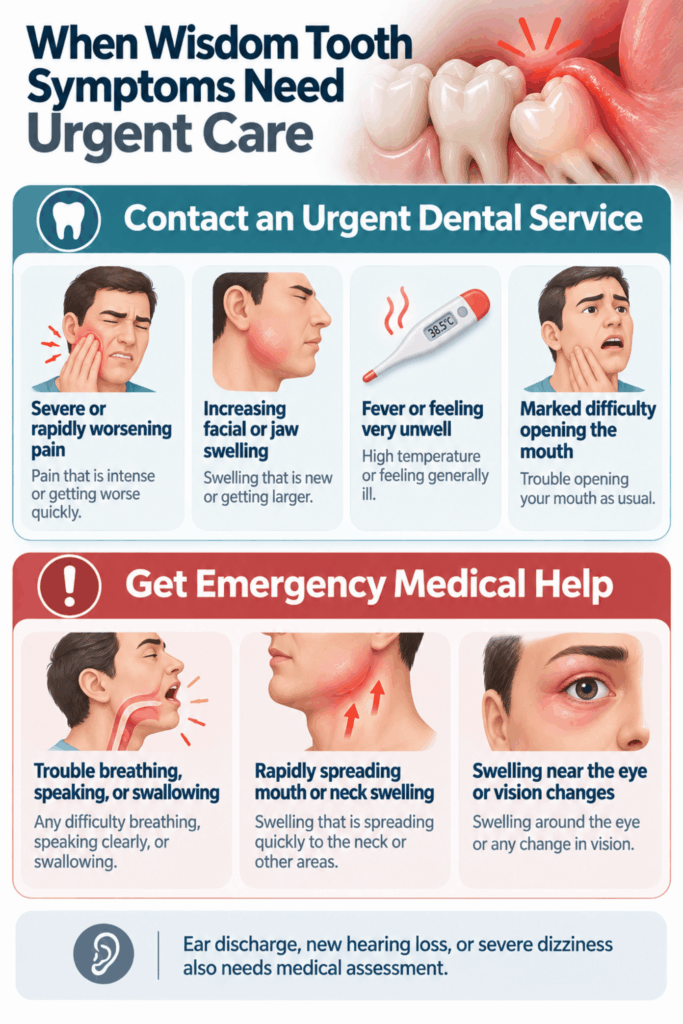
Seek urgent dental or medical care when an infection may be spreading. The NHS guidance on dental abscess symptoms and emergency signs advises urgent dental treatment for a suspected abscess and emergency help for serious swelling or difficulty breathing, speaking, or swallowing.
Contact an urgent dental service promptly for:
- Severe or Rapidly Worsening Pain: Pain becomes intense or does not respond to appropriate pain relief.
- Increasing Facial or Jaw Swelling: Swelling is spreading beyond the gum around the tooth.
- Fever or Feeling Very Unwell: These symptoms may indicate that the infection is no longer limited to one small area.
- Marked Difficulty Opening Your Mouth: Jaw movement becomes severely restricted.
Get emergency medical help for:
- Trouble Breathing, Speaking, or Swallowing: These symptoms can indicate that swelling is affecting the airway.
- Extensive Mouth or Neck Swelling: Rapidly spreading swelling needs immediate assessment.
- Swelling Near the Eye or Vision Changes: Do not wait for a routine dental appointment.
Ear discharge, new hearing loss, severe dizziness, or swelling around the ear also needs medical assessment because these symptoms are not typical of referred wisdom tooth pain.
Frequently Asked Questions
Can Wisdom Teeth Cause Ear Pain Without Tooth Pain?
Yes. Referred pain may be felt near the ear before you notice obvious tooth or gum pain. However, ear disease, TMJ problems, and other dental conditions can create the same pattern. A dentist can examine the back teeth and jaw, while a medical clinician may need to assess the ear if the dental findings do not explain the pain.
Can an Upper Wisdom Tooth Cause Ear Pain?
An upper or lower wisdom tooth can produce discomfort that radiates toward the ear. Lower wisdom teeth are often linked with inflamed gum tissue and jaw soreness, while upper teeth may cause pain toward the cheek, temple, or ear area. The location alone cannot identify which tooth is responsible, so a dental exam and X-rays may be needed.
Can Wisdom Teeth Make Your Ear Feel Blocked or Affect Hearing?
Jaw and ear discomfort may create a sense of pressure or fullness, but wisdom teeth do not usually block the ear canal or cause true hearing loss. Persistent fullness, muffled hearing, discharge, ringing, or dizziness may point to an ear condition. Arrange a medical examination instead of assuming that the wisdom tooth is responsible.
Why Do I Have Ear Pain After Wisdom Tooth Removal?
It can be normal to have mild ear pain after wisdom teeth are removed because swelling, jaw stiffness, and muscle soreness can produce referred discomfort. It should gradually improve with recovery. Contact your dentist or oral surgeon if the pain becomes severe, worsens after improving, or appears with fever, a bad taste, drainage, or increasing swelling.
Can Wisdom Tooth Ear Pain Affect Both Ears?
A problem with one wisdom tooth is more likely to cause pain on the same side of the jaw and ear. Pain in both ears is possible if jaw muscles or both temporomandibular joints are involved, but it may also come from sinus, throat, or ear conditions. Bilateral or persistent symptoms deserve a proper examination.
Bottom Line: Ear Pain Needs the Right Diagnosis
Wisdom teeth can cause referred ear pain when a tooth is impacted, partly erupted, decayed, or surrounded by inflamed or infected gum tissue. Jaw-muscle tension and the nearby TMJ can also contribute to the discomfort.
Because dental and ear conditions can feel similar, persistent or recurring pain should not be self-diagnosed. Contact your dentist when ear discomfort appears with back-tooth pain, swollen gum, a bad taste, or jaw stiffness, and seek faster care for spreading swelling, fever, or trouble swallowing or breathing.
