A headache near your temples or behind your jaw can feel linked to a sore wisdom tooth. So, can wisdom teeth cause headaches? They can contribute to head pain when eruption, impaction, inflammation, or infection causes pain that spreads from the back of the mouth. Jaw-muscle tension from guarding the area may also play a role.
Still, a headache alone does not prove that a wisdom tooth is responsible. Migraine, tension-type headache, sinus problems, teeth grinding, and jaw-joint disorders can cause similar discomfort. Dental clues are more useful when the headache appears with pain behind the last molar, swollen gum, a bad taste, trouble opening the mouth, or pain while chewing.
A dentist can examine the gum, tooth, bite, and jaw and use an X-ray when needed to look for impaction, decay, or infection. Treatment should address the actual cause; wisdom tooth removal is not an automatic headache cure. Knowing the pain pattern, related mouth symptoms, and warning signs can help you choose the right next step.
Can Wisdom Teeth Cause Headaches?
Yes, wisdom tooth problems can sometimes contribute to headaches. Pain from an impacted, inflamed, decayed, or infected wisdom tooth may spread toward the jaw, ear, cheek, or temple. Guarding the painful area or changing how you chew may also strain the jaw muscles and produce tension-like headache pain.
However, a headache alone does not show that your wisdom teeth are causing it. Healthy, symptom-free wisdom teeth are unlikely to explain recurring headaches. Even impacted wisdom teeth may remain painless and free of disease. The connection is more likely when headache pain begins or worsens with tooth pain, gum swelling, chewing discomfort, or another clear dental symptom.
How Wisdom Tooth Problems May Contribute to Head Pain
Wisdom teeth do not directly cause migraines or every headache near the jaw. When the two are connected, the likely pathways include referred pain, inflammation around the tooth, infection, or tension in the muscles used for chewing.
Referred Pain From the Back of the Mouth
A wisdom tooth can refer pain because the teeth, jaw, face, and parts of the head share branches of the trigeminal nerve. This major nerve carries sensation from these areas to the brain. As a result, your brain may not always identify the exact starting point. Pain that begins at the back of your mouth may feel as though it is coming from your ear, cheek, temple, or one side of your head.
Inflamed or Infected Tissue Around the Tooth
Partially erupted wisdom teeth can be difficult to clean. Food and bacteria may collect beneath the gum flap that covers part of the tooth, causing inflammation called pericoronitis. This often produces pain at the back of the mouth, tender gum, swelling, a bad taste, or discomfort when chewing.
Decay, inflammation inside the tooth, and a dental abscess can also cause tooth pain and headaches. These conditions are more likely to produce strong, throbbing, or persistent pain. An infected wisdom tooth may also cause facial swelling, fever, drainage, or difficulty opening the mouth. Headache without any mouth or jaw symptoms is less suggestive of a dental infection.
Jaw-Muscle Tension and Changes in Chewing
When one side of your mouth hurts, you may chew on the other side or hold your jaw differently without noticing. Clenching in response to pain can further strain the chewing muscles. Because some of these muscles extend toward the temples, that strain may feel like a dull or tight headache.
Temporomandibular disorders, or TMDs, can also cause pain in the jaw joint and chewing muscles. The National Institute of Dental and Craniofacial Research’s overview of TMD symptoms and diagnosis recognizes headaches associated with these disorders. This does not mean that an impacted tooth automatically causes TMD.
It is also important to correct a common misconception. Wisdom teeth pushing against other teeth or creating pressure on nearby teeth is not a well-established explanation for chronic headaches. Crowding, teeth out of alignment, or the mere presence of back teeth does not prove that the headache is caused by wisdom teeth.
Signs Your Headache May Be Related to a Wisdom Tooth
No single symptom can confirm a wisdom tooth headache. A dental connection becomes more plausible when the head pain follows the same pattern as pain, swelling, or tenderness around the tooth.
Your headache may be related to a wisdom tooth if:
- Matching Timing: The headache begins when wisdom tooth pain flares and improves as the dental discomfort settles.
- Chewing Trigger: Biting, chewing, or opening wide increases both the jaw pain and headache.
- One-Sided Pattern: Pain develops on the same side as an inflamed, decayed, or partially impacted wisdom tooth.
- Local Tenderness: Touching the gum behind the last molar or biting on the back tooth reproduces the discomfort.
- Recurring Dental Symptoms: Headaches appear during repeated episodes of gum swelling, bad taste, or pain at the back of the mouth.
These patterns provide clues, not a diagnosis. Migraine, tension headaches, sinus illness, teeth grinding, and jaw-joint disorders can overlap with them.
Where the Pain May Be Felt
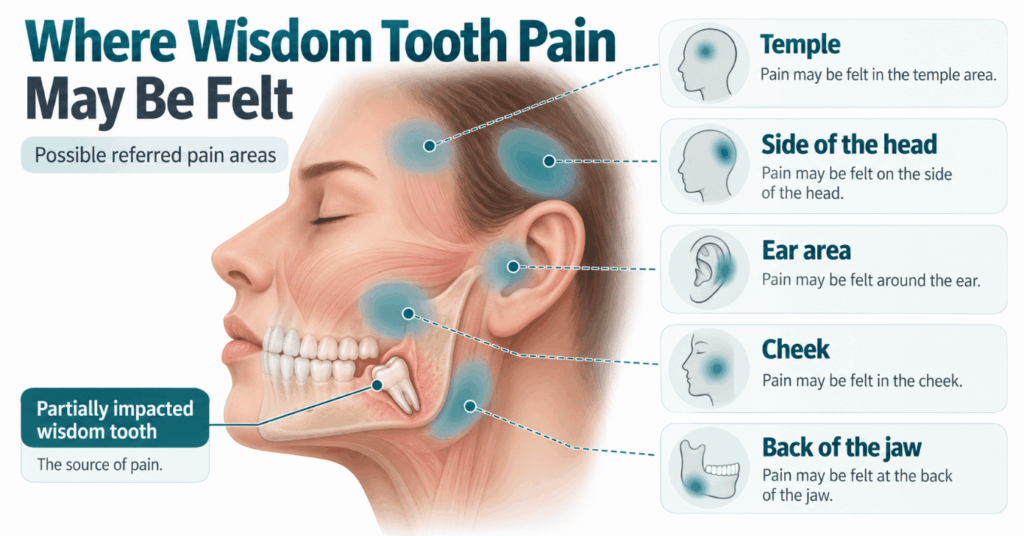
Pain related to a wisdom tooth often begins behind the last visible molar. Referred pain can make the affected area feel larger than it is.
Possible locations include:
- Back of the Jaw: This is the area closest to lower impacted wisdom teeth and partially erupted wisdom teeth.
- Ear Area: Referred dental or jaw-muscle pain can feel like ear pain even when the ear is healthy.
- Cheek or Side of the Face: Inflammation around an upper or lower wisdom tooth may produce nearby facial discomfort.
- Temple: Jaw-muscle tension or referred pain may create an ache along the side of the head.
- Upper Jaw or Beneath the Cheekbone: Upper back teeth and the maxillary sinus are close together, so symptoms from either area may feel similar.
Pain location alone cannot identify the cause. For example, temple pain may come from migraine, tension-type headache, jaw-muscle pain, or a dental problem.
Mouth and Jaw Symptoms to Check
Look for symptoms around the tooth rather than focusing only on the headache:
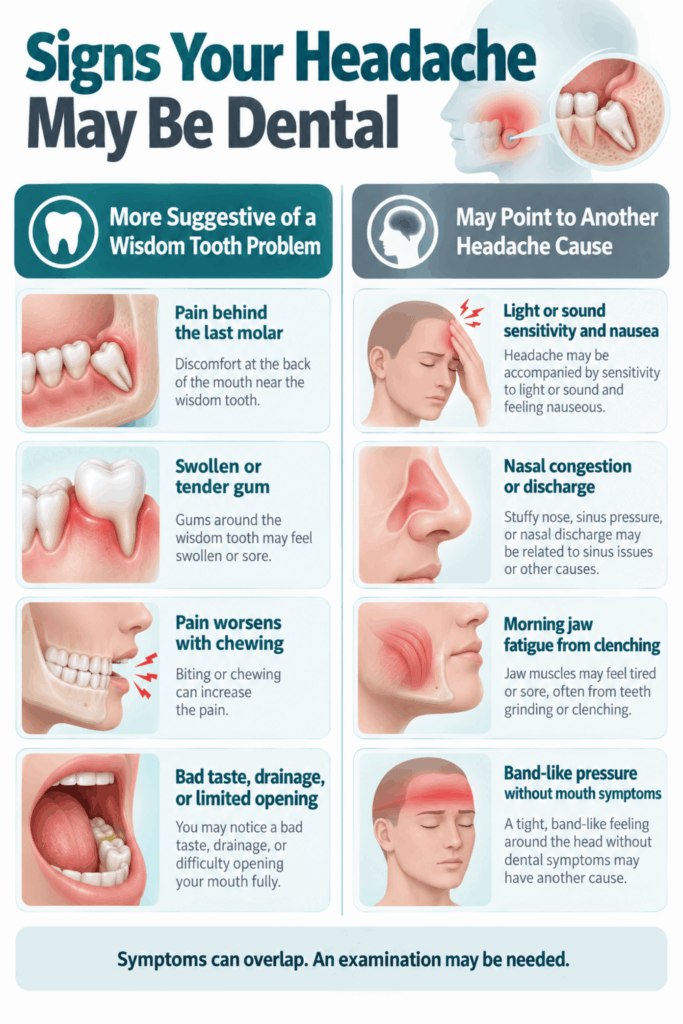
- Pain Behind the Last Molar: This may occur while a wisdom tooth is erupting or when nearby tissue becomes inflamed.
- Swollen or Tender Gum: Mild tenderness can occur during eruption, but ongoing or increasing swelling needs dental assessment.
- Pain While Biting: Decay, inflammation around the root, or an opposing tooth pressing on swollen gum may make chewing painful.
- Bad Taste or Drainage: Fluid or pus around the tooth can indicate infection and requires prompt dental care.
- Persistent Bad Breath: Trapped debris or infection around a partially erupted tooth may contribute to an unpleasant odor.
- Limited Mouth Opening: Jaw stiffness can occur with significant inflammation or infection and should not be ignored.
- Facial or Jaw Swelling: Visible swelling is more concerning than mild local gum tenderness, especially if it is spreading.
- Fever or Feeling Unwell: These symptoms may mean that a dental infection is affecting more than the immediate area.
Can It Happen Without Obvious Tooth Pain?
A partially impacted wisdom tooth may cause vague pressure, mild gum tenderness, or discomfort only while chewing. Some people notice jaw pain or ear pain before they recognize a clear toothache. A tooth hidden beneath gum or bone may also develop a problem that is difficult to see without an examination.
Still, wisdom teeth are less likely to cause recurring headaches when there are no tooth, gum, or jaw symptoms. Do not assume that hidden or misaligned wisdom teeth are causing your headaches based only on their appearance on an X-ray. A dentist should look for active disease and compare the dental findings with your symptom pattern.
Wisdom Tooth Headache or Another Type of Headache?
Several conditions can produce pain near the temples, ears, or jaw. The pattern may suggest where to begin, but overlapping symptoms often require professional evaluation.
| Possible Source | Likely Clues | Common Accompanying Symptoms | Appropriate Professional |
|---|---|---|---|
| Wisdom tooth problem | Pain begins behind the last molar and may worsen with chewing or biting | Swollen gum, bad taste, tooth tenderness, restricted opening, facial swelling | Dentist or oral surgeon |
| Jaw-joint or muscle problem | Pain changes with jaw movement, clenching, or prolonged chewing | Jaw tenderness, stiffness, painful clicking, temple pain | Dentist, physician, or orofacial pain clinician |
| Teeth grinding | Headache is often worse after sleep or during stressful periods | Jaw fatigue, worn teeth, tooth sensitivity, morning facial soreness | Dentist |
| Migraine | Often throbbing or disabling and may worsen with normal activity | Nausea, light or sound sensitivity, possible aura | Primary care clinician or neurologist |
| Tension-type headache | Usually feels like pressure or a tight band | Scalp, neck, or shoulder tenderness; often mild to moderate | Primary care clinician |
| Sinus illness | Facial pressure occurs with nasal or respiratory symptoms | Congestion, nasal discharge, reduced smell, fever in some infections | Primary care clinician or ENT specialist |
It is possible to have more than one problem at the same time. Someone with migraine may also have an infected wisdom tooth, while a person with wisdom tooth pain may clench and develop jaw-muscle discomfort. Treating one condition will not necessarily resolve the other.
When Headache and Wisdom Tooth Symptoms Need Care
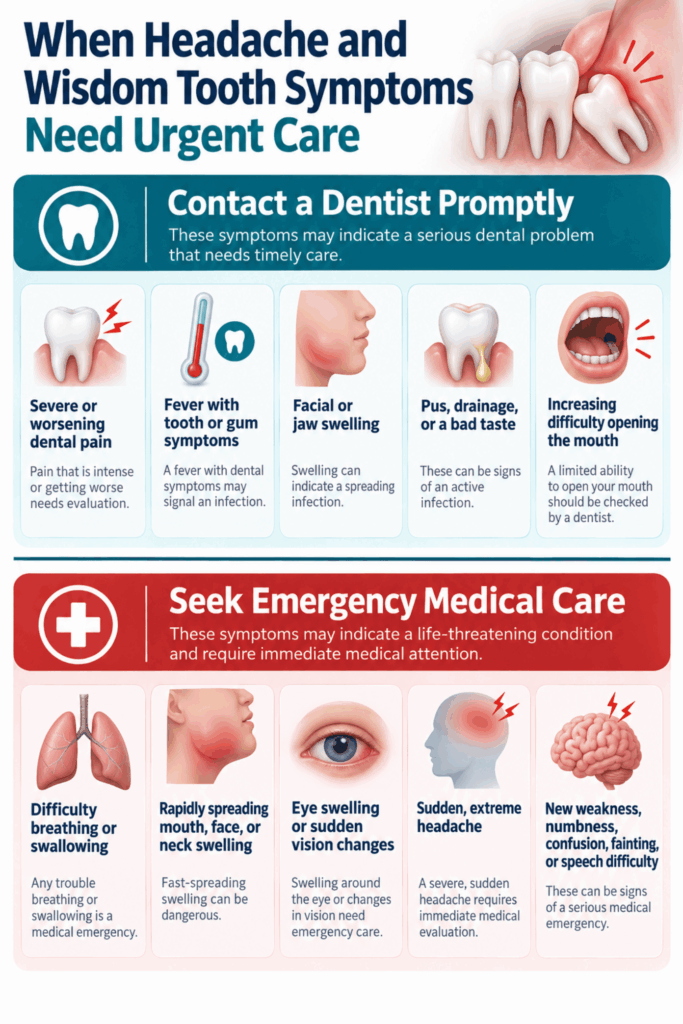
Mild, brief discomfort does not always mean you have an emergency. However, recurring pain, worsening symptoms, or signs of infection deserve professional attention. Severe headache warning signs require medical care even if you also have a wisdom tooth problem.
When to Arrange a Dental Examination
Schedule a dental examination if you notice:
- Recurring Pain: Tooth, jaw, or headache pain keeps returning instead of resolving fully.
- Worsening Symptoms: Discomfort becomes stronger, more frequent, or harder to control.
- Swollen Gum: The tissue around a partially erupted tooth repeatedly becomes red, tender, or enlarged.
- Pain With Chewing: Biting on the back tooth or opening your mouth makes the pain worse.
- Bad Taste or Drainage: Fluid from around the tooth may indicate infection.
- Restricted Jaw Movement: You cannot open as comfortably or widely as usual.
- Visible Tooth Damage: A wisdom tooth appears broken, dark, or decayed.
- Persistent Headaches With Dental Symptoms: The headaches follow the same pattern as pain or swelling around the wisdom tooth.
When to Seek Urgent Dental or Medical Care
Contact an urgent dental service when pain is severe, facial swelling is developing, you have a fever with dental symptoms, or you suspect an abscess. The NHS guidance on dental abscess symptoms and emergency care notes that an abscess needs urgent dental treatment and does not resolve on its own.
Seek emergency medical care for:
- Breathing or Swallowing Problems: Swelling that affects your airway or ability to swallow can become dangerous.
- Rapidly Spreading Swelling: Large or increasing swelling in the mouth, face, jaw, or neck needs immediate assessment.
- Eye Symptoms: Swelling or pain around the eye, double vision, or sudden vision changes require urgent care.
- Severe Difficulty Opening the Mouth: Marked restriction, especially with swelling or fever, can signal spreading infection.
- Sudden Severe Headache: A headache that reaches extreme intensity very quickly should not be blamed on a tooth.
- Neurological Changes: New weakness, numbness, confusion, fainting, trouble speaking, or unusual vision changes require immediate medical evaluation.
The American Headache Society’s guidance on secondary-headache warning signs also identifies sudden onset, neurological symptoms, fever, and a clear progression in severity or frequency as reasons for further evaluation.
How a Dentist Identifies the Source of the Pain
A dentist cannot determine the cause from the headache location alone. The goal is to find out whether there is active disease around a wisdom tooth and whether that finding fits the timing and behavior of your pain.
- Review the Symptom Pattern: The dentist will ask when the headache and tooth pain began, where each is felt, how long it lasts, and what makes it better or worse.
- Examine the Back of the Mouth: The dentist checks for partially erupted wisdom teeth, gum swelling, trapped debris, decay, drainage, and tenderness.
- Test the Teeth: Biting, tapping, temperature, or pulp tests may help identify whether pain is coming from the wisdom tooth or a neighboring tooth.
- Check the Jaw and Chewing Muscles: The dentist may examine jaw movement, muscle tenderness, painful clicking, clenching signs, and whether movement changes the headache.
- Use Dental X-Rays When Needed: An X-ray can show whether a tooth is impacted, how it is positioned, whether decay is hidden, and whether nearby bone or neighboring teeth are affected. Three-dimensional imaging is not automatically needed; it is reserved for cases in which extra anatomical detail could change treatment.
- Refer When the Pattern Is Not Dental: A complex extraction may require an oral surgeon. Persistent, unusual, or recurring headaches may need assessment by a physician, neurologist, ENT specialist, or orofacial pain clinician.
Seeing wisdom teeth on an X-ray does not prove that they cause headaches or other pain. The clinical findings, imaging, and symptom history should point toward the same explanation before treatment is recommended.
How to Ease Symptoms While Waiting for Dental Care
Home measures may reduce pain and discomfort, but they do not remove decay, drain an abscess, or correct a problematic impaction. Use them only as temporary support while arranging appropriate care.
Helpful steps include:
- Clean the Area Gently: Use a soft toothbrush to remove visible plaque and food without digging beneath swollen tissue.
- Rinse With Warm Salt Water: A gentle rinse may help clear debris around partially erupted wisdom teeth. Do not rinse forcefully after a recent extraction unless your surgeon has told you to begin.
- Choose Soft Foods: Eggs, yogurt, soup, mashed vegetables, and other easy-to-chew foods place less stress on the painful side.
- Chew Away From the Area: Avoid hard, sharp, or sticky foods that press against sore gum.
- Drink Enough Water: Dehydration can contribute to headache pain, especially when mouth discomfort reduces your food and fluid intake.
- Rest the Jaw: Avoid gum chewing, very wide opening, and repeated clenching.
- Use Medication Safely: The American Dental Association’s acute dental pain guideline recommends nonopioid options, especially nonsteroidal anti-inflammatory drugs with or without acetaminophen, as first-line treatment for most short-term dental pain when medically appropriate.
Check the package directions and do not exceed the recommended dose. Ask a dentist, physician, or pharmacist before using over-the-counter pain relievers if you are pregnant, take blood thinners, have stomach ulcers, kidney or liver disease, drink alcohol heavily, or have had a reaction to these medicines. Avoid taking two products that contain the same ingredient.
Also avoid:
- Putting Aspirin on the Gum: It can burn and damage the tissue.
- Using Leftover Antibiotics: The drug may be unnecessary, unsuitable, or unable to treat the source.
- Poking Beneath the Gum: Sharp tools can injure the tissue and push debris deeper.
- Delaying Care Because Pain Medicine Works: Temporary relief does not show that the dental problem has healed.
How Dentists Treat the Underlying Wisdom Tooth Problem
Treatment depends on what the examination finds. Dentists do not remove every impacted tooth, and wisdom tooth extraction is not a standard treatment for an unexplained headache.
Possible approaches include:
- Mild Local Gum Inflammation: The dentist may clean and irrigate beneath the gum flap, remove trapped debris, and show you how to keep the area clean.
- Repeated Pericoronitis: If inflammation keeps returning and the tooth cannot erupt into a useful, cleanable position, removing the tooth may provide a more lasting solution. Removing the gum flap may be considered in selected cases when the tooth has enough room to erupt and function.
- Tooth Decay: A small, accessible cavity may be restored. Extraction may be more practical if the wisdom tooth is difficult to reach, badly damaged, nonfunctional, or unlikely to remain clean.
- Inflamed or Infected Pulp: Root canal treatment can save some teeth, but position, access, restorability, and long-term value matter. A severely damaged wisdom tooth is often removed instead.
- Dental Abscess: Treatment may involve drainage, root canal treatment, or extraction to control the source. Antibiotics cannot replace the required dental procedure.
- Disease-Free Impacted Tooth: Keeping the wisdom tooth may be appropriate when it is healthy and easy to monitor, especially if the risks of surgery outweigh the likely benefits. NICE guidance on impacted wisdom tooth removal recommends limiting surgery to teeth with evidence of disease rather than removing every symptom-free impacted tooth.
- Complex Impaction: An oral surgeon may manage a tooth close to important nerves, deeply positioned in bone, or otherwise difficult to remove.
Antibiotics are not routinely needed for tooth pain alone. The ADA guideline on antibiotics for dental pain and swelling recommends prioritizing dental treatment for most pulpal and root-related conditions. Antibiotics become more relevant when infection is spreading or producing systemic symptoms such as fever or malaise.
Will Wisdom Tooth Removal Stop the Headaches?
Wisdom teeth-related headaches may improve after extraction when a diseased tooth, repeated infection, or pain-driven jaw tension was truly contributing to them. Improvement is more convincing when the headache consistently occurred with the dental symptoms and settled after the area healed.
Extraction of wisdom teeth cannot always stop headaches when migraine, jaw tension, teeth grinding, sinus disease, or TMD is the true cause. Removing healthy wisdom teeth to treat unexplained chronic headaches may expose you to surgical risks without addressing the real cause.
After extraction:
- Some Short-Term Discomfort Is Expected: Surgical pain, reduced food intake, dehydration, poor sleep, and holding the mouth open during treatment may contribute to a temporary headache.
- The Overall Trend Should Improve: Pain should become easier to manage as healing progresses, even though symptoms can vary from day to day.
- New or Increasing Pain Needs Attention: Contact the dental office if pain becomes severe after initial improvement or occurs with fever, worsening swelling, pus, or a bad taste.
- Emergency Signs Still Apply: Difficulty breathing or swallowing, eye swelling, neurological symptoms, or a sudden extreme headache requires urgent medical care.
- Persistent Headaches Need Reassessment: If the extraction site heals but the headaches continue, another dental or medical cause should be considered.
What to Do If the Headache Continues
Return to your dentist if tooth pain, gum swelling, jaw stiffness, or chewing discomfort continues after treatment. Seek medical assessment when the dental examination is normal, the oral problem has healed, but the headaches remain, or the headache pattern is becoming more frequent or severe. Do not keep increasing pain medicine without professional advice, because frequent use of some headache medicines can itself contribute to recurring headaches.
A simple symptom record can make the next evaluation more useful. Track:
- Date and Time: Note when each headache starts and how long it lasts.
- Pain Location: Record whether it affects one side, both temples, the jaw, behind the eye, or another area.
- Pain Quality: Describe it as dull, tight, throbbing, sharp, or pressure-like.
- Mouth Symptoms: Note wisdom tooth pain, swollen gum, bad taste, ear pain, jaw stiffness, or chewing discomfort.
- Possible Triggers: Include meals, clenching, poor sleep, stress, missed meals, bright light, or physical activity.
- Associated Symptoms: Record nausea, light or sound sensitivity, nasal symptoms, fever, weakness, numbness, or vision changes.
- Medication Use: Write down what you took, when you took it, and whether it helped.
Frequently Asked Questions
How Long Does a Headache From Wisdom Teeth Last?
There is no set duration for a wisdom tooth headache. Mild irritation may settle as the gum calms, while decay or infection can cause pain that persists or keeps returning until treated. Arrange an examination if the headache is worsening, recurring, or accompanied by tooth pain, swelling, bad taste, fever, or difficulty opening your mouth.
Can Wisdom Teeth Trigger a Migraine Attack?
Wisdom teeth do not directly cause migraine disease. However, dental pain, jaw tension, stress, reduced sleep, or missed meals could trigger an attack in someone who already has migraine. Treating the dental problem may remove one trigger, but it will not necessarily prevent future migraines caused by other factors.
Can Upper Wisdom Teeth Cause Sinus Pressure and Headaches?
Upper wisdom teeth sit near the maxillary sinuses, so pain from an upper tooth and sinus pressure may feel similar. A diseased upper tooth can occasionally affect nearby sinus tissue, but congestion, nasal discharge, and reduced smell suggest a sinus source. A dental examination and medical assessment may be needed when the symptoms overlap.
Why Do I Have a Headache After Wisdom Tooth Removal?
A short-term headache after wisdom tooth removal may relate to dehydration, eating less, poor sleep, jaw-muscle strain, or medication effects. Contact your surgeon if the headache is severe, keeps worsening, or occurs with fever, increasing facial swelling, pus, vomiting, vision changes, weakness, or other unusual symptoms.
Can Fully Erupted Wisdom Teeth Cause Headaches Years Later?
A fully erupted wisdom tooth can develop decay, gum disease, a crack, or an infection years after it appears. Pain from that new problem may spread toward the jaw, ear, or temple. However, the tooth’s presence alone does not explain recurring headaches, especially when it is healthy and causes no mouth symptoms.
Will Antibiotics Stop a Wisdom Tooth-Related Headache?
Antibiotics may help when a dentist finds a bacterial infection that is spreading or causing systemic illness. They do not fix impaction, remove decay, relieve jaw tension, or treat migraine. Even when antibiotics are appropriate, cleaning, drainage, root canal treatment, or extraction may still be needed to control the source.
Bottom Line: Can Wisdom Teeth Cause Headaches?
Wisdom teeth can cause headaches indirectly through referred pain, inflamed or infected tissue, and tension in the jaw muscles. The connection is more likely when headache pain occurs with tenderness behind the last molar, swollen gum, painful chewing, bad taste, or difficulty opening the mouth. A headache by itself cannot confirm that a wisdom tooth is responsible.
Arrange a dental examination when head pain repeatedly occurs with mouth or jaw symptoms. Seek medical care when headaches continue despite dental treatment or have no clear dental pattern. Sudden severe headache, neurological changes, breathing or swallowing difficulty, or rapidly spreading facial swelling requires urgent assessment.
